On this page
Rubber straight from the tree turns soft and sticky when hot and brittle when cold. Heating it with sulphur, called vulcanisation, turns it into something you can put on a wheel. Here is the chemistry, step by step.
What is natural rubber made of?
Natural rubber is a linear polymer of isoprene (2-methyl-1,3-butadiene), also called cis-1,4-polyisoprene, according to the NCERT Class 12 Chemistry chapter on polymers (2021–22 edition). It is made from latex, a colloidal dispersion of rubber in water collected from rubber trees. Our explainer on how natural rubber latex is tapped from trees covers that step.
Isoprene joins through its carbons 1 and 4, so every repeat unit keeps one C=C double bond, which matters later. "Cis" means the chain continues from the same side of each double bond. NCERT says the cis-polyisoprene chains are held together by weak van der Waals interactions and have a coiled structure, so rubber stretches like a spring.
Why can't raw rubber be used for tyres?
The same NCERT chapter lists the problems. Natural rubber becomes soft above 335 K and brittle below 283 K, absorbs a lot of water, dissolves in non-polar solvents and is attacked by oxidising agents. In everyday units, 335 K is about 62 °C and 283 K is 10 °C.
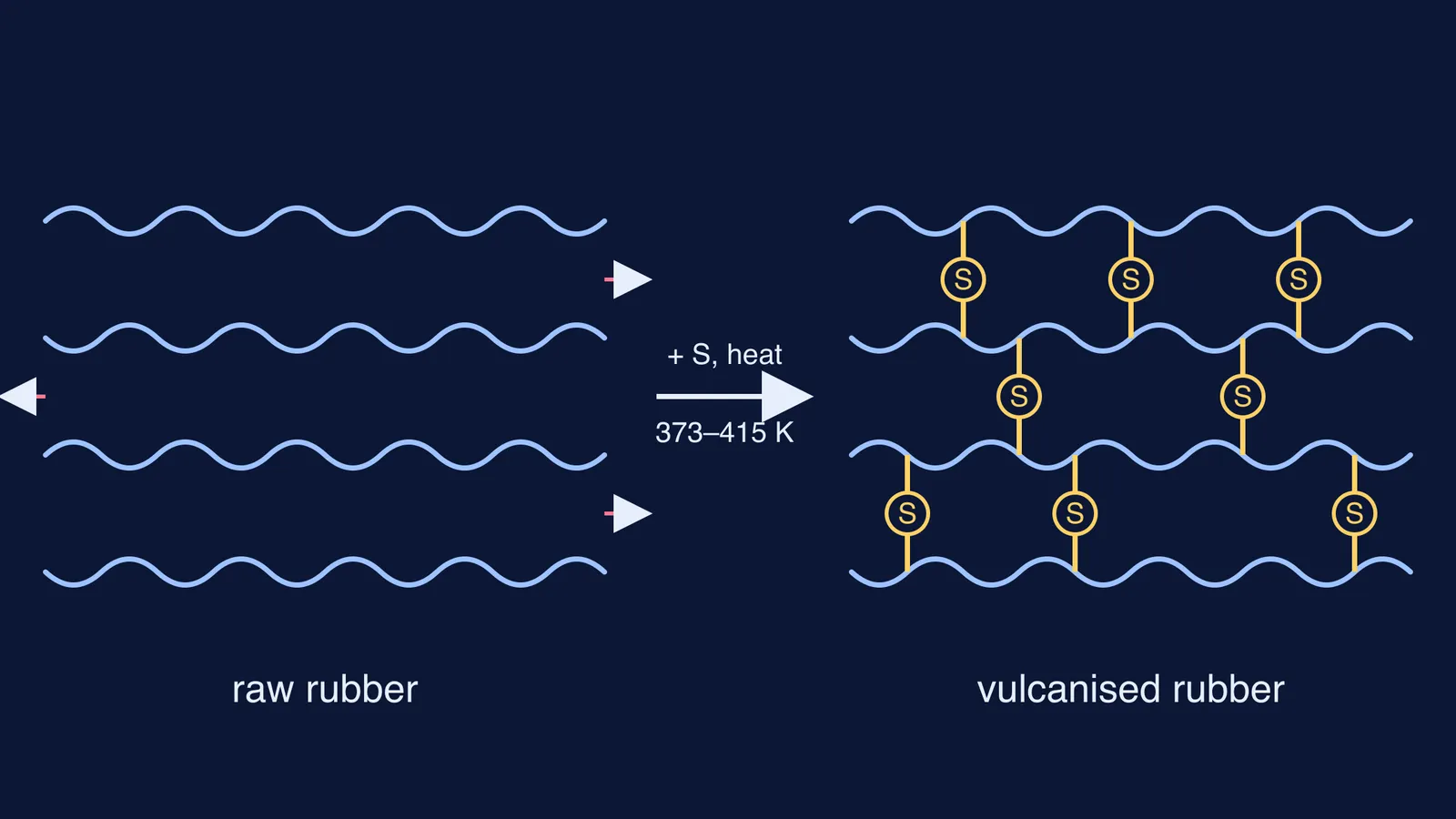
The cause is the weak forces between chains. When rubber is warm, nothing ties one chain to the next, so they slide past each other.
Charles Goodyear found that adding sulphur made rubber less sticky and more resistant to changes in temperature, and he received US patent 3,633 in 1844. Our profile of Charles Goodyear and the sulphur recipe that fixed rubber tells the full story.
What does sulphur do in vulcanisation?
Vulcanisation is heating a mixture of raw rubber with sulphur and a suitable additive at 373 K to 415 K, as described in the NCERT polymers chapter. During heating, sulphur forms cross-links at the reactive sites of the double bonds, and the rubber gets stiffer.
NCERT draws two probable structures for these links:
Both carbons of a former double bond are bonded to sulphur, giving two sulphur bridges between neighbouring chains.
A single sulphur bridge joins carbons next to a double bond, and the double bond itself survives.
Either way, a chain that was free to slide is now tied to its neighbours at several points.
The reaction gives out heat. In a 2023 study, Franco Cataldo used differential scanning calorimetry to measure about 46.0 kJ of heat released per mole of sulphur, counting only the natural rubber in the compound (International Journal of Molecular Sciences). His carbon-black-filled compounds contained 0.5 to 6.0 parts of sulphur per hundred parts of rubber.
How much sulphur goes into tyre rubber?
In tyre manufacture, 5% sulphur is used as the cross-linking agent, according to the NCERT polymers chapter. NCERT does not give a reason for that figure, but its description of elastomers points to one: a few cross-links between chains help the polymer retract to its original position after the force is released.
That is the balance a tyre needs. The coils still straighten under load, but every chain is anchored, so the tread returns to shape after each turn of the wheel.
The links can also be undone on purpose. Cataldo's paper notes that rubber recovered from used tyres can be devulcanised by mechanochemically breaking the sulphur cross-links, then vulcanised again (Cataldo, 2023).
How do you answer a vulcanisation question in an exam?
This question comes from the 2021–22 NCERT polymers chapter, and newer editions may not include the Polymers unit, so check your current syllabus first. A strong answer to "Discuss the main purpose of vulcanisation of rubber" (NCERT Exercise 15.15) covers five points:
Name the polymer: natural rubber, cis-1,4-polyisoprene, with weak van der Waals forces between coiled chains.
State the defects with numbers: soft above 335 K, brittle below 283 K, absorbs water, dissolves in non-polar solvents.
Give the process: heat with sulphur and an additive at 373 K to 415 K.
Explain the mechanism: sulphur cross-links form at the reactive sites of the double bonds. Draw one –S– bridge between two chains.
State the result: the chains are tied together, the rubber is stiffer and returns to shape, and tyre rubber uses 5% sulphur.
Watch for three common traps:
Vulcanisation does not make the polymer. It links chains that already exist.
The double bonds are the point. That is why Exercise 15.14 asks how double bonds influence rubber's structure and reactivity.
Don't write that vulcanisation removes elasticity. NCERT says the rubber gets stiffer, while a few cross-links help it return to shape.
To revise how chains form in the first place, read addition and condensation polymers, with examples. If ideas such as cis double bonds or cross-linking still feel shaky, the Fermi Concept Library covers every concept in chemistry, each with its own lesson and its place in the map. When you are ready to test yourself, the Fermi Problem Library has worked problems with a step-by-step solver that explains the reasoning rather than printing an answer.