On this page
Have you ever wondered how the tyres on your car or the eraser in your pencil case begin their life? The journey of natural rubber starts as a milky white liquid flowing from the bark of a tree.
What is natural rubber latex?
Natural rubber latex is a complex colloidal dispersion harvested primarily from the *Hevea brasiliensis* tree. Fresh field latex consists of about 60% to 75% water and 25% to 35% rubber solids (cis-1,4-polyisoprene) (Britannica). It also contains small amounts of proteins (1% to 2%), resins, sugars and minerals.
These rubber particles carry a negative electrical charge, which causes them to repel each other and remain suspended in the water, much like the colloidal particles in milk. The proteins play a crucial role in stabilising this suspension, although they are also the primary cause of latex allergies in medical products.
How is natural rubber latex tapped from trees?
The process of extracting latex is called tapping. Trees are typically ready for tapping when they are five to six years old and have reached a diameter of about 15 centimetres (Wikipedia).
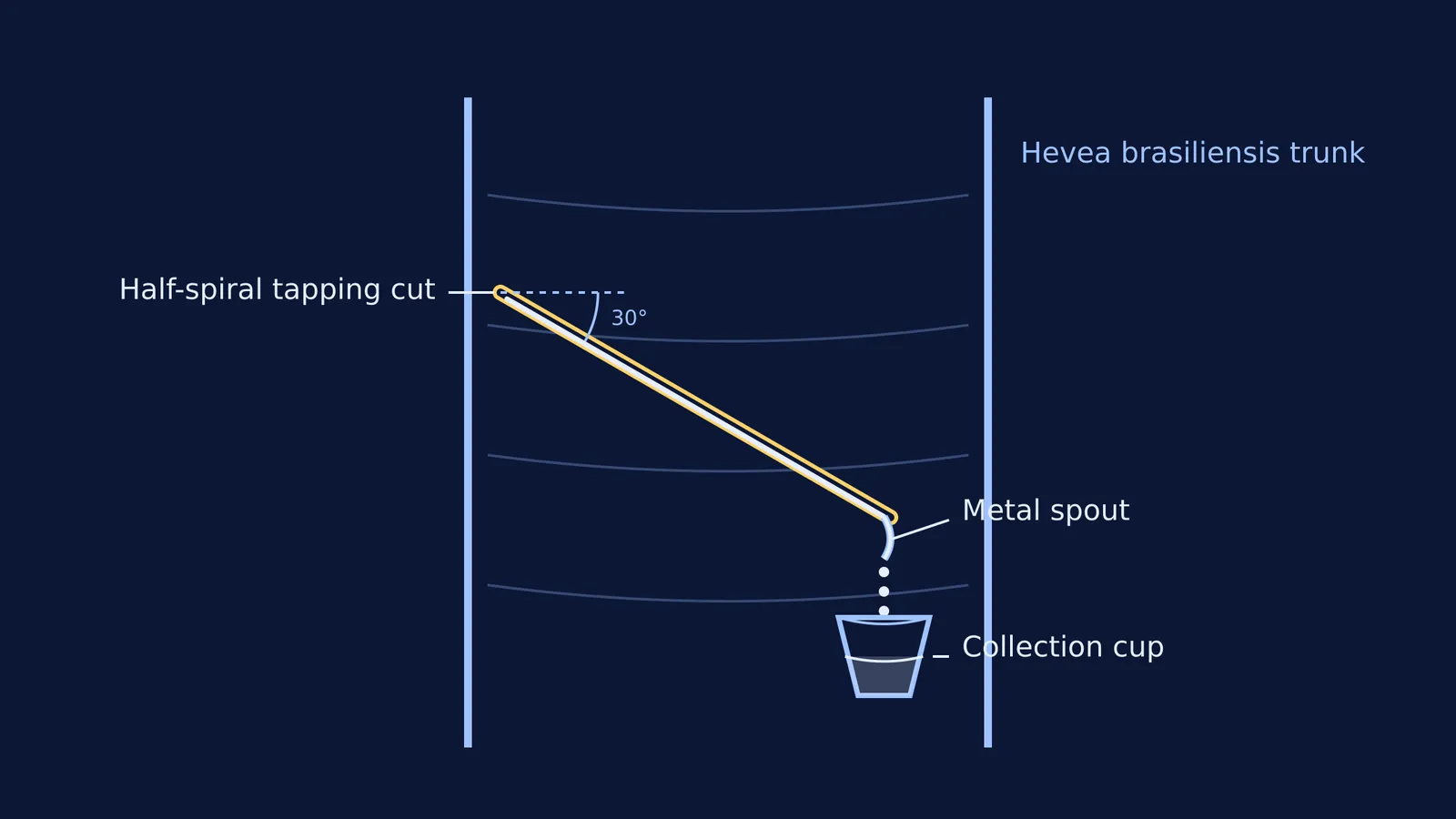
A skilled tapper uses a specialised hooked knife to shave a thin layer of bark from the tree. The standard tapping cut is a downward spiral made at an angle of 25 to 30 degrees, covering half the circumference of the trunk (Wikipedia). This specific angle ensures the maximum number of latex-producing vessels (lactiferous vessels) are cut. The depth of the cut is critical: it must be about 6.4 millimetres deep to reach the vessels in the "soft bast" layer, but shallow enough to avoid damaging the cambium, which is the tree's growing layer.
Once the cut is made, the milky latex flows down the spiral groove and drips into a small collecting cup attached to the tree. Tapping is usually done in the early morning when temperatures are cooler, allowing the latex to flow for several hours before the heat causes it to naturally coagulate and seal the cut. A well-managed tree can be tapped every other day and remain productive for 20 to 30 years (Wikipedia).
If you are exploring plant anatomy, the Fermi Concept Library explains lactiferous vessels and other tissue types clearly. You can also read our post on the ground tissue system of plants for more background, or learn how abscisic acid acts as a stress hormone in plant physiology.
How is latex processed into solid rubber?
When the latex is collected, it is still a liquid suspension. To turn it into solid rubber, it must undergo coagulation.
Ammonia is often added to the collection cups in the field to prevent the latex from coagulating too early while it is being transported (Wikipedia). Once transported to a central processing facility, the latex is carefully strained to remove any bark or dirt, and then diluted with water to a standard dry rubber content.
The key chemical step is adding a dilute acid, typically formic acid or acetic acid. The acid introduces hydrogen ions (H⁺) that lower the pH of the latex from around 6.5 to its isoelectric point of 4.5 (Wikipedia). This neutralises the negative charges on the rubber particles. Without the repulsive forces holding them apart, the polyisoprene particles clump together into a solid mass called a coagulum. Formic acid is often preferred because it is stronger and more efficient, producing high-quality rubber sheets in just one to three hours (Wikipedia).
Finally, the solid coagulum is passed through a series of heavy rollers to form sheets. This mechanical milling process squeezes out the remaining water and acidic serum, thoroughly compressing the rubber into thin, ribbed sheets. These sheets are then dried in open air or slowly smoked in a dedicated smokehouse to prevent fungal growth. Once completely dry, they are ready to be shipped and manufactured into thousands of everyday products, from surgical gloves to vehicle tyres. If you enjoy learning about how plants adapt to their environment, you might also find it interesting to see how a money plant grows in water.