

On this page
If you cut a piece of a money plant (*Epipremnum aureum*) and drop it in a glass of water, it does not die. Instead, it grows new roots and continues to live.
This is a classic example of vegetative propagation. The plant clones itself without seeds, using the cells it already has and the minerals hidden in the water to build an entirely new root system.
Why does a money plant grow in just water?
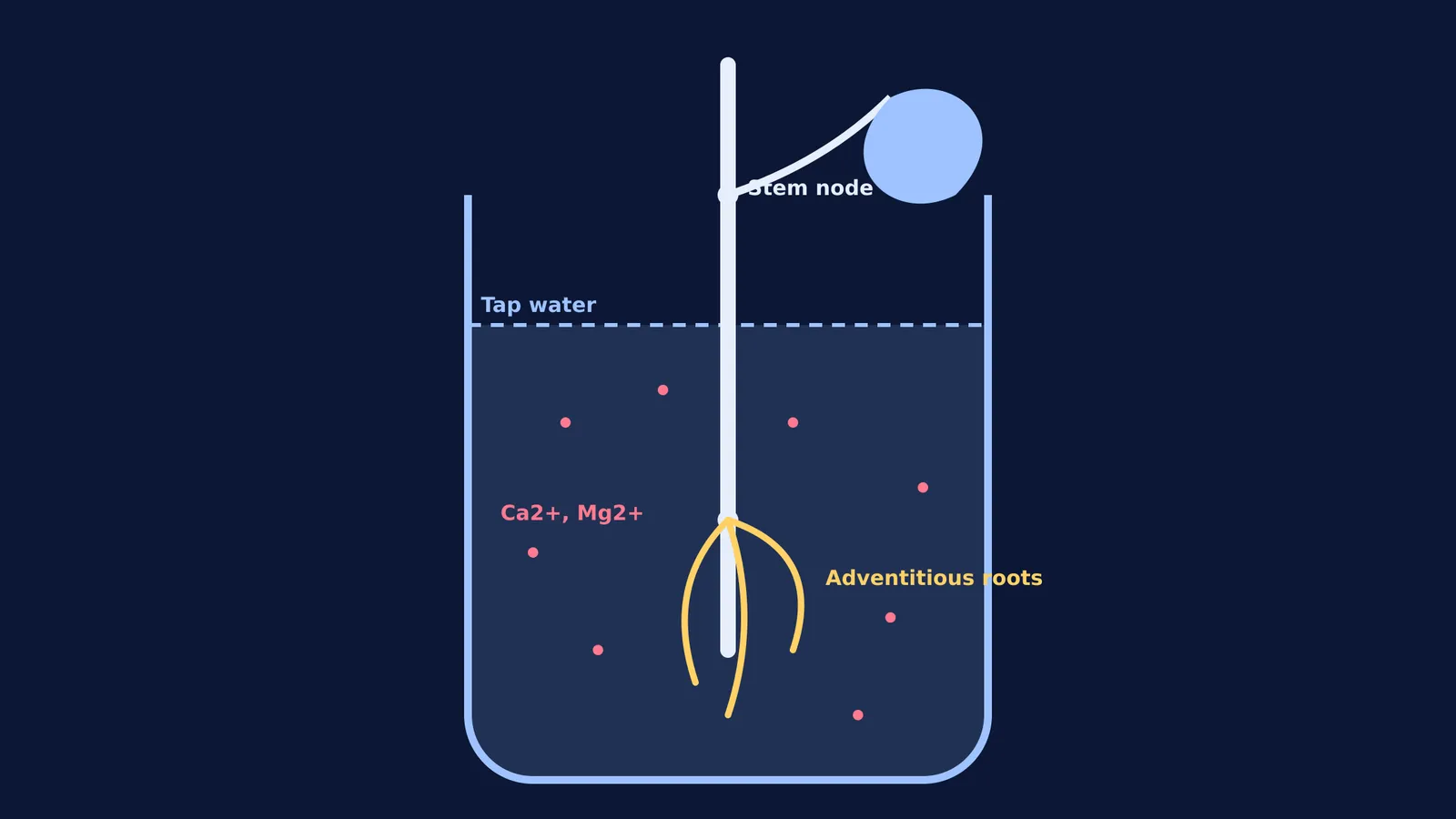
A money plant grows in water because its stem contains nodes. A node is the slight bump or joint on the stem where a leaf attaches.
Inside these nodes is meristematic tissue—clusters of unspecialised cells that can actively divide and change into different types of plant organs. This tissue acts like the stem cells found in animals. When you submerge a node in water, the plant's internal hormones (specifically auxins) pool at the cut site. They signal the meristematic cells to wake up, multiply, and form adventitious roots. Unlike a plant's primary taproot, which grows downward from a newly germinated seed, adventitious roots grow from non-root tissues like the stem or leaves.
Many money plants already have small, brown aerial roots at their nodes, which they use to grip bark and climb trees in the wild. When you place a cutting in a jar, these existing aerial roots quickly transition into water-adapted roots, speeding up the propagation process. These water-grown roots look different from soil roots. They are often finer and more fragile because they do not have to push through hard dirt. Instead, they are specialised to draw dissolved oxygen and nutrients directly from the liquid around them. (Like tropic movements in Class 10, root growth is an active response to the plant's environment.)
How does it survive without soil?
A plant needs water, sunlight, carbon dioxide, and minerals to survive. In a glass jar, the leaves above the surface handle sunlight and carbon dioxide. The roots handle the rest.
But pure water is not enough. If you put a money plant in distilled water—which has zero minerals—it will eventually exhaust its stored nutrients. Without new building blocks, its growth will stall and its leaves will turn yellow.
Tap water, however, is not pure. According to a World Health Organization report on drinking-water quality, natural and tap water typically contains between 10 and 100 mg/L of calcium, alongside trace amounts of magnesium and potassium. The money plant absorbs these dissolved minerals to sustain itself. It uses calcium to strengthen new cell walls and magnesium as the central atom in every new chlorophyll molecule it builds. Without these trace minerals, photosynthesis would eventually grind to a halt.
While tap water has enough trace elements to keep the plant alive, it lacks the heavy concentrations of nitrogen and phosphorus found in soil. This is why a water-grown money plant grows more slowly than one in a pot.
How do you grow a money plant in water?
You can multiply your plant indefinitely with this method. Follow these steps to ensure the new roots have the best chance to form.
Find a healthy stem: Choose a green vine with several mature leaves.
Cut below a node: Make a clean cut just below a node. The smooth space between nodes cannot grow roots (see stem modifications for more on how nodes work).
Strip the bottom leaves: Remove any leaves near the cut. If leaves sit underwater, they will rot and breed bacteria.
Submerge the node: Place the cutting in a glass jar of tap water, making sure at least one node is completely underwater. Leaves must remain in the air.
Change the water: Pour out the old water and refill the jar regularly.
Roots consume oxygen as they perform cellular respiration. Changing the water replaces the dissolved oxygen the roots have breathed in, preventing them from suffocating. It also stops algae and harmful bacteria from taking over the jar.
Visualising how minerals and water move into these new roots and travel up the xylem can be difficult from a textbook alone. For ideas that are easier to see than to read, you can explore interactive models in the Fermi Simulation Lab.
Once the adventitious roots are established, the plant is stable. You can leave it in the jar permanently as a hydroponic display, or move it to a pot of soil to let it grow into a larger vine.


