

On this page
While auxins and gibberellins push a plant to grow, abscisic acid (ABA) tells it to stop. Discovered in 1963 by Frederick T. Addicott and Larry A. Davis while studying the shedding of cotton bolls, ABA acts as a general growth inhibitor. Its primary job is survival. When a plant faces harsh conditions, ABA slows metabolism, halts growth, and shifts the plant into a defensive state.
Because its levels spike dramatically in response to drought, high salinity, and cold temperatures, ABA is widely known as the stress hormone. Its two most tested roles in biology exams are its control over transpiration and its antagonism to other hormones during seed germination.
How does abscisic acid cause stomatal closure?
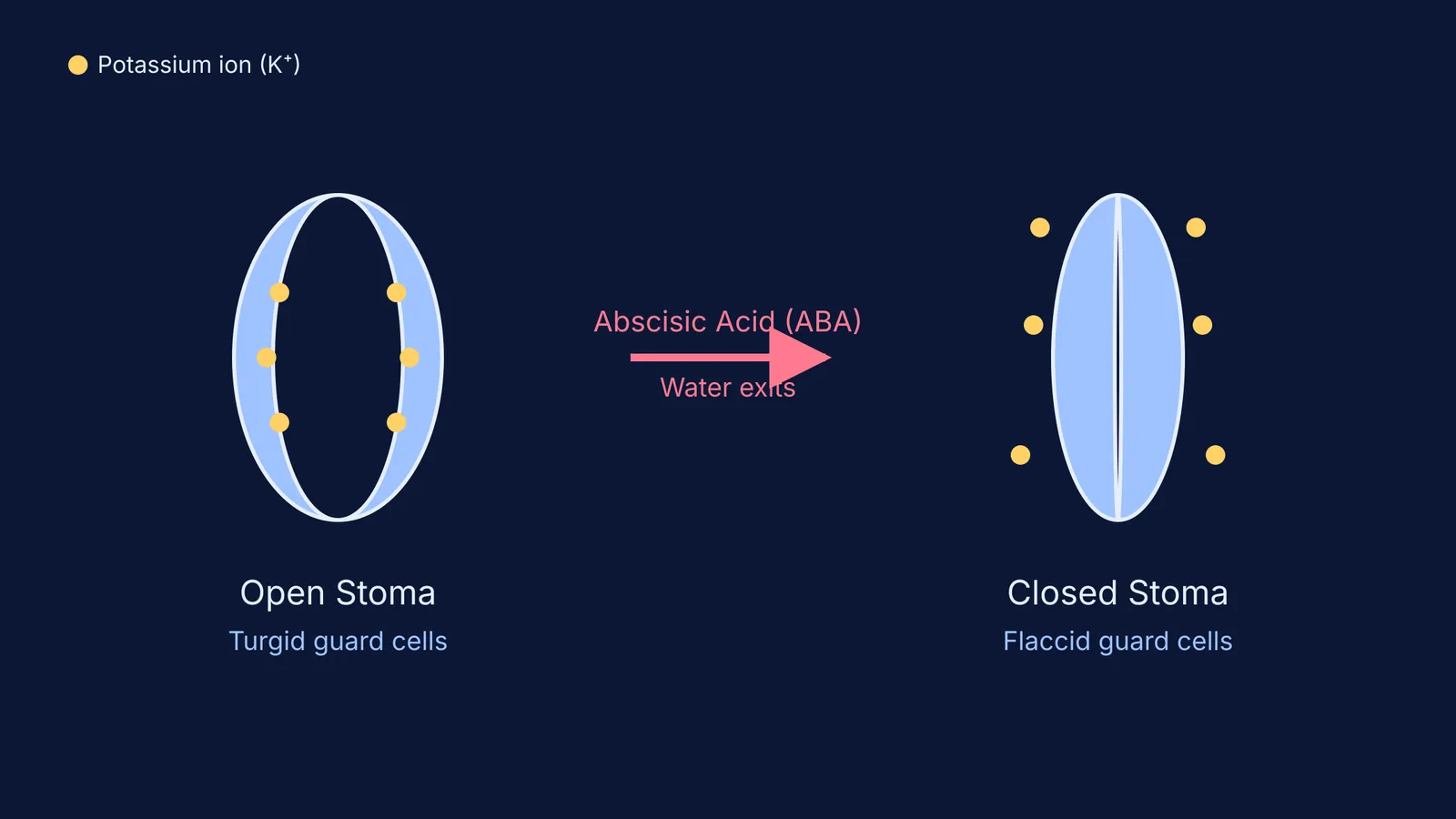
A plant's leaves are covered in microscopic pores called stomata, which open to take in carbon dioxide for photosynthesis but lose water in the process. When water is plentiful, the guard cells flanking each stoma remain turgid (swollen), keeping the pore wide open.
However, during a drought, the roots sense the drying soil and send an urgent signal to the leaves in the form of ABA. The hormone binds to receptors on the cell membranes of the guard cells, triggering a rapid exit of potassium ions (K⁺) and chloride ions. As the internal ion concentration drops, water follows the ions out via osmosis. This causes the guard cells to lose turgor pressure. They become flaccid and collapse together, sealing the stomatal pore. Studies tracking the cellular signals show that this response is incredibly fast, with key protein activity peaking just 30 minutes after the guard cells detect ABA. By shutting the stomata, the plant severely cuts its water loss, trading the ability to photosynthesise for the immediate ability to survive.
If you find the ion exchanges and osmotic pressures hard to visualise, the Concept Library breaks down the mechanics of guard cell action and water potential step by step.
What is the role of abscisic acid in seed dormancy?
Dormancy is a state of suspended animation. If a seed germinates in late autumn, the fragile seedling will be killed by the coming winter frost. Abscisic acid prevents this by enforcing seed dormancy.
As a seed matures on the parent plant, it accumulates high levels of ABA. This hormone inhibits the transcription of enzymes needed for sprouting and allows the seed to survive severe desiccation (drying out). Because of ABA, the seed will only break dormancy when the hormone is washed away by heavy spring rains or broken down by prolonged winter chilling. This mechanism ensures the seedling only emerges when the environment is safe and wet enough to support it.
Why is abscisic acid an antagonist to gibberellic acid?
In plant biology, hormones rarely act alone; they often work in opposing pairs to fine-tune a physiological response. Abscisic acid and gibberellins (GAs) are the classic antagonistic pair governing seed germination.
Gibberellins break dormancy and promote growth. When a seed absorbs water, the embryo produces GA, which stimulates the aleurone layer to produce alpha-amylase—an enzyme that digests stored starches to feed the growing embryo. ABA directly inhibits this process. Whether a seed stays dormant or germinates depends almost entirely on the ratio of ABA to GA inside it. If ABA is high, the seed sleeps; if GA spikes, it sprouts.
This precise hormonal balance is a recurring theme in plant growth, completely distinct from how physical structures lengthen (see Arithmetic vs geometric growth in plants: the growth equations) or how a plant balances its chemical energy budget (as seen in Photorespiration: why RuBisCO wastes energy in C3 plants).
How to study plant hormones for exams?
When preparing for exams, memorising isolated facts about hormones often leads to confusion. Instead, construct a framework by grouping them by their conflicts:
Dormancy: ABA (induces dormancy) vs Gibberellins (breaks dormancy).
Stomatal action: ABA (forces closure) vs Cytokinins (promotes opening).
Senescence (aging): ABA and Ethylene (promotes aging and leaf fall) vs Cytokinins (delays aging).
If you are stuck trying to memorise these pathways from textbook diagrams, Fermi's AI tutor can map out the interactions on a board, testing your understanding of which hormone dominates in a given scenario so you sit down to a clear next step in your revision.


