On this page
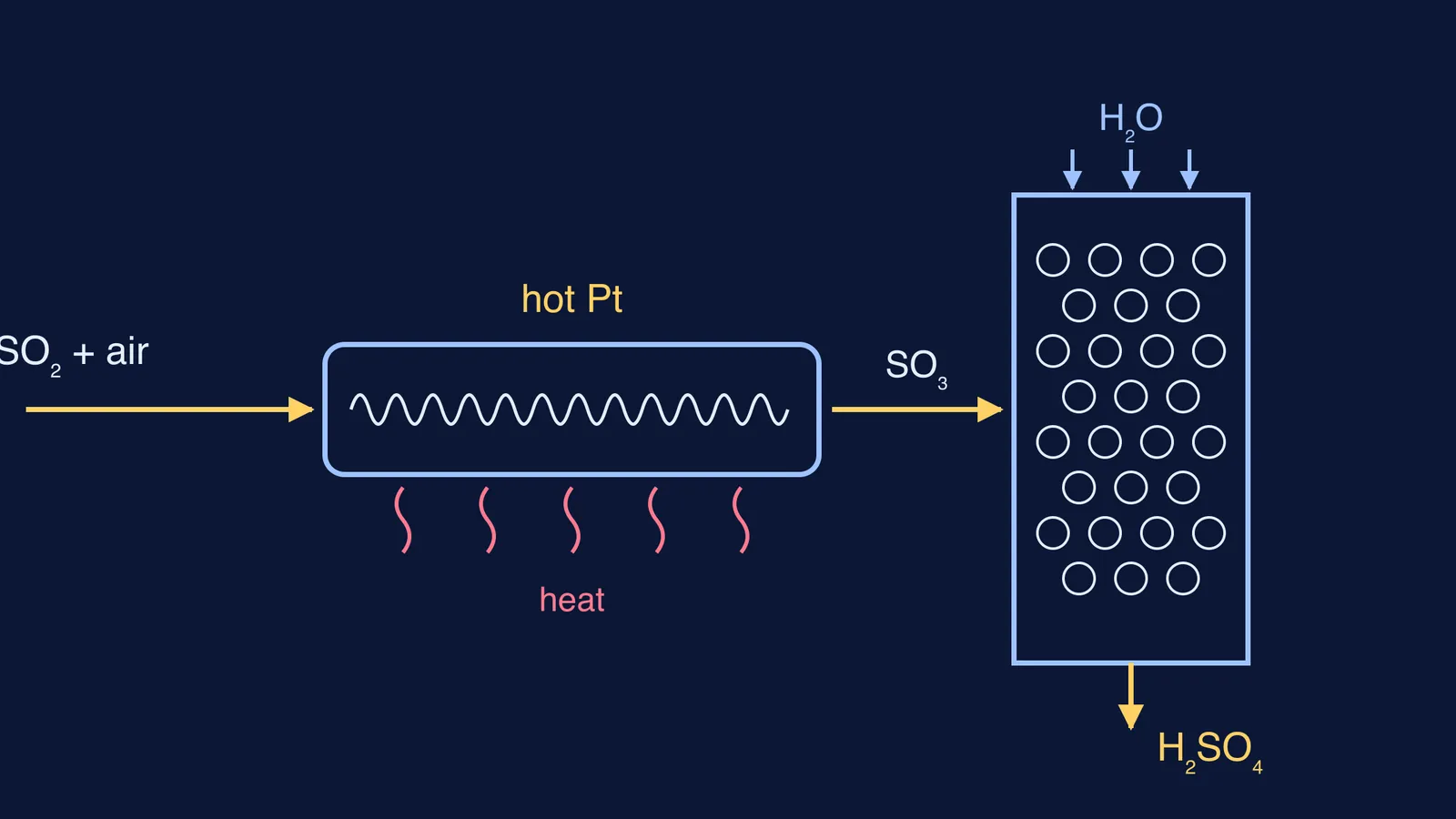
In 1831, a Bristol vinegar maker named Peregrine Phillips took out British Patent No. 6096 for a new way to make sulphuric acid. His idea was to pass sulphur dioxide and air over hot platinum so the two gases combine at once. Grace's Guide to British Industrial History quotes the patent's description of him as "a vinegar maker, of Bristol". The same idea, with a different catalyst, still makes nearly all the world's sulphuric acid, and it is a standard equilibrium topic for JEE Main, NEET-UG and board exams.
Who invented the contact process for sulphuric acid?
Peregrine Phillips, a vinegar manufacturer in Bristol, patented the contact process in 1831 as British Patent No. 6096, according to a history of the process by Leonard and Samantha Friedman of Acid Engineering & Consulting. Their history says the patent described "the instantaneous union of sulfur dioxide with atmospheric oxygen when passing the mixture over platinum."
Little is known about the man himself. Grace's Guide, citing the Oxford Dictionary of National Biography, gives his birth as 30 January 1800 in Philadelphia Street, Bristol. He disappears from Bristol's records after 1831.
Why did his invention wait so long?
At the time there was not much demand for sulphuric acid. The encyclopedia.com entry on sulfuric acid says Phillips's method gave a much higher yield than the older lead chamber process, but little attention was paid to it. The acid became commercially important only after synthetic dyes were invented a few decades later.
The chemistry was also misunderstood. The Friedmans' history describes the long road to working plants:
In 1875, Clemens Winkler published faulty experiments suggesting the catalyst worked worse with diluted gases, a paper that "undoubtedly delayed" commercial use of the process.
In a 1901 lecture to the German Chemical Society, Rudolf Knietsch, drawing on work at the Badische company (BASF), showed that the contact vessels needed cooling, not heating.
Between 1899 and 1914, chemists developed vanadium catalysts. Slama and Wolf's 1913-14 patent, a vanadium salt with alkali promoters on a porous carrier, became the standard sulphuric acid catalyst. It still is.
Platinum had another weakness: it reacts with arsenic impurities in the sulphur feed, which is one reason vanadium(V) oxide took its place, as the Wikipedia article on the contact process explains.
How does the contact process work today?
The key step is reversible and exothermic: 2SO₂(g) + O₂(g) ⇌ 2SO₃(g), with ΔH = −197 kJ/mol (Wikipedia: Contact process). The same page gives typical plant conditions of about 450 °C, near-atmospheric pressure and a vanadium(V) oxide catalyst.
Burn sulphur (or roast sulphide ores) to make sulphur dioxide, then clean the gas.
Pass sulphur dioxide and extra air over the V₂O₅ catalyst to form sulphur trioxide.
Absorb the sulphur trioxide in concentrated sulphuric acid to make oleum, H₂S₂O₇.
Dilute the oleum with water: H₂S₂O₇ + H₂O → 2H₂SO₄.
Modern double contact, double absorption plants convert up to 99.8% of the sulphur dioxide by passing the gas through the catalyst and absorber twice (Wikipedia). Our explainer on the contact process for sulphuric acid goes through each step in more detail.
Why these conditions? A worked exam answer
Every condition is a compromise. Use this four-point check, with the reaction data from the Wikipedia article:
Temperature: The forward reaction is exothermic, so Le Chatelier's principle favours a lower temperature for yield. Too low, though, and the reaction is too slow. About 450 °C balances yield and rate.
Pressure: Three moles of gas become two, so high pressure would favour SO₃. Conversion is already high near atmospheric pressure, so the extra cost of high pressure isn't worth it.
Catalyst: V₂O₅ speeds up the reaction but does not move the equilibrium. See how a catalyst affects equilibrium.
Oleum step: Sulphur trioxide is not added straight to water, because the reaction is so exothermic that it forms an acid mist instead of a liquid.
Now a stoichiometry check. One mole of sulphur (32 g) becomes one mole of SO₂, then SO₃, then H₂SO₄ (98 g). So, at full conversion, 1 kg of sulphur gives about 3.06 kg of acid (98 ÷ 32). If a numerical like this trips you up, the Fermi Problem Library has a step-by-step solver that explains the reasoning rather than printing an answer.
What can a student take from Phillips?
Phillips was not a professional chemist. He was a tradesman who saw that a hot metal surface could speed up a slow reaction. The idea was right, but industry needed Knietsch's 1901 work on catalysts and heat before it could use it widely. Platinum's power to speed up gas reactions also drives Döbereiner's lamp, a story from the same era.
If Le Chatelier's principle still feels like a list of rules to memorise, start with the idea itself. The Fermi Concept Library gives every chemistry concept its own lesson and its place in the map, so you can see how equilibrium, rate and catalysis fit together.