

On this page
Pass nitrogen and hydrogen over an iron catalyst and ammonia forms much faster. It feels natural to expect more ammonia at the end as well. That does not happen, and the reason is a core idea in Class 11 and 12 chemistry.
What does a catalyst actually do to a reaction?
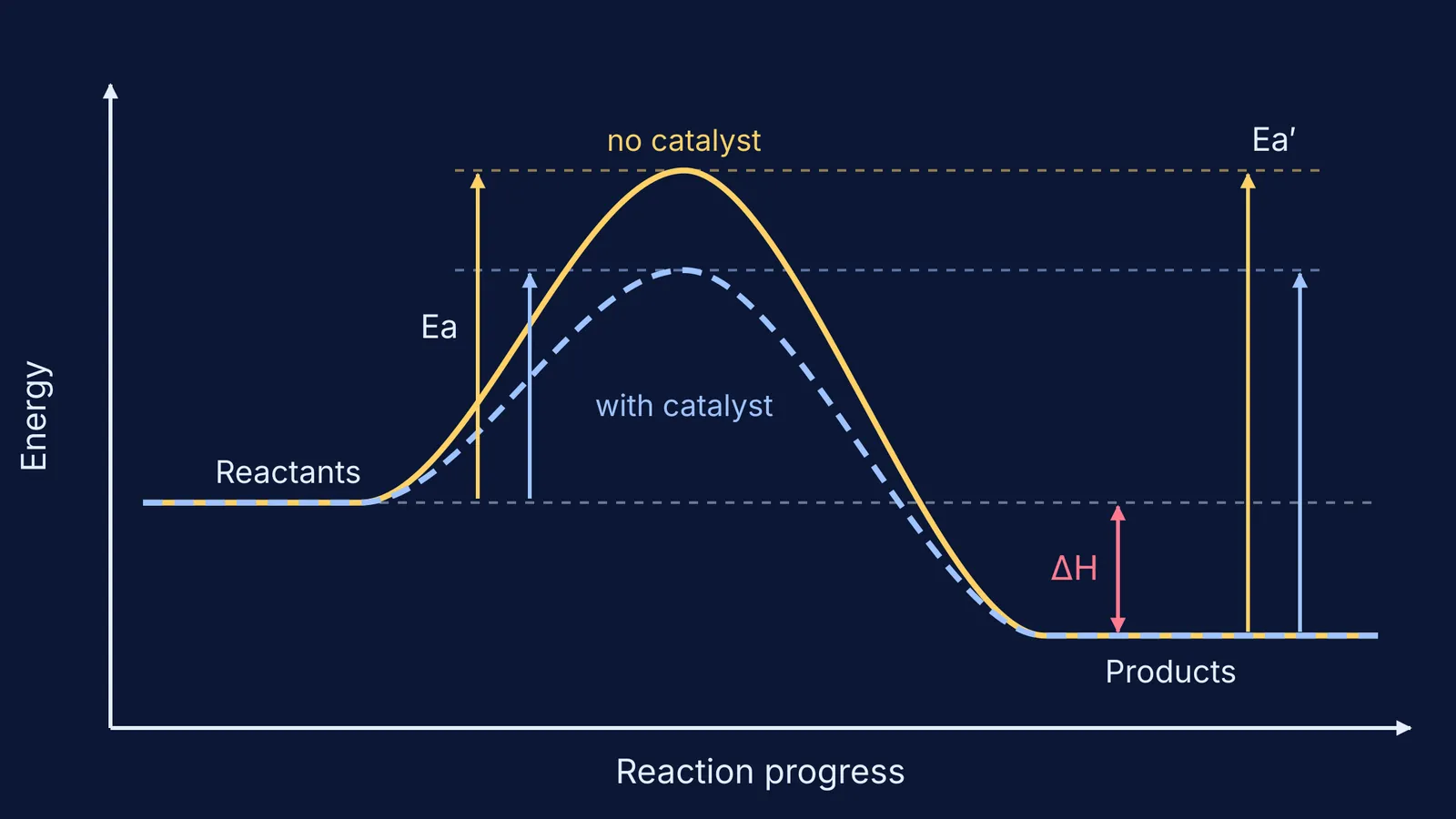
A catalyst is a substance that increases the rate of a reaction without itself undergoing any permanent chemical change, in the definition used by the NCERT Class 12 chemistry chapter on chemical kinetics (section 3.4.1). It works by providing an alternative pathway with a lower activation energy, which that chapter shows in its Figure 3.11.
The same chapter says a catalyst does not alter the Gibbs energy change, ΔG, of a reaction. Reactants and products sit at the same energies whichever route the molecules take; only the hill between them changes.
In the energy profile at the top of this post, the yellow curve has no catalyst and the dashed blue curve has one. Lowering the peak shrinks two barriers at once: Ea, the climb from reactants, and Ea′, the climb from products back up. Both shrink by the same amount, and ΔH, the gap between the valleys, does not move.
Why does a catalyst speed up both directions equally?
The NCERT Class 11 chemistry chapter on equilibrium (section 6.8.5) states that a catalyst increases the rate of the forward and reverse reactions that pass through the same transition state, and lowers the activation energy for both by exactly the same amount.
The Arrhenius equation, k = A e^(−Ea/RT), from the NCERT kinetics chapter, turns that into numbers. Take a one-step reaction with Ea = 100 kJ/mol forward and Ea′ = 140 kJ/mol backward, so the products sit 40 kJ/mol below the reactants. Add a catalyst that lowers the peak by 30 kJ/mol, work at 298 K, and for simplicity keep A the same.
New barriers: 70 kJ/mol forward and 110 kJ/mol backward. The gap between them is still 40 kJ/mol.
Each rate constant is multiplied by e^(30 000 ÷ (8.314 × 298)) = e^12.1, which is about 1.8 × 10^5.
At equilibrium the forward rate equals the backward rate, so for this one-step reaction K = kf ÷ kb.
kf and kb both grew about 1.8 × 10^5 times, so their ratio, K, is exactly what it was.
The catalyst's factor cancels. In this simple model, K at a given temperature depends only on the 40 kJ/mol gap between reactants and products, and the catalyst cannot touch that gap.
Does a catalyst change the equilibrium constant or the yield?
No to both. The NCERT kinetics chapter says a catalyst does not change the equilibrium constant; it helps attain equilibrium faster, so the equilibrium state remains the same but is reached earlier. The Class 11 equilibrium chapter adds that a catalyst does not affect the equilibrium composition and does not appear in the balanced equation or in the equilibrium constant expression.
So why do factories bother? Time. NCERT's own example is the Haber process. Making ammonia is exothermic, so K falls as temperature rises, yet at low temperature equilibrium takes a long time to reach. An iron catalyst gives a satisfactory rate at temperatures where the equilibrium concentration of ammonia is still reasonably favourable, and the Class 11 equilibrium chapter puts the optimum conditions with the catalyst at around 500 °C and 200 atm. The catalyst raises ammonia made per hour; it does not move the equilibrium.
There is a limit. In the contact process, 2SO2 + O2 ⇌ 2SO3 has Kc = 1.7 × 10^26, yet the oxidation is very slow, so platinum or vanadium pentoxide is used. The same NCERT section notes that if a reaction has an exceedingly small K, a catalyst would be of little help.
How do exam questions try to trick you here?
Use this checklist when a question mentions a catalyst:
Equilibrium position: unchanged. Adding a catalyst is not a stress in the Le Chatelier sense, so nothing shifts.
Forward and backward rates: both rise by the same factor, not just the forward one.
K, ΔH and ΔG: all unchanged. Only temperature changes K.
Yield: the equilibrium yield is the same; the time taken to reach it is shorter.
Concentration–time graphs: catalysed curves level off sooner, at the same final concentrations.
A script for the exam hall: before reading the options, write 'faster both ways, same K, same ΔH, same position' in the margin, then strike out every option that breaks one of the four.
Where to go next
For the rate side, read collision theory and catalysts, with numbers. To predict which way a mixture moves, see reaction quotient Q vs K, and for temperature and pressure traps, Kp, Kc and Le Chatelier errors.
If the energy profile still feels abstract, the Fermi Concept Library gives each chemistry concept its own lesson and its place in the map, so you can see how activation energy, the Arrhenius equation and K connect. To practise, the Fermi Problem Library has worked problems with a step-by-step solver that explains the reasoning rather than printing an answer.


