On this page
In 1915 a German engineer named Wilhelm Nusselt published a paper that changed how engineers describe heat passing between a surface and a moving fluid. He showed that a few pure numbers decide the answer, and the most important one carries his name.
Who was Wilhelm Nusselt?
Wilhelm Nusselt was born in Nuremberg on 25 November 1882 and died in Munich on 1 September 1957, according to the Neue Deutsche Biographie. He studied mechanical engineering in Berlin-Charlottenburg and Munich and finished his diploma in 1904.
His doctorate, completed in 1907, measured how well insulating materials conduct heat, using an apparatus now called the Nusselt sphere (University of Waterloo course notes). He then worked in Dresden, spent two years at the chemical company BASF, taught at Karlsruhe from 1920 to 1925, and held a chair at the Technical University of Munich from 1925 until he retired in the early 1950s (Neue Deutsche Biographie; TUM chair history).
The paper that made his name was *Das Grundgesetz des Wärmeübergangs*, "the basic law of heat transfer", published in 1915.
What is the Nusselt number?
The Nusselt number is Nu = hL/k, where h is the convective heat transfer coefficient, L is a characteristic length and k is the thermal conductivity of the fluid (Nusselt number, Wikipedia).
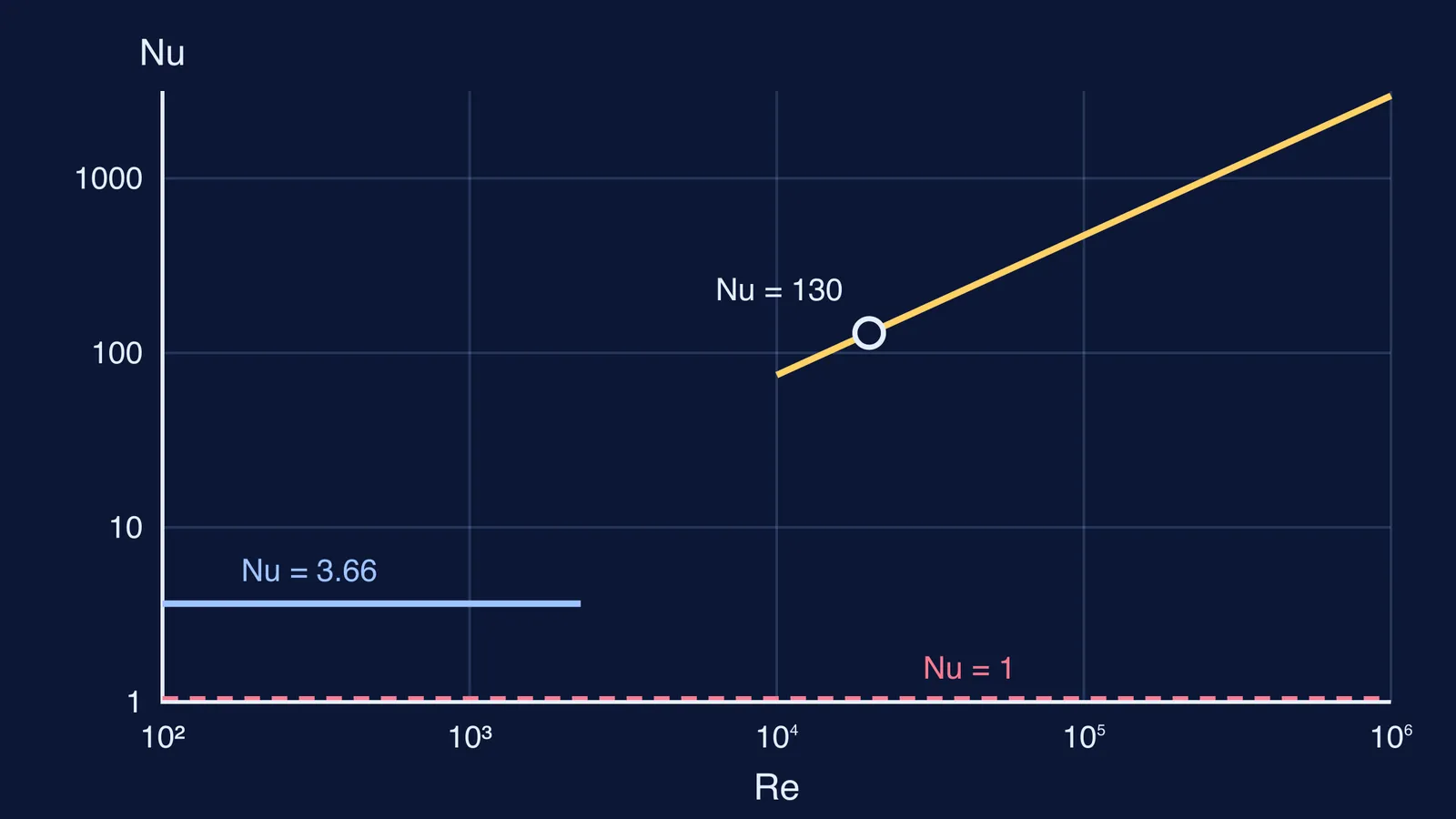
In words, Nu compares the heat a moving fluid carries away from a surface with the heat that would cross the same layer of fluid by conduction alone. Nu = 1 means convection adds nothing: heat crosses the fluid as if it were standing still (SimScale explainer).
For fully developed laminar flow in a round pipe whose wall is held at one temperature, Nu settles at 3.66 (Nusselt number, Wikipedia).
If you know Newton's law of cooling and its rate equation, h is hidden inside its cooling constant. The Nusselt number is h made dimensionless.
How do you calculate the Nusselt number? A worked example
Engineers get h from a correlation for Nu. A standard one for turbulent flow in a smooth pipe is the Dittus–Boelter equation, named after F. W. Dittus and L. M. K. Boelter, who studied heat transfer in car radiators (reprinted in International Communications in Heat and Mass Transfer, 1985); the form used today was introduced by W. H. McAdams. For a fluid being heated it reads Nu = 0.023 Re^0.8 Pr^0.4, for Reynolds numbers of about 10,000 or more, Prandtl numbers from 0.6 to 160 and pipes at least 10 diameters long (Nusselt number, Wikipedia).
The problem: water is heated as it flows through a long pipe 2 cm across, with Re = 20,000 and Pr = 6. Find h.
Check the range: Re = 20,000 and Pr = 6 are both inside it.
Work out the powers: 20,000^0.8 ≈ 2,760 and 6^0.4 ≈ 2.048.
Multiply: Nu = 0.023 × 2,760 × 2.048 ≈ 130.
Turn it back into h with h = Nu × k / D. Liquid water near room temperature has k of about 0.6 W/(m·K): 0.598 at 20 °C and 0.615 at 30 °C (Engineering ToolBox). So h ≈ 130 × 0.6 / 0.02 ≈ 3,900 W/(m²·K).
Compare with laminar flow in the same pipe, where Nu = 3.66: h ≈ 3.66 × 0.6 / 0.02 ≈ 110 W/(m²·K).
Turbulence makes the wall about 35 times better at passing heat to the water, one reason many heat exchangers run turbulent.
Why did Nusselt's dimensionless numbers matter?
Nusselt started from the differential equations of a flowing, heat-conducting fluid and showed that their solutions depend on dimensionless quantities rather than on each physical variable separately (Neue Deutsche Biographie). His 1915 paper also identified the groups we now call the Grashof, Prandtl and Reynolds numbers (Wilhelm Nusselt, Wikipedia).
The practical payoff is similarity. Two flows past the same shape with the same Reynolds and Prandtl numbers have the same Nusselt number, so a small laboratory rig can predict a full-sized boiler or condenser. You may know the Reynolds number from our explainer on laminar and turbulent flow; the Nusselt number is its partner for heat.
In 1916 he published a theory of how steam condenses as a film on a cooled surface (Wilhelm Nusselt, Wikipedia), and a paper on burning coal that pointed to the analogy between heat and mass transfer (Neue Deutsche Biographie). In 1951 he received the Grashof Commemorative Medal and the Gauss Medal (University of Waterloo course notes).
How should you read a Nusselt number formula?
Check any Nu correlation with five questions:
What is L? For a pipe it is the diameter; for a flat plate, usually the length along the flow.
Laminar or turbulent? Work out Re before you choose a formula.
Is it in range? Outside the Re and Pr a correlation was fitted to, it is a guess.
Heating or cooling? Dittus–Boelter uses Pr^0.4 for heating and Pr^0.3 for cooling (Nusselt number, Wikipedia).
Does the size make sense? Turbulent h should come out far above laminar h.
If flow and boundary layers are hard to picture, the Fermi Simulation Lab has interactive simulations for ideas that are easier to see than read. And if a heat-transfer numerical goes wrong halfway, the Fermi Problem Library has a step-by-step solver that explains the reasoning rather than printing an answer.