

On this page
The Reynolds number (Re) is a dimensionless quantity that predicts how a fluid will behave as it moves. It tells you whether the flow will be smooth and orderly, or chaotic and swirling.
First introduced by George Stokes and popularised by Osborne Reynolds in 1883, the number is a pure ratio. It compares the fluid's inertia (its momentum pushing it forward) against its viscosity (internal friction holding it back).
What is laminar and turbulent flow?
When fluid moves through a pipe, it can travel in one of two main ways:
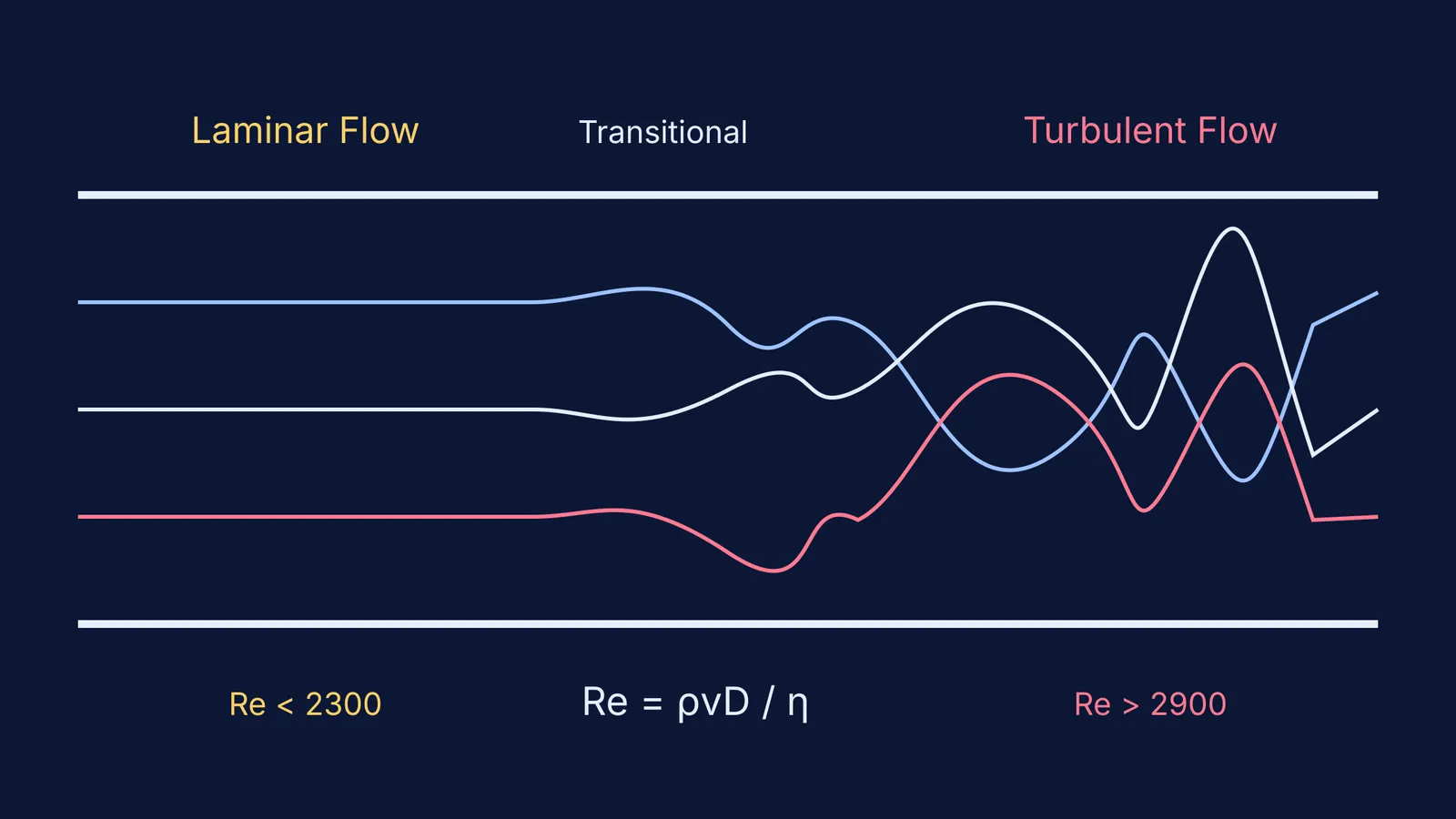
Laminar flow: The fluid moves in parallel layers, or laminae, that do not mix. If you inject a thin streak of dye into the centre, it travels in a perfectly straight line. This happens when the fluid is thick or moving slowly.
Turbulent flow: The fluid moves in irregular, chaotic paths full of eddies and swirls. The same dye streak would instantly break apart and mix across the whole pipe.
Between the two lies a transitional zone where the flow is unstable, switching back and forth between smooth and chaotic.
What is the threshold for laminar and turbulent flow?
For fluid flowing through a circular pipe, engineers and physicists use standard critical thresholds to predict the flow state (Reynolds number):
Laminar flow: Re < 2300. The flow is highly stable. Even if you bump the pipe, the fluid's viscosity dampens the disturbance and restores smooth flow.
Transitional flow: 2300 < Re < 2900. The flow is unstable and hard to predict.
Turbulent flow: Re > 2900. Inertia overwhelms viscosity, and the flow is fully turbulent.
These numbers are practical boundaries. Under tightly controlled laboratory conditions with perfectly smooth pipes, researchers have kept water laminar up to a Reynolds number of 50,000, but in the real world, turbulence dominates past 2900.
If you are learning the nuances of Fluid mechanics: pressure, buoyancy and Bernoulli mistakes to avoid, remembering these thresholds will help you choose the right equation. Bernoulli's equation, for instance, assumes smooth, steady flow without viscous losses.
How do you calculate the Reynolds number?
The formula for flow in a pipe connects four physical properties (Reynolds number):
Re = ρvD / η
ρ (rho): Density of the fluid in kg/m³.
v: Mean flow velocity in m/s.
D: Inside diameter of the pipe in metres.
η (eta): Dynamic viscosity of the fluid in Pa·s (or kg/(m·s)).
Because all the units cancel out, the Reynolds number is dimensionless. A Reynolds number of 2000 means the inertial forces are 2000 times stronger than the viscous forces.
A worked example: classifying the flow
Imagine water flowing through a 2 cm diameter pipe at 0.5 m/s (Viscosity of water, Reynolds number). Let's find out if it is laminar or turbulent.
Find the density (ρ): For water at room temperature, ρ ≈ 1000 kg/m³.
Find the velocity (v): Given as 0.5 m/s.
Find the diameter (D): Convert 2 cm to metres, so D = 0.02 m.
Find the viscosity (η): The dynamic viscosity of water is approximately 0.001 Pa·s.
Now, plug these into the formula: Re = (1000 × 0.5 × 0.02) / 0.001 Re = 10 / 0.001 Re = 10,000
Since 10,000 > 2900, the flow is fully turbulent. If you wanted to make it laminar without changing the pipe, you would need to drop the velocity below 0.115 m/s so that Re drops below 2300.
Why does fast flow in wide pipes turn turbulent?
If you look at the formula Re = ρvD/η, the reasons behind turbulence become clear.
Velocity (v) and Diameter (D) are on top. If you pump water faster (increasing v) or use a wider pipe (increasing D), you increase the fluid's inertia. The momentum of the fast, heavy mass of water becomes too great for internal friction to control, so the layers shear apart into eddies. This is why wide, fast-moving rivers are turbulent, while slow, narrow streams can run smooth.
Viscosity (η) is on the bottom. Thick, sticky fluids like honey have a high viscosity. Dividing by a large number keeps Re low, which is why honey pours in a smooth, laminar stream even if it moves quickly. Water is far less viscous, so it easily becomes turbulent. You can trace this resistance to flow in other contexts, too, such as Surface tension and viscosity: capillary rise to terminal velocity.
Seeing the invisible
Visualising how these forces interact can be difficult when reading a textbook. Osborne Reynolds and the dye streak that showed turbulence is a classic experiment because it made the invisible math suddenly visible.
If you want to see exactly how velocity and diameter warp the flow field, the Fermi Simulation Lab offers interactive simulations for the ideas that are easier to see than to read. You can also explore every concept in physics, chemistry, biology, mathematics and computing, each with its own lesson and its place in the map, in the Fermi Concept Library.


