On this page
Textbooks say the Moon's gravity is too weak. True, but the interesting part is how: the Moon loses gas a little at a time, one fast molecule after another, and it is still happening today.
Why does the Moon have no atmosphere?
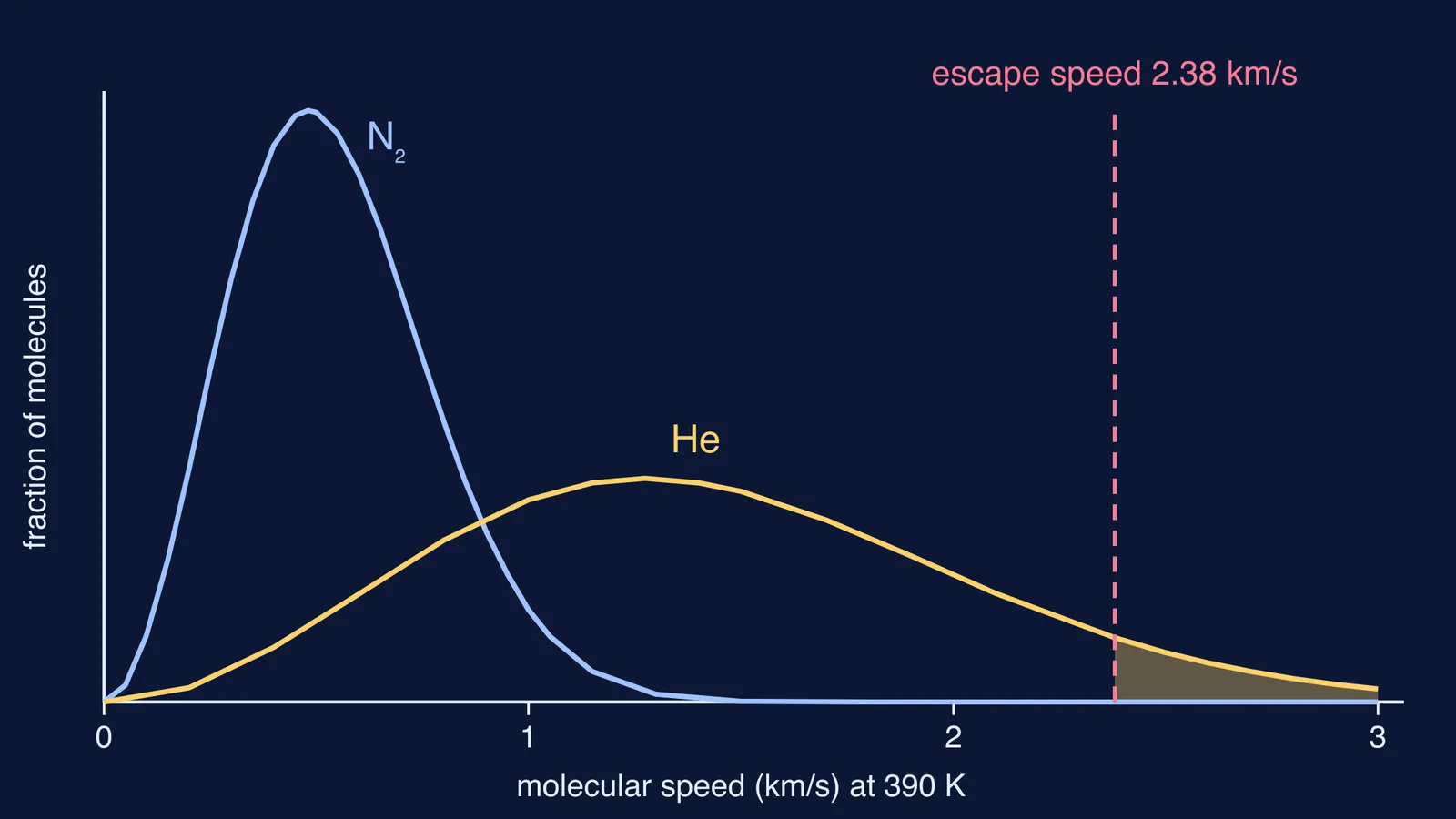
A molecule leaves a world for good if it moves away faster than that world's escape speed, v = √(2GM/R). NASA's Moon fact sheet gives the Moon's mass as 7.346 × 10²² kg and its mean radius as 1,737.4 km. Put those in and you get about 2,376 m/s.
The Moon's escape speed is 2.38 km/s, against 11.2 km/s for Earth, according to the NASA Moon fact sheet.
The second half of the answer is heat. At the lunar equator the surface swings between 95 K at night and 390 K in sunlight, per the same NASA data. Hot gas means fast molecules, and a weak pull lets the fast ones get away.
How fast do gas molecules move on the Moon?
Kinetic theory says the molecules in a gas do not all move at one speed. They follow the Maxwell speed distribution, and their mean speed is √(8RT/πM), where M is the molar mass (HyperPhysics on kinetic temperature and molecular speeds). Here is that formula worked out at the Moon's daytime 390 K:
Hydrogen (H₂, 2 g/mol): about 2,030 m/s
Helium (4 g/mol): about 1,440 m/s
Water vapour (18 g/mol): about 680 m/s
Nitrogen (N₂, 28 g/mol): about 540 m/s
Oxygen (O₂, 32 g/mol): about 510 m/s
Argon (40 g/mol): about 450 m/s
None of these averages reaches 2,380 m/s. The gas leaves because the distribution has a long tail. From the same Maxwell formula, about 7% of helium atoms at 390 K are faster than the Moon's escape speed. For nitrogen it is roughly one molecule in 7 billion. That sounds tiny, but every time a molecule strikes the hot ground it comes off with a fresh random speed, so the fast tail keeps refilling.
A rule of thumb from astronomy: if a gas's average molecular speed is below 0.2 times the escape speed, more than half of it stays after a billion years (Nick Strobel's Astronomy Notes). For the Moon, 0.2 × 2,380 m/s is about 476 m/s. Nitrogen, oxygen and water vapour all sit above that line on a sunlit day. For Earth the line is at about 2,240 m/s, well above all three.
Does the Moon have any air at all?
Yes, a trace. The Moon's whole atmosphere has a total mass of about 25,000 kg, according to the NASA fact sheet. Scientists call it an exosphere: gas so thin that its atoms rarely meet each other.
NASA's LADEE spacecraft measured it for seven months from November 2013. It found the exosphere is made mostly of helium, argon and neon, and is about 100 trillion times less dense than Earth's air at sea level (NASA). Most of that gas arrives on the solar wind; some seeps out of lunar rocks as radioactive elements decay.
India has added to this picture. The CHACE-2 instrument on Chandrayaan-2 made the first observations of how argon-40 is spread around the whole Moon's exosphere; that argon comes from potassium-40 decaying below the surface (ISRO). The results, by M. B. Dhanya and colleagues, appeared in Geophysical Research Letters in October 2021 (the paper).
ISRO lists how the exosphere loses atoms: thermal (Jeans) escape, the leak described above, plus photo-ionisation, charge exchange with solar wind ions and sweeping by the solar wind's electric field. So argon, at about 450 m/s just under the 476 m/s line, can still leave: once sunlight or a solar wind ion strips an electron, the solar wind's electric field can sweep the ion away. Thermal escape is the main idea, not the only way out.
How do you answer this in an exam?
This question joins two Class 11 chapters, gravitation and kinetic theory. Use five steps:
Write the escape speed, v = √(2GM/R), and put in the Moon's numbers to get 2.38 km/s (NASA).
Write the gas speed, rms √(3RT/M) or mean √(8RT/πM), at the hottest surface temperature.
Compare them, and use the word distribution: even when the average is lower, the fast tail is above escape speed.
Add time: the tail keeps refilling, so the loss never stops.
Say what is left: a thin exosphere, not a perfect vacuum.
For the full calculation, see rms speed vs escape velocity on the Moon, the derivation of the escape velocity formula and what heating a gas does to the Maxwell speed distribution.
The tail is hard to picture from a formula. The Fermi Simulation Lab has interactive simulations for the ideas that are easier to see than to read. If your numbers keep coming out wrong, the Fermi Problem Library has worked problems with a step-by-step solver that explains the reasoning rather than printing an answer.
Next time someone says the Moon has no air, you can tell them where it went.