On this page
You have Kc, the question wants Kp, and the formula looks like a one-liner. The marks are lost in one small number: Δn. Count it wrong and your answer is off by a whole factor of RT. This post shows you how to count it, how to convert in both directions, and how to make an AI chatbot show its count before you trust its answer.
What is the relation between Kp and Kc?
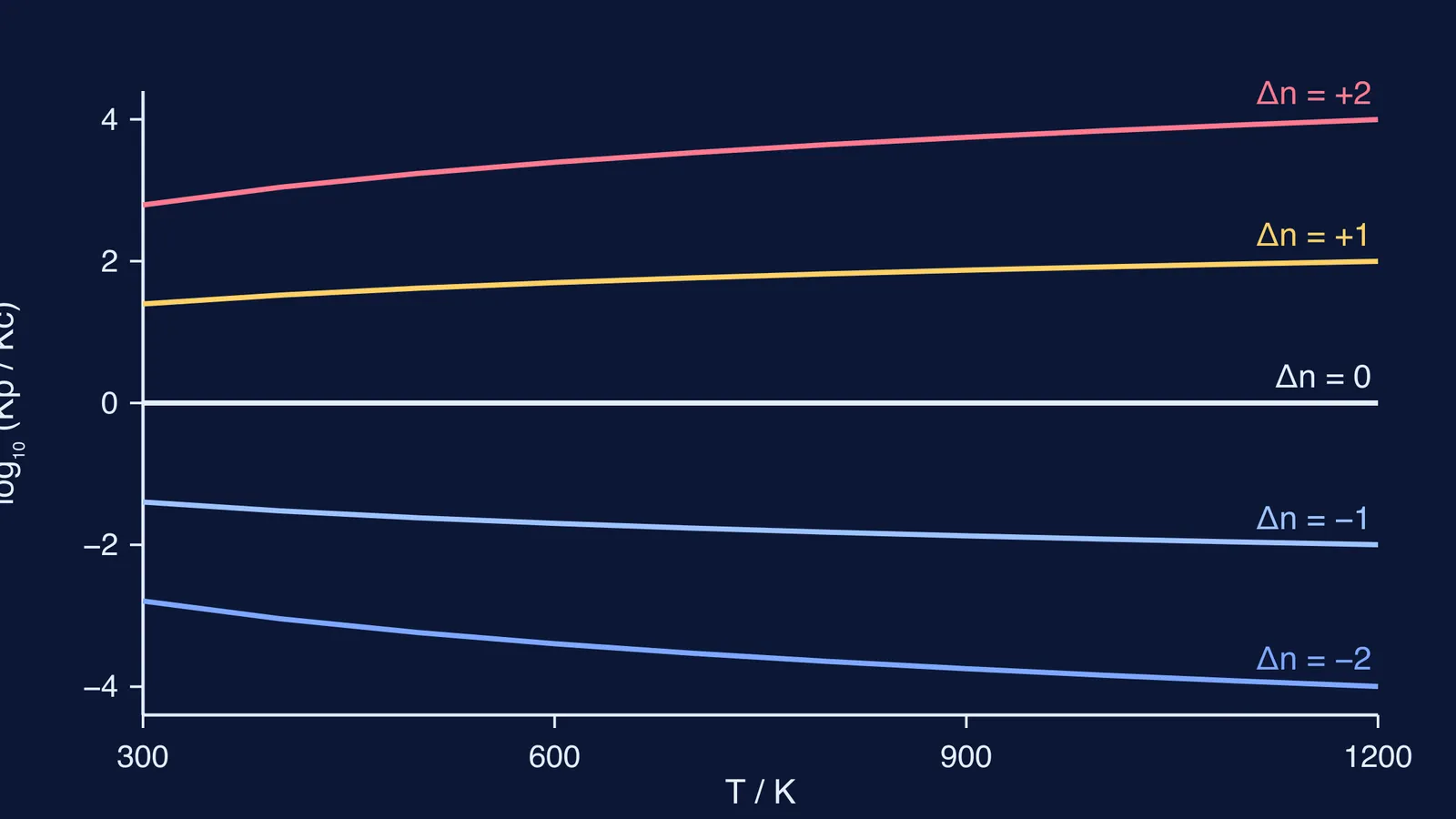
The NCERT Class 11 Chemistry textbook gives the relation as Kp = Kc(RT)^Δn (NCERT Chemistry Part I, Unit 6: Equilibrium).
In NCERT's definition, Δn = (number of moles of gaseous products) − (number of moles of gaseous reactants) in the balanced chemical equation (NCERT, Unit 6).
NCERT uses R = 0.0831 bar litre/mol K and says pressure should be in bar when you calculate Kp, because the standard state for pressure is 1 bar. If your data come in other units, start with our guide to matching the value of R to your units.
The chapter works two cases, and the third follows from the formula:
Δn = 0: Kp = Kc, as for H₂(g) + I₂(g) ⇌ 2HI(g).
Δn negative: for N₂(g) + 3H₂(g) ⇌ 2NH₃(g), Δn = 2 − 4 = −2, so Kp = Kc(RT)^−2.
Δn positive: Kp is Kc multiplied by RT once for each extra mole of gas.
For the full algebra from pV = nRT, read how Kp = Kc(RT)^Δn is derived.
Why does Δn go wrong so often?
Almost every mistake is a counting mistake, not an algebra mistake:
Counting a solid or a pure liquid. NCERT explains that their molar concentration is constant, so they do not appear in the equilibrium expression (NCERT, Unit 6). They do not appear in Δn either. More in why solids and pure liquids drop out of K.
Using a different form of the equation. Δn comes from the balanced equation you were given; double the equation and Δn doubles.
Flipping the sign: reactants minus products instead of products minus reactants.
An AI chatbot can make the same slips, and it can hide them inside a tidy, confident solution. Trusting or distrusting the final number does not help. Seeing the count does.
How do you convert Kc to Kp, step by step?
Example 1: all gases. NCERT Problem 6.5 gives Kc = 3.75 × 10⁻⁶ at 1069 K for 2NOCl(g) ⇌ 2NO(g) + Cl₂(g) (NCERT, Unit 6).
Gas moles: products 2 + 1 = 3, reactants 2, so Δn = +1.
RT = 0.0831 × 1069 = 88.8.
Kp = 3.75 × 10⁻⁶ × 88.8 = 3.33 × 10⁻⁴.
The printed answer in the 2026-27 reprint reads 0.033. Multiply it out yourself and you get 3.33 × 10⁻⁴, which is a good reminder that any answer, printed or generated, deserves an arithmetic check.
Example 2: the solid trap. NCERT Problem 6.6 gives Kp = 3.0 at 1000 K for CO₂(g) + C(s) ⇌ 2CO(g) (NCERT, Unit 6). The book then finds partial pressures; we find Kc.
Cross out C(s). Gas moles: products 2, reactants 1, so Δn = +1.
RT = 0.0831 × 1000 = 83.1.
Kc = Kp ÷ (RT)^Δn = 3.0 ÷ 83.1 = 0.036.
Count the carbon and Δn becomes 0, so you would write Kc = 3.0, which is 83 times too big.
What prompt makes AI show its Δn count first?
Ask for the count before the calculation, and ask it to stop. Paste this with your question:
Do your own count on paper before you read the reply. Then:
If the counts match, tell it to continue, and check each line of arithmetic.
If they differ, ask: "Which species did you count as gas, and why?" Usually one of you included a solid or used a different form of the equation.
If it ignores the stop and jumps to a final number, set the number aside and ask for the species list again.
This works because the whole error lives in one line. A solution that shows that line can be corrected; one that hides it cannot.
How do you check a Kp answer in under a minute?
Run this list before you accept any Kc-to-Kp answer, yours or an AI's. RT values below use NCERT's R = 0.0831 bar L/mol K (NCERT, Unit 6).
Is a state written next to every species?
Were only the (g) terms counted?
Is it products minus reactants?
Is pressure in bar with R = 0.0831?
Does the direction make sense? With positive Δn and RT above 1, Kp should be larger than Kc.
Is the answer off from yours by about RT (roughly 25 at 300 K, 83 at 1000 K)? Then Δn is probably off by one.
If Δn slips keep showing up in your mock tests, the Fermi Problem Library has worked problems with a step-by-step solver that explains the reasoning rather than printing an answer. Fermi's AI tutor notices where you are stuck and decides whether to explain, ask or show.
Next time, write the states first. Δn takes ten seconds once they are on the page.