On this page
Genes that sit on the same chromosome tend to be inherited together. They separate only when crossing over during meiosis swaps segments between partner chromosomes. Count how often that happens and you get a number that works like a ruler. Below you will run a cross on paper, count the recombinants, and place three genes on a simple map.
What is recombination frequency?
The NCERT Class 12 Biology chapter on inheritance tells the story through Thomas Hunt Morgan's fruit-fly crosses. When two genes sat on the same X chromosome, parental combinations of traits turned up far more often than new ones. Morgan called this physical association linkage, and the making of non-parental combinations recombination.
Recombination frequency is the number of recombinant offspring divided by the total number of offspring, multiplied by 100.
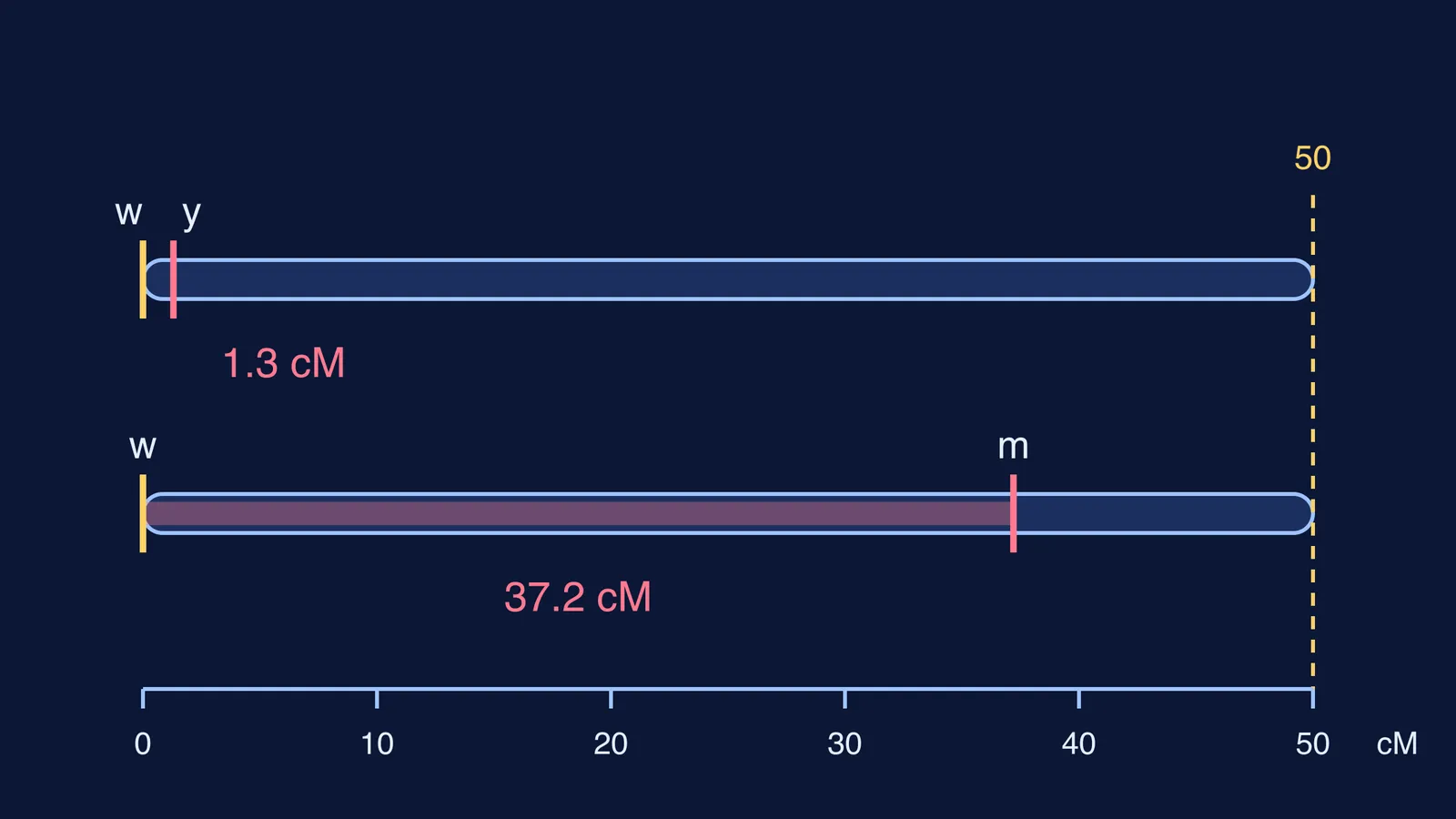
In the NCERT account, the genes white and yellow showed only 1.3 per cent recombination, while white and miniature wing showed 37.2 per cent (NCERT Biology, Principles of Inheritance and Variation). Morgan's student Alfred Sturtevant used recombination frequencies between gene pairs as a measure of distance, and in 1913 published the linear arrangement of six sex-linked genes in Drosophila (Sturtevant, Journal of Experimental Zoology).
How do you convert recombination frequency into map distance?
One map unit, also called a centimorgan (cM), equals 1% recombination (Introduction to Genetics, LibreTexts). The US National Human Genome Research Institute defines one centimorgan as a 1% chance that two markers on a chromosome are separated by recombination during meiosis (NHGRI glossary).
So white and yellow are about 1.3 map units apart, and white and miniature about 37.2. The LibreTexts genetic mapping chapter also explains two limits:
Recombination frequency reaches a maximum at 50%, the value two independently assorting genes would show.
A double crossover between two distant genes restores the parental combination, so it is not counted and long distances come out too short.
Worked example: simulate a testcross and count recombinants
Take a fly heterozygous for two linked genes, with A and B on one chromosome and a and b on its partner (AB/ab). Cross it with an ab/ab tester, so each offspring shows which gamete it got from the heterozygous parent. Pretend the genes are 15 map units apart; since one map unit equals 1% recombination (LibreTexts), 15% of gametes should be recombinant.
Simulate it with a random number app or two ten-sided dice:
Draw a number from 1 to 100 for each offspring.
If it is 15 or below, the offspring is recombinant: toss a coin to choose Ab or aB.
If it is above 15, the offspring is parental: toss a coin to choose AB or ab.
Tally the four classes.
One run of 400 offspring might give AB 172, ab 168, Ab 31 and aB 29. The recombinants are 31 + 29 = 60, so the recombination frequency is 60 ÷ 400 × 100 = 15%, which places the genes 15 map units apart.
Run only 20 offspring and you expect 3 recombinants, but chance can hand you 1 or 6, which reads as 5 or 30 map units. Small samples wobble for the same reason Mendel's 3:1 ratio needs large numbers.
How do you build a gene map from three linked genes?
Add a third gene, C, and run two more simulated testcrosses, converting each frequency to map units as LibreTexts describes. Suppose you count 6% recombination between A and C, and 9% between C and B.
Write down all three distances: A to B is 15, A to C is 6, C to B is 9.
The largest distance marks the two outer genes, so A and B sit at the ends.
Place C between them: A at 0, C at 6, B at 15.
Check the sum: 6 + 9 = 15. If the outer distance had come out smaller than the sum, suspect uncounted double crossovers between the outer genes.
Morgan's numbers make a good test: in the NCERT account, white to yellow is 1.3 and white to miniature is 37.2, but without the yellow to miniature value you cannot tell which side of white yellow sits on. For full three-point problems, see our guide to solving recombination frequency and map distance numericals.
How can you practise linkage before the exam?
Run the simulation with a small batch, then a large one, and write both frequencies side by side.
Build three-gene maps from made-up distances, and always check that the two short distances add up to the long one.
Revisit sex-linked inheritance, since Morgan's linked genes were on the X chromosome: see how to solve X-linked crosses.
Some ideas are easier to see than to read, and the Fermi Simulation Lab has interactive simulations for them. If you are unsure where to begin in genetics, Fermi's AI tutor can work out what you already know and build a plan for the session.
Run one batch of 400 this week and count the recombinants yourself.