On this page
A Leitner box is a flashcard system that sorts cards by how well you know them, so your time goes to the cards you keep getting wrong. The German science journalist Sebastian Leitner described it in his 1972 book *So lernt man lernen* ("How to learn to learn"), according to the Wikipedia entry on the Leitner system. The rule is simple: answer a card correctly and it moves up one box, which you review less often; get it wrong and it goes back to Box 1.
Why does a Leitner box work?
It puts two well-tested study habits into one routine. In a 2013 review of ten learning techniques, John Dunlosky and colleagues rated only two as high utility: practice testing and distributed practice, which means spreading study out over time. Rereading and highlighting were rated low utility.
Every card is a small test, and testing does work that rereading does not. In a 2008 study in Science, Jeffrey Karpicke and Henry Roediger found that once students had learned foreign-language words, studying them again had no effect on delayed recall, while testing them again produced a large benefit. Their predictions of their own scores bore no relation to how they actually did.
Spacing also feels worse than it is. Nate Kornell tested flashcards directly in a 2009 study with word pairs: spacing beat massing for 90% of participants, yet after the first session 72% believed massing had worked better. So expect the box to feel slow, and trust your test results over that feeling.
How does the Leitner box schedule your reviews?
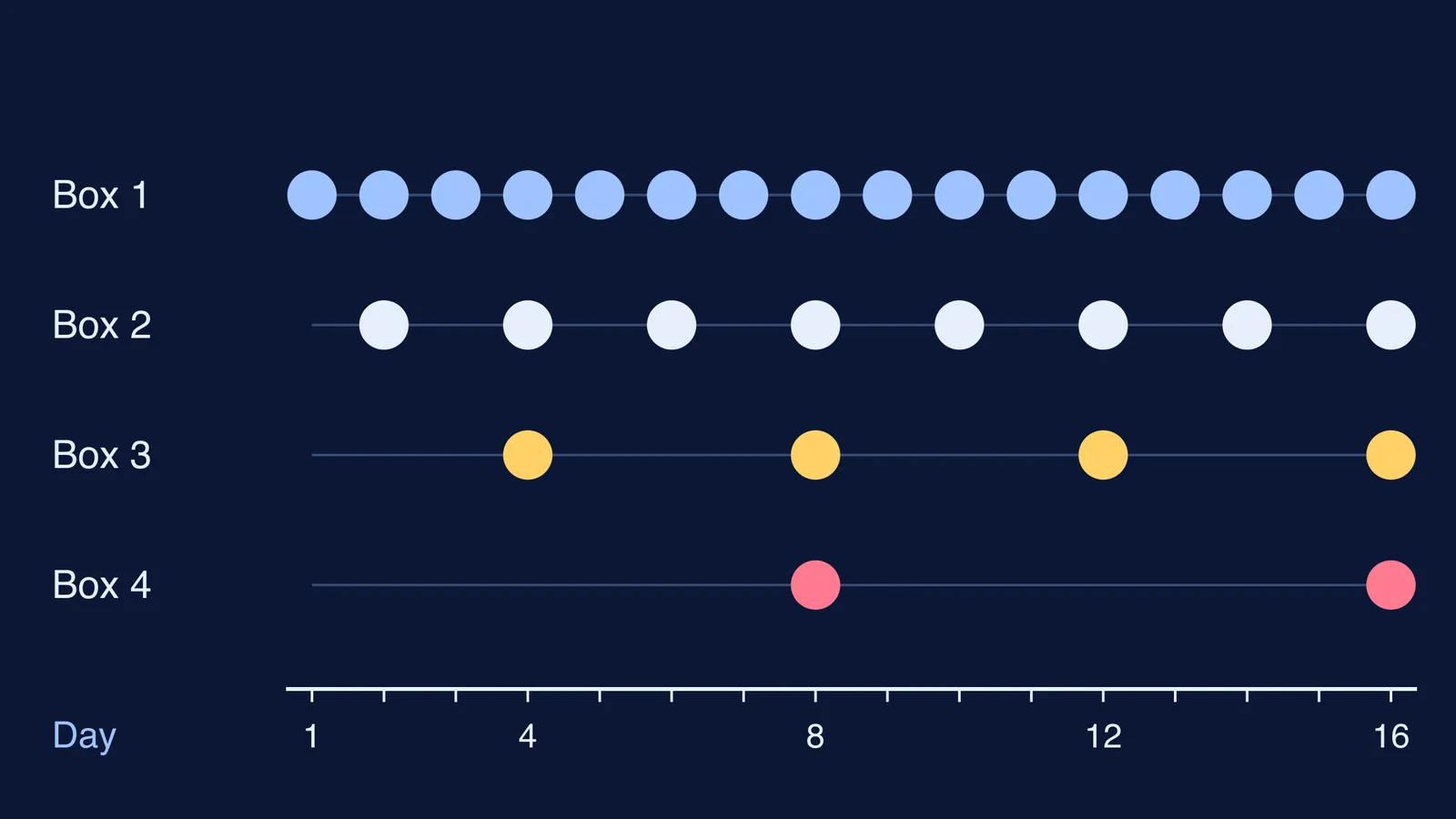
Leitner's original box had sections of different widths, reviewed when each filled up, but a calendar is easier to follow. Here is a four-box schedule we suggest, where each box comes round half as often as the one before:
Box 1: every day
Box 2: every 2 days
Box 3: every 4 days
Box 4: every 8 days
A card you answer correctly from Box 4 is retired. Shuffle the retired pile back in for one last pass in the final week before the exam.
How far apart should the top box be? It depends on how far away the exam is. In a study of more than 1,350 people, Nicholas Cepeda and colleagues found that the best gap between first study and review was about 20 to 40% of the time to the test when the test was a week away, falling to about 5 to 10% when it was a year away. The study did not test Leitner boxes, but for an exam about two months off, our rough reading is a longest gap of one to two weeks, which is why Box 4 comes round every 8 days. If your exam is many months away, you could add a Box 5 that you review every 16 days.
Here is a worked example. You write 30 cards on named reactions on day 1, and all of them start in Box 1. You get 18 right, so they move to Box 2, and 12 stay behind. On day 2 you review Box 1 and Box 2 together. Any Box 2 card you get right moves to Box 3; any card you miss, from either box, goes to Box 1. The cards still in Box 1 after two weeks are your to-do list.
How do you set up a Leitner box with paper cards?
Get index cards, or cut A4 sheets into eighths. Make four sections: a shoebox with cardboard dividers, or four envelopes labelled Box 1 to Box 4.
Put one question on the front and its answer on the back. Make yourself produce the answer, not just recognise it: "What does toluene give in the Etard reaction?" works better than a true-or-false statement.
Write the start date on a calendar and mark which boxes are due each day.
Say or write your answer before you flip the card. Be strict: half-right counts as wrong.
Add only a small batch of new cards each day, so Box 1 never grows too big to finish.
A short session every day does more than one long session on Sunday.
Which exam topics suit a Leitner box?
It suits anything you must recall exactly and quickly:
Biology: NCERT terms, examples, and what each hormone or enzyme does.
Chemistry: named reactions, reagents, colours of compounds, and exceptions to periodic trends.
Physics: dimensions, SI units, constants and formulae.
Maths: standard integrals, trigonometric values and identities.
It does not suit long problem solving or derivations. Instead, make cards for the decision that starts a problem, such as "A coin on a turntable: what supplies the centripetal force?" Then practise full problems separately. The Fermi Problem Library has worked problems with a step-by-step solver that explains the reasoning rather than printing an answer.
If one card keeps falling back to Box 1, the problem is often the idea behind it, not your memory. Learn the concept properly, then rewrite the card. The Fermi Concept Library has a lesson for every concept in physics, chemistry, biology, mathematics and computing.
Start tonight with a small stack of cards and one envelope marked Box 1.