On this page
CBSE Class 12 students meet this question in some form: a culture of bacteria grows "at a rate proportional to the number present", and you are asked when it reaches a certain size. Marks are lost where words become an equation, and where logarithms become hours.
Where does this question come from in CBSE Class 12?
It sits in the Differential Equations chapter of NCERT's Class 12 Mathematics Part II. NCERT Exercise 9.3, Question 22 reads: "In a culture, the bacteria count is 1,00,000. The number is increased by 10% in 2 hours. In how many hours will the count reach 2,00,000, if the rate of growth of bacteria is proportional to the number present?" The same chapter's Example 9 uses the identical model for money in a bank that grows continuously at 5% a year.
The CBSE Class 12 Mathematics syllabus for 2026-27 lists "solution of differential equations by method of separation of variables" and gives the Calculus unit 35 of the paper's 80 marks. The same document sets aside 20 marks for "Applying" questions, which ask you to use a technique in a new situation: exactly what a growth word problem does.
How do you turn the words into dN/dt = kN?
Read the sentence slowly and translate one phrase at a time:
"the rate of growth" means dN/dt, where N is the number of bacteria at time t.
"is proportional to" means "equals a constant times", so you write k.
"the number present" means N itself.
So the model is dN/dt = kN, with k > 0 because the culture is growing. Write down the unit of t (hours here) before going further; k then carries the unit "per hour".
Next, list NCERT's conditions as pairs: at t = 0, N = 1,00,000; at t = 2, N = 1,10,000 (a 10% rise). Two conditions fix two unknowns: C and k.
How do you solve dN/dt = kN step by step?
Here is the NCERT problem worked through, then extended to the tripling question that school papers like to ask.
Separate the variables: dN/N = k dt.
Integrate both sides: ln N = kt + C.
Use t = 0, N = N₀: C = ln N₀, so ln(N/N₀) = kt, which means N = N₀e^(kt).
Use the second condition: ln(1,10,000/1,00,000) = 2k, so k = ½ ln(11/10) ≈ 0.0477 per hour.
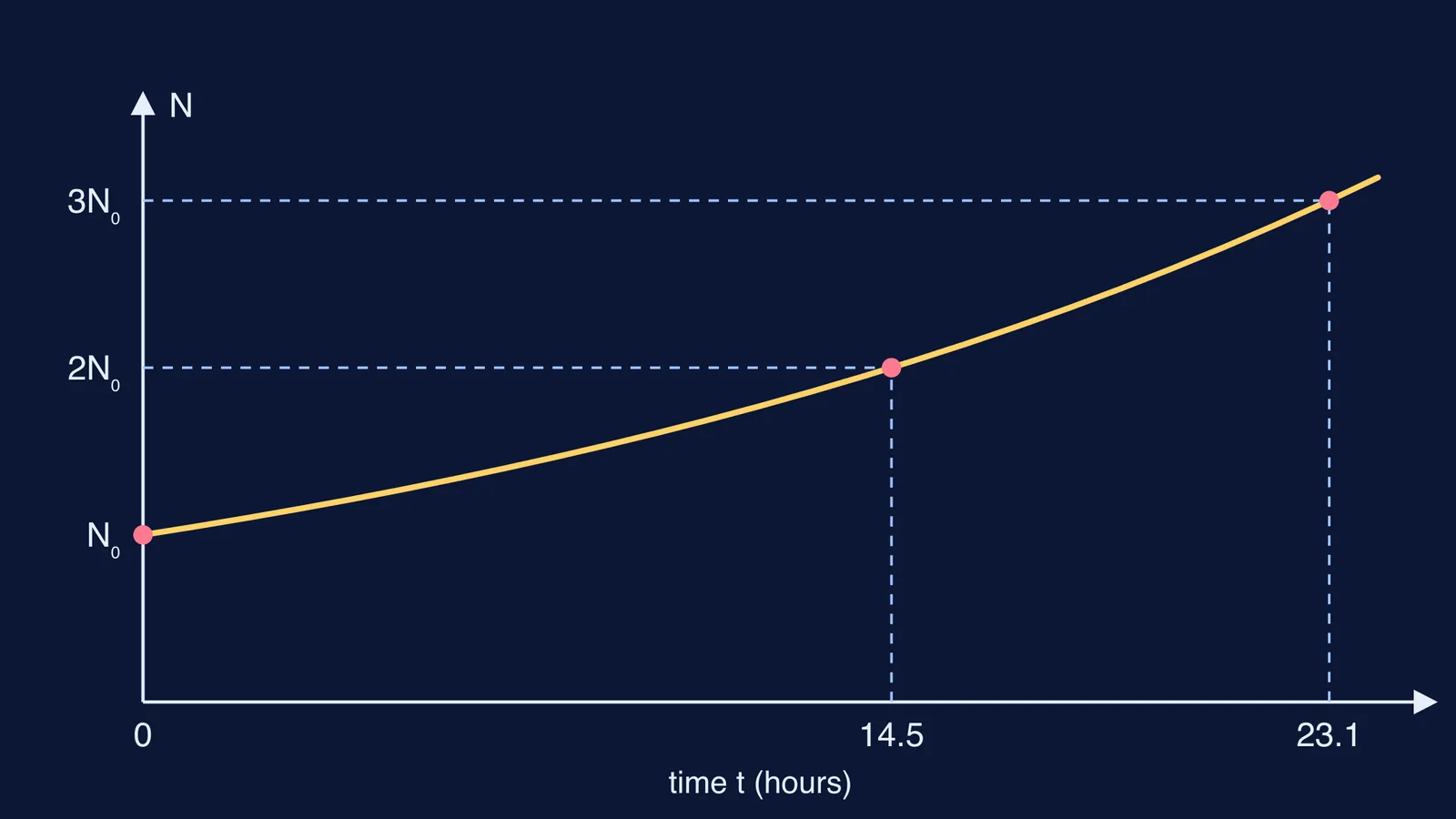
For the doubling NCERT asks about: ln 2 = kt gives t = 2 ln 2 / ln(11/10) ≈ 14.5 hours.
For tripling: ln 3 = kt gives t = 2 ln 3 / ln(11/10) ≈ 23.05 hours, about 23 hours 3 minutes.
N₀ cancelled in steps 5 and 6: the time to triple depends only on k, not on the starting count. The same idea gives half-life in radioactive decay, as in our post on finding the decay constant from an ln A vs t graph.
Check: 23.053 / 14.545 ≈ 1.585 = ln 3 / ln 2. A different ratio means an arithmetic slip.
How long does a culture take to triple if you know its doubling time?
Many papers give the doubling time instead of the percentage in NCERT's version. Suppose a culture doubles in 3 hours. Then k = ln 2 / 3, and the tripling time is t = ln 3 / k = 3 ln 3 / ln 2 ≈ 4.75 hours, about 4 hours 45 minutes. You never needed the starting count.
Without a calculator, leave the answer in exact form, such as 3 log 3 / log 2; NCERT writes its own answer to Example 9 as 20 logₑ2. For turning one log into another, see our change of base formula guide.
Where do students lose marks on this question?
Check this list before you move on:
Writing dN/dt = k instead of dN/dt = kN. That is constant growth, not proportional growth.
Reading NCERT's "increased by 10%" as N = 10,000 instead of N = 1,10,000.
Dropping the constant of integration, and then having no way to use the starting count.
Mixing units: if t is in hours, k is per hour; do not switch to minutes halfway.
Stopping at ln N = kt + C. The question asks for hours, so end with hours.
Writing only a decimal. Show the exact form first, then the approximation.
If you keep slipping at the same line, the Fermi Problem Library has worked problems with a step-by-step solver that explains the reasoning rather than printing an answer, so you can see where your working went off course. If separating variables itself feels shaky, the Fermi Concept Library has a lesson for every concept in mathematics.
For where e comes from, read how Jacob Bernoulli found e by compounding interest.