On this page
Radioactive activity falls fast at first, then slower: a curve that is hard to read by eye. Plot the natural log of activity against time instead and the curve becomes a straight line, from which you can read the decay constant λ and the half-life with a ruler.
Why does ln A against t give a straight line?
Activity is the number of decays per second. In OpenStax University Physics Volume 3, section 10.3, activity is defined as A = λN, where N is the number of undecayed nuclei and λ is the decay constant. The same section gives how activity falls with time: A = A₀e^(−λt). One becquerel (Bq) is one decay per second, also per OpenStax; our explainer on becquerel and curie units of activity covers the conversions.
Take the natural log of both sides and you get ln A = ln A₀ − λt.
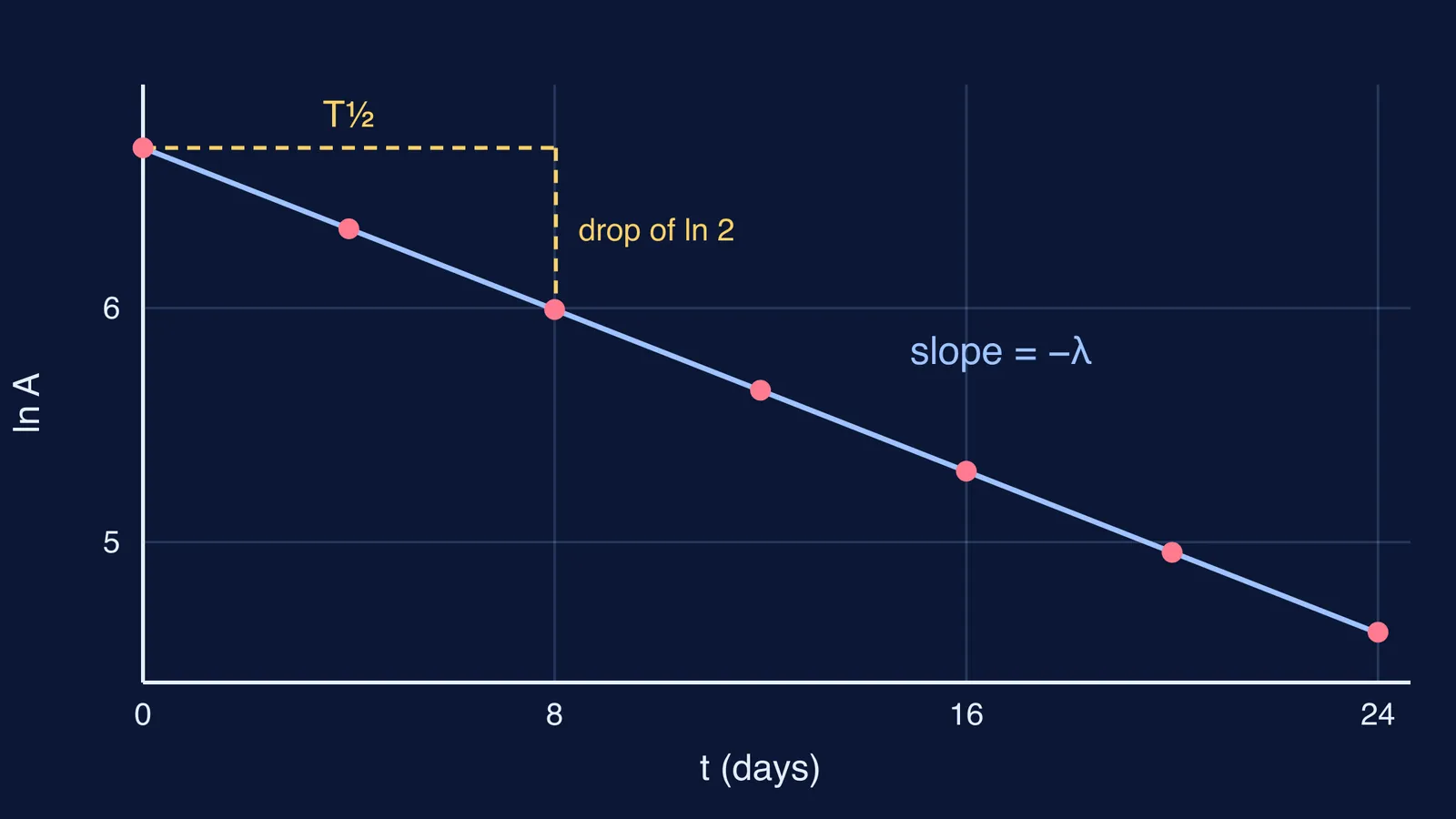
Compare that with y = c + mx. With ln A on the y-axis and t on the x-axis, OpenStax notes, you get a straight line with slope −λ and y-intercept ln A₀.
Half-life is the time for half of the original nuclei to decay, and OpenStax gives λ = 0.693/T½. So once you have λ, the half-life is T½ = ln 2/λ ≈ 0.693/λ.
How do you find the decay constant from the slope?
Work out ln A for each reading (the ln key, not log).
Plot ln A against t. The y-axis need not start at zero.
Draw one straight line of best fit.
Pick two points on the line, far apart, and read their coordinates.
Slope = (ln A₂ − ln A₁)/(t₂ − t₁). It is negative; λ = −slope, per unit of time.
Half-life: T½ = 0.693/λ.
Worked example: a sample of iodine-131
Iodine-131 has a half-life of 8.0233 days in the LNHB Table de Radionucléides evaluation for I-131. Suppose a sample's activity is measured every 4 days. The readings below are made up for practice: we computed them from that half-life, starting at 800 MBq, and rounded them.
t = 0 days: A = 800 MBq, ln A = 6.685
t = 4 days: A = 566 MBq, ln A = 6.339
t = 8 days: A = 401 MBq, ln A = 5.994
t = 12 days: A = 284 MBq, ln A = 5.649
t = 16 days: A = 201 MBq, ln A = 5.303
t = 20 days: A = 142 MBq, ln A = 4.956
t = 24 days: A = 101 MBq, ln A = 4.615
Plotted, they fall on a straight line. Its ends are (0, 6.685) and (24, 4.615), so the slope is (4.615 − 6.685)/(24 − 0) = −2.070/24 = −0.0863 per day.
So λ ≈ 0.0863 per day and T½ = 0.693/0.0863 ≈ 8.03 days, within a hundredth of a day of the evaluated value; the gap is rounding. The intercept checks out too: e^6.685 ≈ 800 MBq.
How do you read the half-life straight off the graph?
You can skip λ. By the OpenStax half-life definition, A halves every half-life, so ln A drops by ln 2 = 0.693. Start anywhere on the line, go down 0.693, and read how far along the time axis the line has moved. In the example, 6.685 − 0.693 = 5.992, which the line reaches at about t = 8 days. The distance is the same wherever you start: half-life does not depend on how much sample is left.
If your graph uses log₁₀ A, the slope is −λ/2.303, because ln x = 2.303 log₁₀ x. In the example, log₁₀ A falls from 2.903 to 2.004 over 24 days, a slope of −0.03746 per day, and 0.03746 × 2.303 ≈ 0.0863 per day, the same λ.
Once you have λ, the mean life is τ = 1/λ; our post on why mean life is 1.44 times the half-life shows where that factor comes from.
What mistakes cost marks on this graph?
Using log₁₀ A and forgetting the factor of 2.303.
Dropping the minus sign: the slope is negative, λ is positive.
Mixing units: if t is in hours, λ is per hour, and so is the half-life.
Taking the slope from two readings that sit off the best-fit line.
With lab counts, taking logs before subtracting the background count.
Reading ln A₀ off an axis that does not start at t = 0.
Real counts scatter around the line because each decay is random; our radioactive decay simulation post shows why the trend still holds.
For practice, the Fermi Problem Library has worked problems with a step-by-step solver that explains the reasoning rather than printing an answer, so you can see where a slope calculation went wrong. If exponentials still feel shaky, the Fermi Concept Library gives each concept its own lesson.
Next time a question hands you a table of activities, take the logs first.