

On this page
Half-life and mean life describe the same decay curve but answer different questions. Two slips are common: multiplying by 0.693 instead of dividing, and assuming half the sample is left after one mean life. The official JEE (Advanced) 2026 syllabus lists “Law of radioactive decay; Decay constant; Half-life and mean life” under Modern Physics. The 2026-27 reprint of NCERT's Class 12 chapter on nuclei, though, only names alpha, beta and gamma decay in its radioactivity section (13.6). If you read only that section, you will not find the decay law, half-life or mean life there, or the curve behind them.
What is the difference between mean life and half-life?
Start with the decay law: N = N₀e^(−λt), where λ is the decay constant, the probability per unit time that any one nucleus decays.
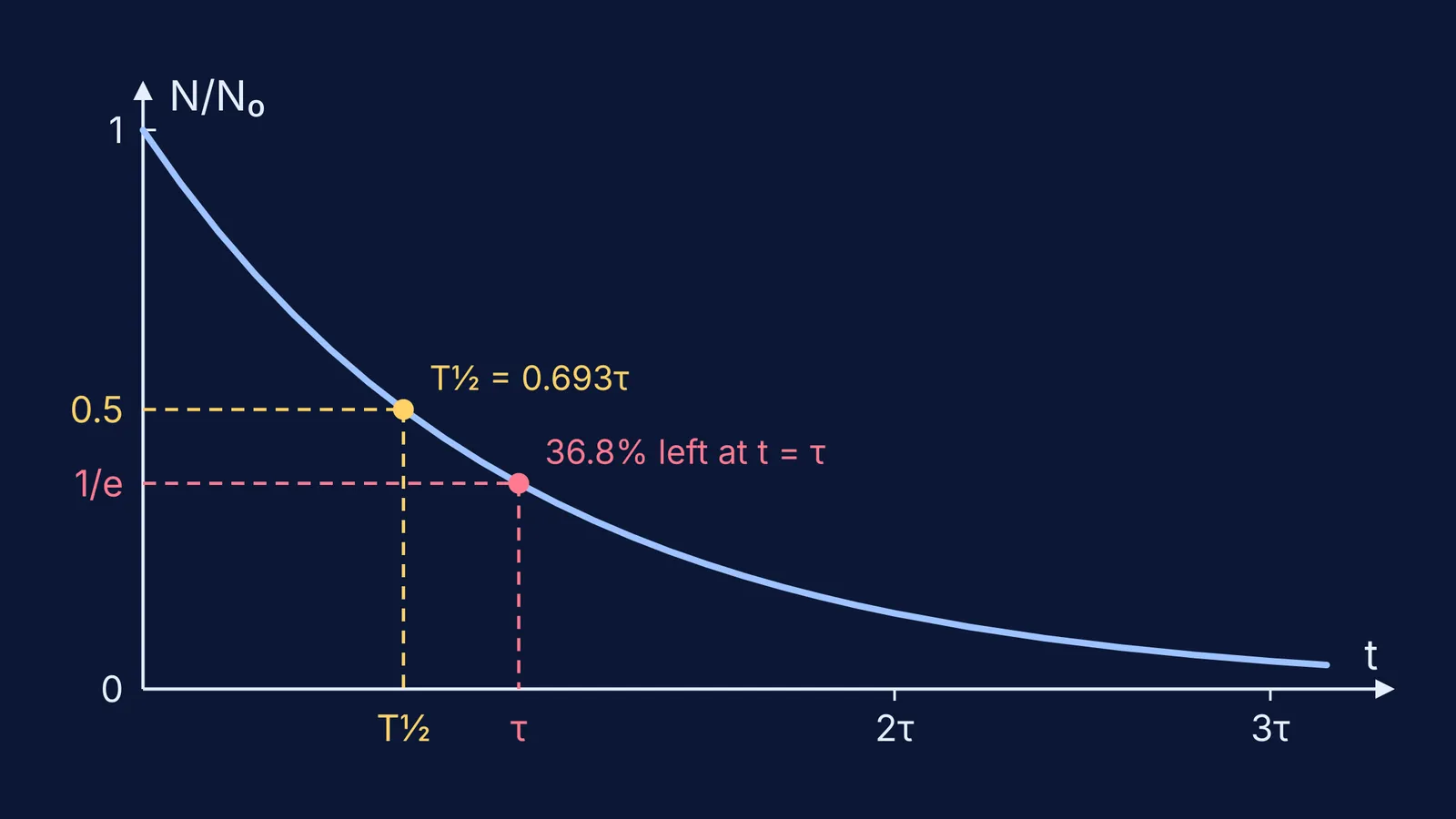
Half-life (T½) is the time in which half of the nuclei present decay.
Mean life (τ) is the average time a single nucleus survives before it decays.
Mean life is the reciprocal of the decay constant, τ = 1/λ (Wikipedia: Exponential decay).
Half-life is T½ = ln 2/λ, which makes it 0.693 times the mean life (HyperPhysics, Georgia State University).
Turn that around and you get τ = T½/0.693, so the mean life is about 1.44 times the half-life (Wikipedia: Exponential decay).
Why is mean life longer than half-life?
Half-life is really the median lifetime (Wikipedia: Exponential decay). Set e^(−λt) = 1/2 and you get t = ln 2/λ: half the nuclei have decayed before this moment and half survive past it.
Mean life is the average lifetime, and averages are pulled by the long tail. There is no upper limit on how long a nucleus can last. A few survive 3τ, 5τ or longer, and those long lives drag the average up while the median stays put, just as a few very high salaries lift a company's average pay above its median. Done properly, the average comes from an integral, τ = ∫λt·e^(−λt)dt from 0 to ∞, which works out to 1/λ (Wikipedia: Exponential decay).
What fraction is left after one mean life?
Put t = τ into the decay law: N = N₀e^(−1). After one mean life, the population falls to 1/e ≈ 0.368 of its starting value (Wikipedia: Exponential decay).
So about 36.8% of the nuclei remain and 63.2% have decayed. After 2τ, e^(−2) ≈ 13.5% remain. After 3τ, about 5.0% remain. Less than half is left after one mean life, which fits with τ coming after T½ on the curve.
Which numericals mix up τ and T½, and how do you fix them?
A real number to anchor you: HyperPhysics gives the free neutron a half-life of 10.3 minutes and an average lifetime of 14.9 minutes (HyperPhysics). Check it yourself: 10.3/0.693 ≈ 14.9 minutes. The mean life comes out longer, as it should.
Now a worked example with clean numbers. A sample has λ = 0.1 per hour.
Mean life: τ = 1/λ = 10 hours.
Half-life: T½ = 0.693 × 10 = 6.93 hours.
Left after 6.93 hours: 50%.
Left after 10 hours: e^(−1), about 36.8% (Wikipedia: Exponential decay).
Decayed between T½ and τ: 50% − 36.8% = 13.2% of the original sample.
Five common mix-ups, each with its fix:
τ = 0.693 × T½. This makes τ shorter than T½, which cannot happen. Fix: τ = T½/0.693.
λ = 0.693/τ. Fix: λ = 1/τ = 0.693/T½.
“Half is left after one mean life.” Fix: 36.8% is left and 63.2% has decayed.
Mixed bases, such as N₀(1/2)^(t/τ) or N₀e^(−t/T½). Fix: e goes with τ, and 1/2 goes with T½. N = N₀e^(−t/τ) = N₀(1/2)^(t/T½).
Remaining given when the question asks for decayed. Fix: decayed = 1 − remaining. Underline which one is asked.
If you keep reaching for the wrong formula, the Fermi Problem Library has worked problems with a step-by-step solver that explains the reasoning rather than printing an answer, so you can see where τ and T½ split apart.
How do you check a decay answer in 30 seconds?
Is τ about 1.44 times T½ (Wikipedia: Exponential decay)?
Is λ in units of 1/time, and does λτ = 1?
Did you pair e with τ and 1/2 with T½?
Did you answer “remaining” or “decayed”, whichever was asked?
The same maths turns up in chemistry. The JEE (Advanced) 2026 syllabus lists “Rate law, rate constant, half-life” under Chemical Kinetics, and for a first-order reaction t½ = 0.693/k plays the role of T½ = 0.693/λ. The Fermi Concept Library gives each concept its own lesson and shows its place in the map, so you can study the two topics side by side.
To go further, read why a radioactive sample is not fully decayed after two half-lives and how the decay constants add up in the effective half-life of a nucleus with two decay modes. To see the randomness behind the smooth curve, try predicting what happens in this radioactive decay simulation.


