

On this page
When you first encounter radioactive decay in physics or chemistry, the term "half-life" can be misleading. It sounds like a measure of time where half the sample disappears in the first period, and the other half disappears in the second.
If you bake a cake and eat half on Monday and the other half on Tuesday, the cake is gone. But radioactive decay is not linear; it is exponential. The rate at which atoms decay depends strictly on how many unstable atoms are left right now.
Why is a sample not fully decayed after two half-lives?
The half-life of a radioactive nuclide is the time required for half of the atoms in a sample to decay (OpenStax).
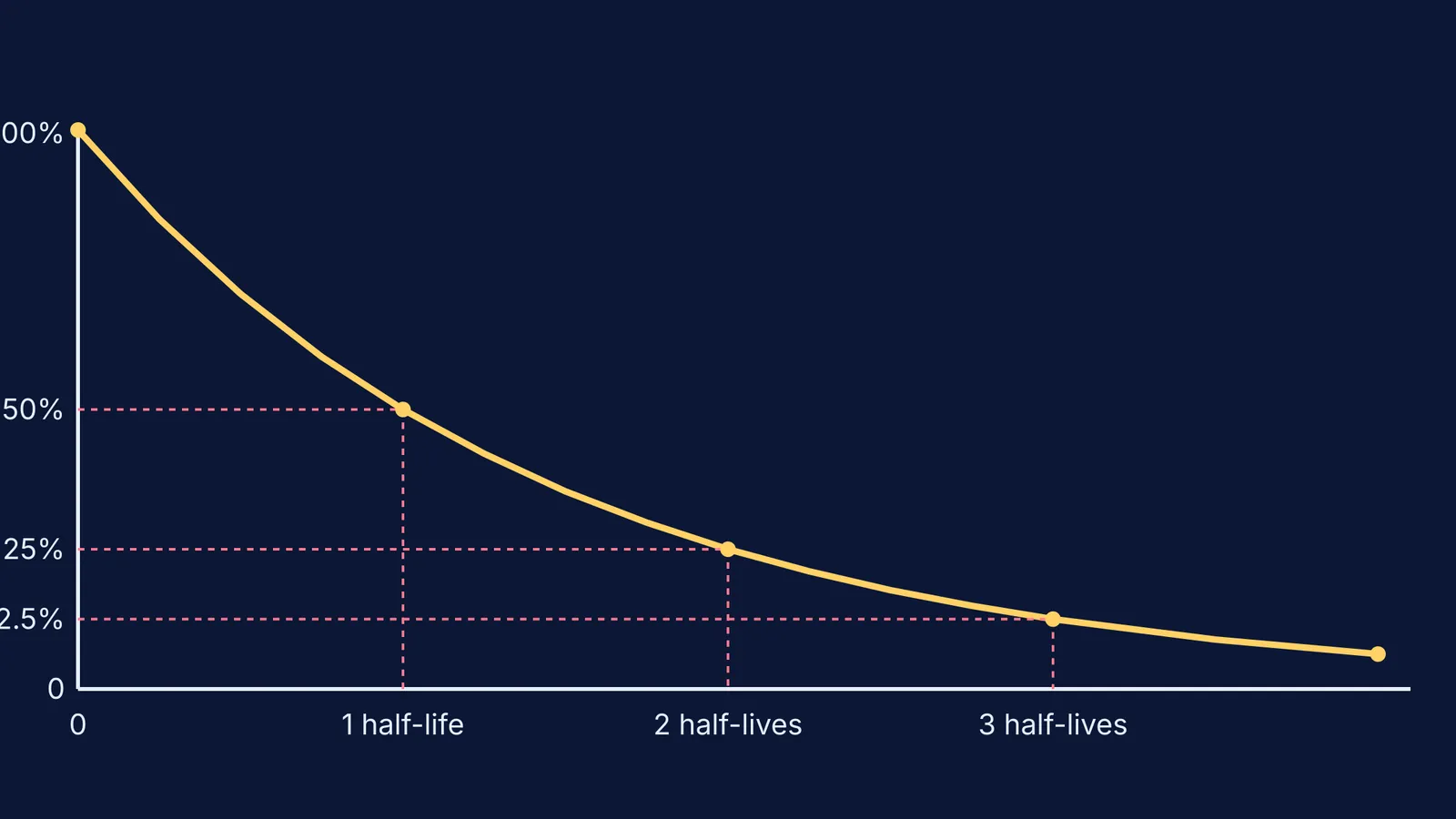
Let's trace what actually happens if you start with a sample of 1,000,000 unstable atoms.
After one half-life: Exactly half of the initial 1,000,000 atoms decay. You have 500,000 unstable atoms left.
After two half-lives: The halving rule applies again, but only to the *remaining* atoms. Half of 500,000 decay. You are left with 250,000 unstable atoms, which is exactly one-quarter (25%) of your starting amount.
After three half-lives: Half of the 250,000 decay, leaving 125,000 atoms, or 12.5% of the original sample.
Each half-life halves what is left. Because you are always taking a fraction of a continuously shrinking number, the decay curve flattens out but theoretically never hits absolute zero.
How does carbon-14 dating work?
This reliable halving process is what makes radiometric dating possible. Carbon-14 is a common radioactive isotope that decays by beta emission into nitrogen-14 with a half-life of 5,730 years (OpenStax).
While living, a plant or animal takes in carbon from the environment, maintaining a steady ratio of radioactive carbon-14 to stable carbon-12. When the organism dies and becomes wood or bone, it stops taking in new carbon. The carbon-14 trapped inside slowly ticks down.
If archaeologists find a wooden artefact that has only 25% of the normal atmospheric carbon-14 ratio, they know the wood has sat through exactly two half-lives. Two times 5,730 years means the tree died 11,460 years ago. This dating method is accurate for objects up to about 30,000 years old, with a maximum limit of approximately 50,000 years, after which the remaining carbon-14 is too sparse to measure reliably (OpenStax).
Why does decay slow down over time?
Radioactive decay is a probabilistic process that happens at the level of individual atoms. An unstable nucleus has a fixed probability of decaying within a given second. It has no memory of how long it has been waiting, and it does not coordinate with its neighbours.
Because each atom acts independently, a large group of atoms decays at a rate proportional to their total number. If you have a billion atoms, a lot of them will happen to decay in the next minute. If you only have a thousand atoms left, very few will decay in that same minute. As the sample shrinks, the overall decay process slows down, stretching the final disappearance of the substance over a long tail.
What is the decay constant?
While the half-life tells you the time needed for half the sample to vanish, you might also need the decay constant (λ) for your calculations. The mathematical relationship between the half-life and the decay constant is an inverse one: the half-life equals the natural logarithm of 2 divided by the decay constant (OpenStax).
Since the natural logarithm of 2 is approximately 0.693, you can quickly find the decay constant if you know the half-life, or vice versa. A shorter half-life means a larger decay constant, indicating a substance that is highly radioactive and decays rapidly. A longer half-life means a smaller decay constant, which is why ancient materials like carbon-14 take thousands of years to dwindle.
Getting it right in exams
In JEE and NEET, confusing linear and exponential decay is a classic trap. Examiners often set questions where the time passed is a neat multiple of the half-life. The formula linking the remaining amount Nt to the initial amount N0 and the number of half-lives n is:
Nt = N0 × (1/2)ⁿ
If you are stuck trying to remember whether an equation needs a natural logarithm or a power of e, fall back on this simple halving rule. If you want to review the underlying mathematics, the Fermi Concept Library has every concept in physics, chemistry, biology, mathematics and computing, each with its own lesson and its place in the map.
For further practice on nuclear physics problems, you can read our guides on counting alpha and beta decays in a radioactive decay series or calculating the recoil of the daughter nucleus in alpha decay: sharing the energy.


