On this page
Suppose a question gives you a sample's activity in millicuries and asks how many nuclei are left. It is testing one idea: activity counts decays per second, and it is tied to how many undecayed nuclei you still have. Get that link right and the units, the conversions and the half-life steps all follow.
What is the activity of a radioactive sample?
Activity is the frequency of radioactive decay, the number of disintegrations per unit time produced by a given amount of radioactive material (US EPA, radiation terms and units).
In symbols, A = −dN/dt = λN, where N is the number of undecayed nuclei and λ is the decay constant (OpenStax University Physics, Radioactive Decay/University_Physics_III_-_Optics_and_Modern_Physics_(OpenStax)/10:__Nuclear_Physics/10.04:_Radioactive_Decay)).
Read it like this: every nucleus of a given kind has the same small chance of decaying in each second, and λ is that chance per second. Double the number of nuclei and you double the decays per second. Since λ is measured in s⁻¹, λN comes out in decays per second.
What are the becquerel and the curie?
One becquerel (Bq) is equal to one radioactive decay per second (US EPA).
One curie (Ci) is 3.7 × 10¹⁰ Bq, approximately the number of decays per second in one gram of radium (US EPA; the US NRC glossary gives the same conversion).
The becquerel is the SI unit; the curie is the older unit you still meet in textbooks and past papers. One becquerel is tiny, so real samples are quoted in kBq, MBq or GBq. One curie is huge, so you usually see mCi and µCi. Two conversions worth memorising: 1 mCi = 3.7 × 10⁷ Bq = 37 MBq, and 1 µCi = 3.7 × 10⁴ Bq = 37 kBq.
Where does 3.7 × 10¹⁰ come from?
The curie was originally defined as the activity of 1 g of radium-226 (OpenStax University Physics/University_Physics_III_-_Optics_and_Modern_Physics_(OpenStax)/10:__Nuclear_Physics/10.04:_Radioactive_Decay)). You can check that number yourself with A = λN. Radium-226 has a half-life of 1,600 years (US EPA, radium basics), and the Avogadro constant is exactly 6.022 140 76 × 10²³ per mole (NIST).
Half-life in seconds: 1,600 × 365.25 × 86,400 ≈ 5.05 × 10¹⁰ s.
Decay constant: λ = 0.693 / T½ ≈ 1.37 × 10⁻¹¹ s⁻¹.
Nuclei in 1 g, taking the molar mass as about 226 g per mole: N ≈ (1/226) × 6.022 × 10²³ ≈ 2.66 × 10²¹.
Activity: A = λN ≈ 3.66 × 10¹⁰ Bq, which is about 0.99 Ci.
So the strange-looking 3.7 × 10¹⁰ is simply the activity of a gram of radium, rounded.
Why does activity fall with the same half-life as N?
For a given nuclide λ is a constant, so A = λN means activity is just N multiplied by a fixed number. When N halves, A halves. Formally, N = N₀e^(−λt) gives A = A₀e^(−λt), with the same λ and therefore the same half-life, T½ = 0.693/λ (OpenStax University Physics/University_Physics_III_-_Optics_and_Modern_Physics_(OpenStax)/10:__Nuclear_Physics/10.04:_Radioactive_Decay)).
This is why you can apply the half-life rule straight to a reading in becquerels without first working out N. Two related traps are worth a look: why a sample is not fully decayed after two half-lives, and how mean life differs from half-life. And since λ is fixed, half-life does not change with heat or pressure, so neither does the shape of the activity curve.
If the links between λ, T½ and mean life still feel shaky, the Fermi Concept Library gives each concept in physics and chemistry its own lesson and shows its place in the map.
How do you solve an activity question step by step?
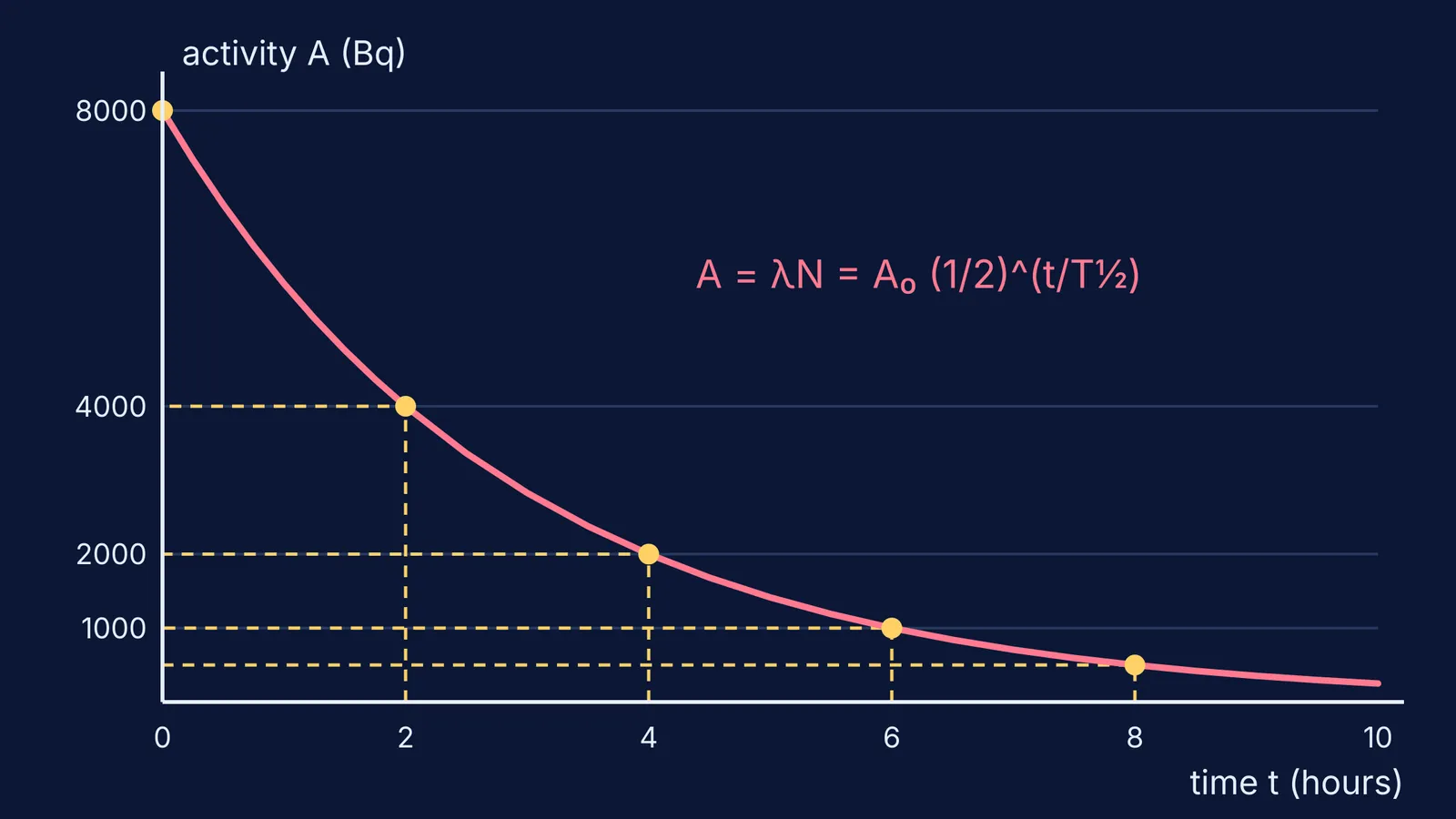
Here is a practice question with made-up numbers, worked with A = A₀e^(−λt) and λ = 0.693/T½ from the OpenStax chapter/University_Physics_III_-_Optics_and_Modern_Physics_(OpenStax)/10:__Nuclear_Physics/10.04:_Radioactive_Decay). A sample has a half-life of 2 hours and an activity of 8000 Bq now.
Activity after 6 hours: 6 hours is three half-lives, so A = 8000 / 2³ = 1000 Bq.
In curies: 1000 / (3.7 × 10¹⁰) ≈ 2.7 × 10⁻⁸ Ci, or about 0.027 µCi.
Nuclei left at 6 hours: λ = 0.693 / 7200 s ≈ 9.63 × 10⁻⁵ s⁻¹, so N = A/λ ≈ 1.04 × 10⁷.
Before you move on, run this checklist:
Is T½ in seconds? With A in becquerels, λ must be in s⁻¹.
Did you change curies into becquerels first, multiplying by 3.7 × 10¹⁰?
From a mass, did you go mass → moles → nuclei using the Avogadro constant?
If t is a whole number of half-lives, count halvings; otherwise use e^(−λt).
Did A and N shrink by the same factor? If not, something is off.
If you keep picking the right method but landing on the wrong power of ten, the Fermi Problem Library has worked problems with a step-by-step solver that explains the reasoning rather than printing an answer.
Next time you see a curie in a question, convert it, write A = λN, and let the half-life do the rest.