

On this page
If you are preparing for competitive exams like JEE Main or NEET, you will eventually encounter a trick question that looks somewhat like this: "A radioactive sample with a half-life of 10 days is heated to a temperature of 1000 °C. What is its new half-life after heating?"
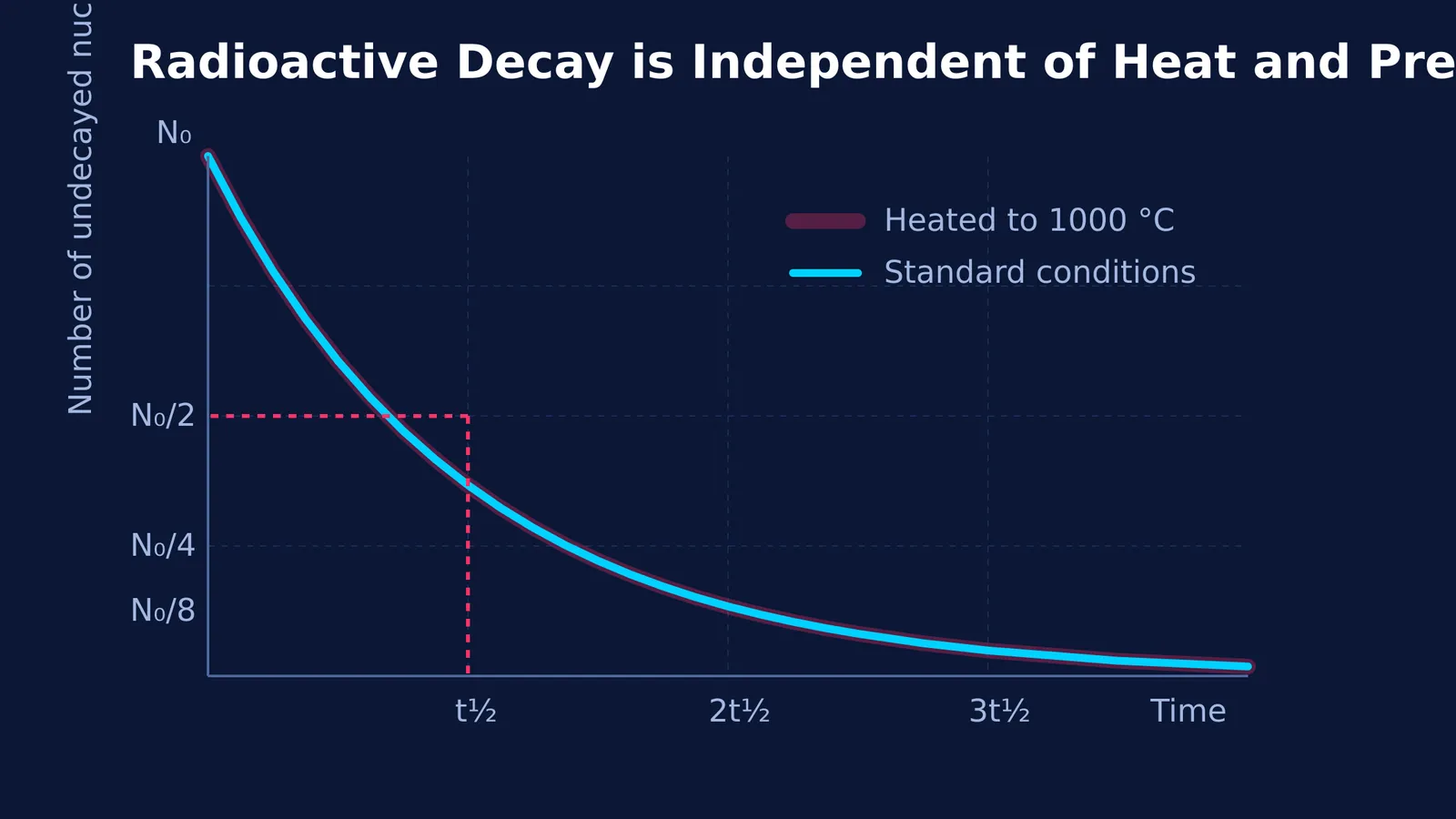
The correct answer is always exactly 10 days. The rate at which an unstable isotope decays is a fixed, intrinsic property of its atomic nucleus. Whether you boil the sample, freeze it to absolute zero, compress it under tonnes of rock, or react it to form a new chemical compound, its half-life remains exactly the same.
Here is a detailed look at why this fundamental rule of physics holds true, along with the one tiny exception that physicists found by squeezing atoms inside a diamond anvil cell.
Why does temperature not affect radioactive decay?
Radioactive decay is a purely nuclear process. It happens because a specific internal arrangement of protons and neutrons is inherently unstable. The forces that hold these subatomic particles together inside the nucleus—specifically the strong and weak nuclear forces—operate on enormous energy scales, typically measured in mega-electronvolts (MeV).
By contrast, the ordinary physical and chemical changes we experience every day involve interactions within the atom's outer electron cloud. When you heat a material, its atoms vibrate faster. When atoms form chemical bonds to create molecules, they share or swap their outermost electrons. All of these macroscopic processes involve tiny energies of just a few electronvolts (eV).
Because the nucleus is extremely compact—about 10,000 to 100,000 times smaller than the overall atom—and sits heavily shielded at the centre, ordinary thermal and chemical energies cannot penetrate it. According to the NCERT Physics curriculum, the radioactive decay constant λ is completely independent of external physical conditions.
Can pressure change half-life?
There is exactly one rare decay mechanism that can be slightly altered by applied pressure: electron capture.
Some specific isotopes, rather than spitting out a heavy alpha particle or a fast-moving beta particle, decay by "swallowing" one of their own inner-shell electrons. Because this specific type of decay directly depends on the probability of an electron being physically close to the nucleus, changing the shape and density of the electron cloud changes the half-life.
Beryllium-7 (⁷Be) is the classic textbook example of this phenomenon. Under standard conditions, it has a half-life of about 53 days. If you squeeze it hard enough, the entire electron cloud compresses inward, increasing the chance that the nucleus will successfully capture an electron. A 1973 study in Science found that when Beryllium-7 is compressed to a massive 27 GPa (about 270,000 times standard atmospheric pressure), its half-life drops by about 0.6%.
Similarly, the chemical compound the beryllium is trapped within can pull its electrons away or push them closer. A 2004 study in Physical Review Letters found that when Beryllium-7 is trapped inside a carbon buckyball, its half-life shifts by 0.83% compared to metallic beryllium. However, for heavy elements that decay by firing out particles—which is what you are calculating when counting alpha and beta decays in a radioactive decay series or finding the recoil of the daughter nucleus in alpha decay—these environmental effects are virtually zero.
How do they test this in exams?
Exam setters love to test your conceptual clarity by throwing distracting numbers into a physics problem. If a question gives you an initial temperature, pressure, or chemical state, you should first check if the question is asking about radioactivity. If it is, ignore the environmental variables entirely. The mathematical decay curve N(t) = N₀e⁻λt remains exactly the same curve whether the radioactive sample is stored in a freezer or placed in a high-temperature furnace.
When you use the Fermi Concept Library to review modern physics, the tutor explicitly checks your understanding of these specific energy scales. It ensures you know why the dense nucleus completely ignores the surrounding electron cloud, rather than just asking you to memorise a rigid rule. If you ever get stuck on a tricky numerical that tries to confuse you with changing temperatures or pressures, the Fermi Problem Library will carefully walk you through the reasoning step by step, pointing out the distractors before you fall for them.


