On this page
Most students meet e as a calculator button. It first turned up when a Swiss mathematician studied compound interest.
Jacob Bernoulli was born in Basel on 6 January 1655, became professor of mathematics there in 1687 and held the post until he died in 1705, according to his MacTutor biography. He is also known for probability: his book Ars Conjectandi, published in 1713, eight years after his death, contains the law of large numbers, which we cover in Jacob Bernoulli and the law of large numbers.
What question did Jacob Bernoulli ask about compound interest?
In 1683 Bernoulli studied compound interest and tried to find the limit of (1 + 1/n)ⁿ as n tends to infinity, according to the MacTutor history of e at the University of St Andrews.
Here is the idea in rupees. Put ₹1 in an account that pays 100% interest a year.
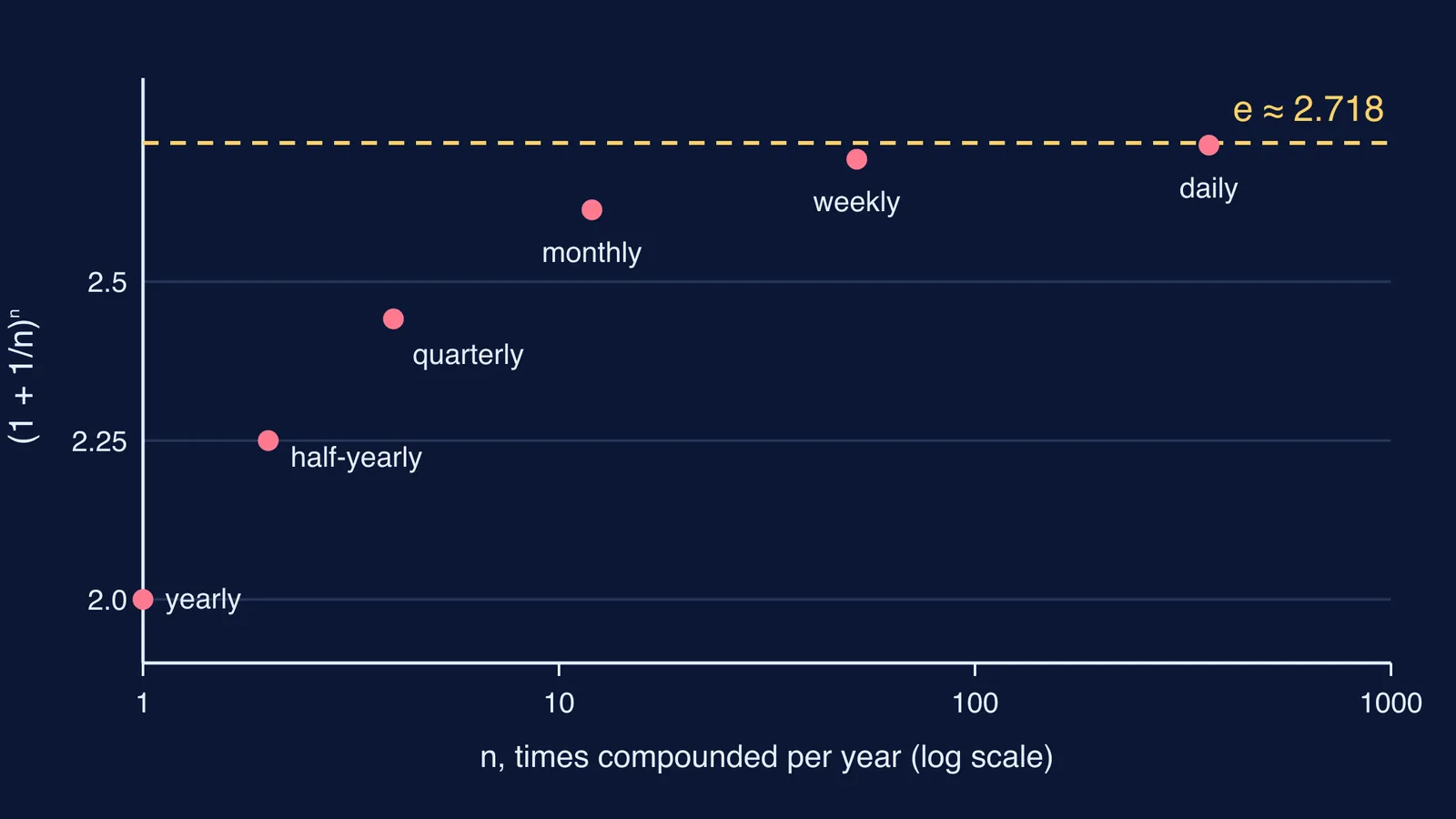
Credited once a year, you end with ₹2.
Credited twice a year at 50% each time, you get 1.5 × 1.5 = ₹2.25.
Credited quarterly at 25% each time, you get 1.25⁴ = about ₹2.441.
Monthly gives about ₹2.613, weekly about ₹2.693 and daily about ₹2.7146.
These values match the worked example in the Wikipedia article on e), which uses $1 instead of ₹1. If the year is split into n equal parts, the amount is (1 + 1/n)ⁿ.
You might guess that compounding more often means endless growth. It doesn't: each jump is smaller than the last, and the total crawls towards a ceiling.
How did Bernoulli know the limit was between 2 and 3?
Bernoulli used the binomial theorem to show that the limit had to lie between 2 and 3, which MacTutor calls the first approximation found to e (MacTutor).
MacTutor does not reproduce his working, but you can follow a binomial-theorem argument of this kind with Class 11 algebra. Expand (1 + 1/n)ⁿ with the binomial theorem:
The first two terms are 1 + n × (1/n) = 2, so the total is always at least 2.
The next term is n(n − 1)/2! × 1/n², which is a little less than 1/2!. Every later term is likewise a little less than 1/3!, 1/4! and so on.
So (1 + 1/n)ⁿ is less than 1 + 1 + 1/2! + 1/3! + 1/4! + …
Since k! is at least 2 to the power k − 1, each 1/k! is no bigger than 1/2, 1/4, 1/8, … and those add up to 1. So the whole sum is less than 1 + 1 + 1 = 3.
That is the heart of why the limit sits between 2 and 3 (a full proof also shows the values keep rising, so the limit exists). Step 3 also hints at the series e = 1 + 1 + 1/2! + 1/3! + …, which is how e is usually calculated.
Why is it called e and not b?
Bernoulli did not name the number. In 1690 Leibniz used the letter b for it in a letter to Huygens, and the letter e first appeared in a letter Euler wrote to Goldbach in 1731, according to the MacTutor history of e. Euler gave the full treatment in his 1748 book Introductio in Analysin infinitorum. MacTutor calls the claim that Euler chose e after his own name "ridiculous". More on what Euler gave us is in Leonhard Euler: the notation and ideas you use every day.
The decimal expansion of e begins 2.7182818284590452353, as listed in the OEIS entry A001113.
What does Bernoulli's limit mean for real interest rates?
Real accounts do not pay 100%, but the same ceiling applies. At an annual rate r compounded n times a year, ₹P grows to P(1 + r/n)ⁿ in a year, and as n grows this approaches Peʳ, the continuous-compounding result given in the Wikipedia article on e). Here is our own calculation from that formula for ₹1,00,000 at 8% a year:
Yearly: ₹1,08,000
Quarterly: 1.02⁴ gives about ₹1,08,243
Monthly: about ₹1,08,300
Continuous (the limit, e⁰·⁰⁸): about ₹1,08,329
Going from yearly to quarterly adds about ₹243. Going from monthly to the limit adds less than ₹30. That is Bernoulli's ceiling at work. For exam-style practice with these formulas, see compound interest compounded half yearly and quarterly.
If limits still feel slippery, the Fermi Concept Library gives each concept in mathematics its own lesson, so you can revisit limits and the binomial theorem. For ideas that are easier to see than to read, the Fermi Simulation Lab has interactive simulations.
Try it with a pencil tonight: work out (1 + 1/n)ⁿ for n = 1, 2, 3 and 4 by hand, and watch the jumps shrink.