

On this page
NCERT's Class 8 chapter Comparing Quantities builds compound interest year by year and arrives at A = P(1 + R/100)^n, where P is the principal, R the rate per cent per annum and n the number of years (NCERT Class 8 Mathematics, Comparing Quantities). Compounding half yearly or quarterly changes only two inputs: the rate for each period and the number of periods. To see where the formula comes from, read how the compound interest formula grows out of year-by-year steps.
How do you calculate compound interest compounded half yearly?
Compounded half yearly means interest is added to the principal every six months. You use the same NCERT compound interest formula with two changes.
Rate per period: halve the yearly rate. 10% per annum becomes 5% per half-year.
Number of periods: double the years. 1½ years becomes 3 half-years.
Put both into the formula: A = P(1 + R/200)^(2n).
Subtract to get the interest: CI = A − P.
Worked example. Find the compound interest on ₹10,000 for 1½ years at 10% per annum, compounded half yearly. The rate per period is 5% and there are 3 periods, so A = 10,000 × (1.05)^3 = 10,000 × 1.157625 = ₹11,576.25. The compound interest is ₹11,576.25 − ₹10,000 = ₹1,576.25.
What changes when interest is compounded quarterly?
The Reserve Bank of India's Interest Rate on Deposits Directions, 2025 say that interest on savings deposits "shall be credited by commercial banks at quarterly or shorter intervals" (RBI Master Direction on Interest Rate on Deposits).
A quarter is three months, so a year has four periods. Divide the yearly rate by 4 and multiply the years by 4: A = P(1 + R/400)^(4n). At 8% per annum, that is 2% per quarter; over 2 years, it is 8 quarters.
Annual vs half-yearly vs quarterly: how big is the difference?
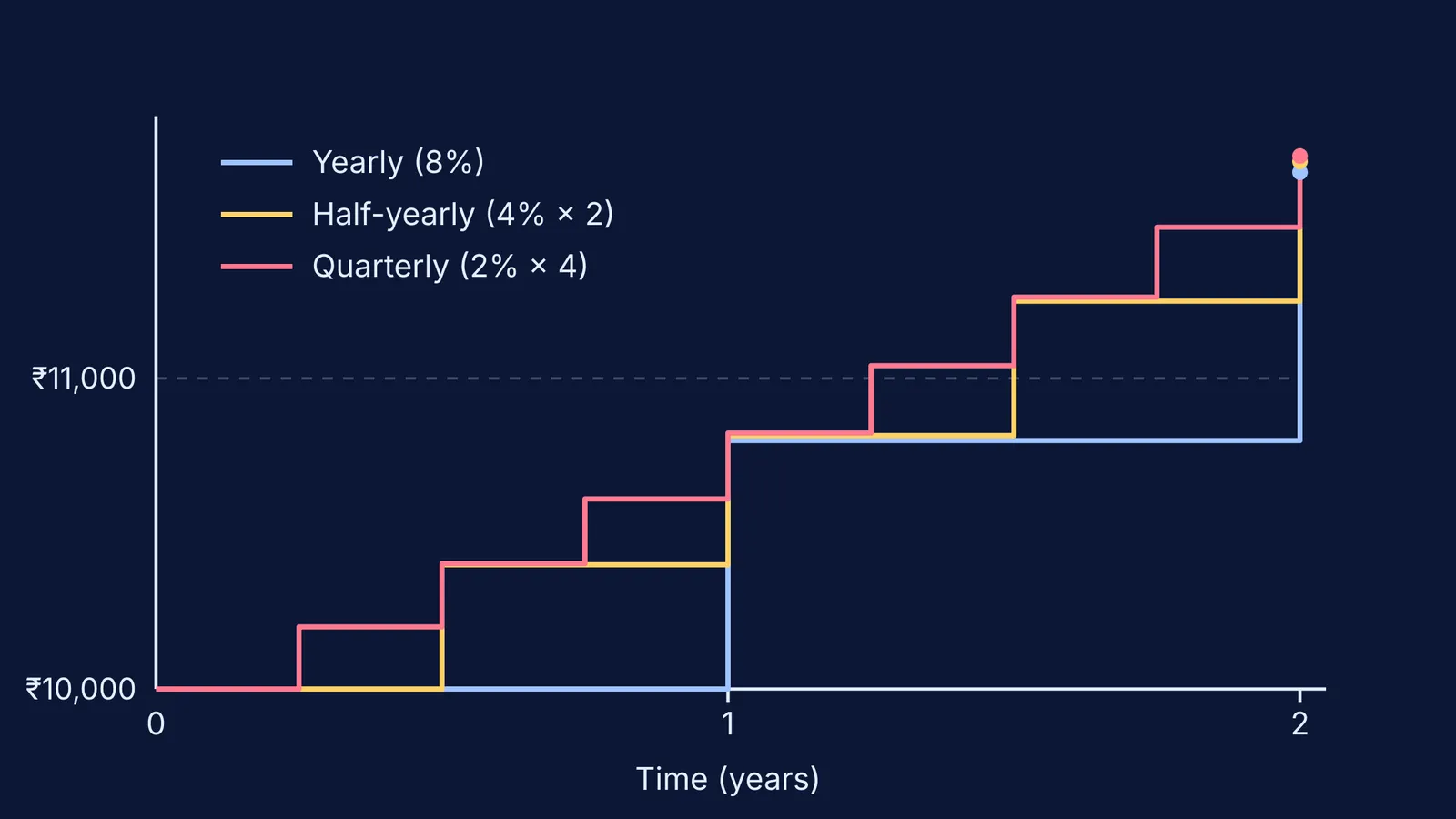
Take ₹10,000 at 8% per annum and run the same NCERT formula (Comparing Quantities) with three settings. These are our calculations, rounded to the paisa.
Yearly, 1 year: 10,000 × 1.08 = ₹10,800.00
Half-yearly, 1 year: 10,000 × (1.04)^2 = ₹10,816.00
Quarterly, 1 year: 10,000 × (1.02)^4 = ₹10,824.32
Yearly, 2 years: 10,000 × (1.08)^2 = ₹11,664.00
Half-yearly, 2 years: 10,000 × (1.04)^4 = ₹11,698.59
Quarterly, 2 years: 10,000 × (1.02)^8 = ₹11,716.59
More frequent compounding always gives a little more, because interest added partway through the year starts earning interest of its own. The gain is small: over one year, quarterly beats yearly by ₹24.32 on ₹10,000. Put another way, 8% compounded half yearly works like 8.16% compounded yearly, and 8% compounded quarterly works like about 8.24%.
Why does halving the rate and doubling the time work?
In the yearly formula, each year multiplies the amount by (1 + R/100). With half-yearly compounding, the bank adds only half a year's interest at a time, which is R/2 per cent, so each six months multiplies the amount by (1 + R/200). That happens twice a year, so n years give 2n multiplications. Quarterly works the same way, with R/4 per cent per step and 4n steps.
The usual slip is changing one input and forgetting the other.
Halving the rate but keeping n: you get the answer for half the time.
Doubling n but keeping the full rate: you add a whole year's interest every six months.
Treating the extra half-year as simple interest when the question says compounded half yearly. For the worked example, 10,000 × 1.10 × 1.05 = ₹11,550, which is ₹26.25 short of the correct ₹11,576.25.
Writing the amount when the question asks for the interest. Here is the difference between amount and interest if the two still blur.
The same multiply-per-period idea also runs population growth and depreciation problems.
A three-line routine for any compounding question
Write the periods per year next to the question: 1 for yearly, 2 for half yearly, 4 for quarterly.
Rate per period = yearly rate ÷ periods per year. Number of periods = years × periods per year.
A = P(1 + rate per period/100)^(number of periods), then CI = A − P.
If your answer keeps differing from the key, the Fermi Problem Library has worked problems with a step-by-step solver that explains the reasoning rather than printing an answer, so you can find the exact step where the period count slipped. For the exponent rules underneath, the Fermi Concept Library gives each mathematics concept its own lesson.
Pick three questions from your exercise, solve each yearly, half yearly and quarterly, and check that the answers rise in that order.


