

On this page
When you deposit money in a bank, take out a loan, or solve a mathematics problem on an exam, you start with an initial sum of money. One of the most common mistakes in examinations is calculating one value when the question specifically asks for another.
Understanding the clear mathematical difference between the amount and the interest is the essential first step to avoiding these easily preventable traps.
What is the difference between amount and interest?
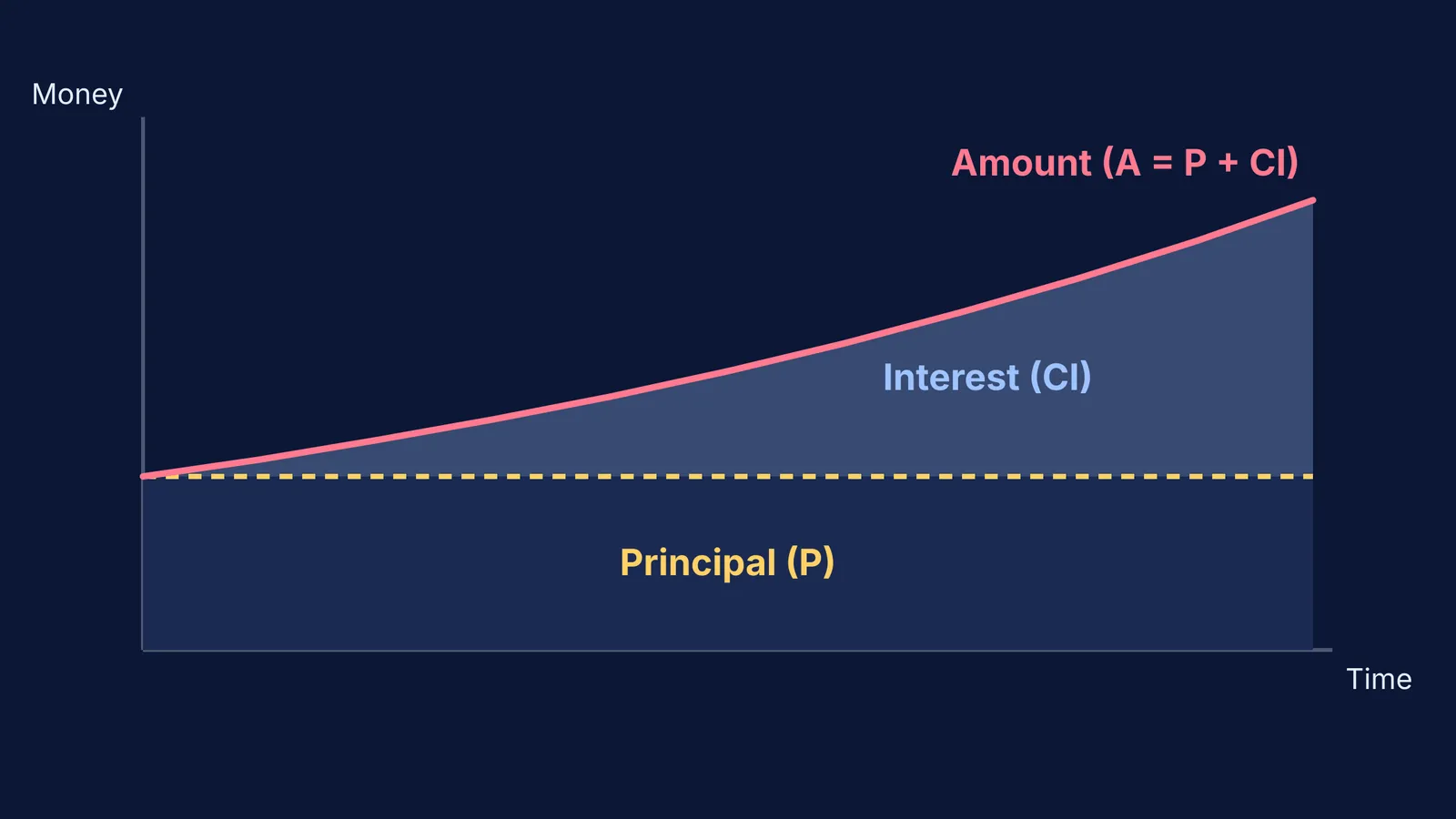
In compound interest calculations, the money you start with is called the principal (P). Over time, this money grows because a specific interest rate is applied to it at regular intervals.
The amount (A) is the final total at the very end of the time period. It includes your original principal sum and all the extra money that was added on top of it. When a bank tells you your final balance, they are giving you the amount.
The interest (I or CI) is only the profit or the extra money that was added during that time. It does not include the money you originally started with.
As a simple word equation, the relationship is:
Amount = Principal + Interest
Interest = Amount − Principal
What is the compound interest formula?
According to standard mathematical definitions detailed on Wikipedia, the formula for the total amount in periodic compounding is:
A = P(1 + r/n)^(nt)
Where:
A is the final amount.
P is the original principal sum.
r is the annual interest rate (written as a decimal).
n is the compounding frequency (how many times interest is added per year).
t is the time in years.
Notice that this main formula directly gives you the amount. It does not directly give you the interest. To find the interest, you must calculate the amount first and then subtract the original principal.
How do you calculate amount and interest?
Let's see the practical difference in a real calculation using the formula from Wikipedia. Suppose you invest ₹10,000 at a 5% interest rate compounded annually for 2 years.
Identify the variables: P is 10,000, r is 0.05, n is 1, and t is 2.
Calculate the amount: A = 10,000 × (1 + 0.05 / 1)²
A = 10,000 × (1.05)² = 10,000 × 1.1025 = 11,025.
The total amount in the account is ₹11,025. This is the final balance you would withdraw.
Calculate the interest: I = 11,025 − 10,000 = 1,025.
The compound interest earned is ₹1,025. This is the pure profit.
If an exam question asks "What is the compound interest?", the correct answer is ₹1,025. If you write down ₹11,025 instead, you will lose the marks for answering the wrong question.
How can you check your exam answers?
Multiple-choice questions often try to trick you with the options they provide. They might ask for the compound interest, but the very first option (Option A) will list the total amount instead, hoping you will select it as soon as your calculator shows that number.
If a question asks for the amount, your final answer must logically be larger than the principal. If the question asks for the interest, your answer is usually much smaller than the principal (unless the money is invested for a very long time).
Just like you can learn how to use dimensions to check your physics answers, you can do a quick logical size check here. According to the formula logic from Wikipedia, if the principal is ₹10,000 and the options provided are ₹1,025 and ₹11,025, you immediately know which number represents the interest and which number represents the amount. This logic holds true whether you are dealing with large financial investments or calculating a simple ratio with different units.
Where can you practice step by step?
If you find yourself repeatedly calculating the wrong value and losing marks on tests, you need to fix your initial setup process.
The Fermi Problem Library has worked problems with a step-by-step solver that explains the reasoning rather than printing an answer. When you get stuck on a difficult question, the AI tutor checks whether you are looking for the amount or the interest and helps you set up the right equation before you do the math. This step-by-step approach ensures you build the right habits and catch these errors before you sit down for the real exam.


