

On this page
When comparing two amounts in maths, you write a ratio. But there is a catch: you cannot compare quantities if their units do not match. If you try to compare 50 to 2 directly, you get 25:1, which implies 50 paise is much larger than 2 rupees—a clear mistake.
Here is exactly how to convert units correctly, calculate the ratio of 50 paise to 2 rupees, and avoid the common trap of adding units to your answer.
How do you convert to the same unit before writing a ratio?
India transitioned to a decimal currency system in 1957, making one rupee equal to exactly 100 paise [[1]](https://en.wikipedia.org/wiki/Indian_rupee). This means whenever you see rupees and paise in the same problem, you must multiply the rupees by 100 to get paise. (If you are working with physical units like metres or kilograms instead of money, the idea is exactly the same as converting a quantity between unit systems using dimensions—the units must match before you can relate the numbers.)
For our money problem, follow these steps to set up the comparison:
Identify the first quantity: 50 paise.
Identify the second quantity: 2 rupees.
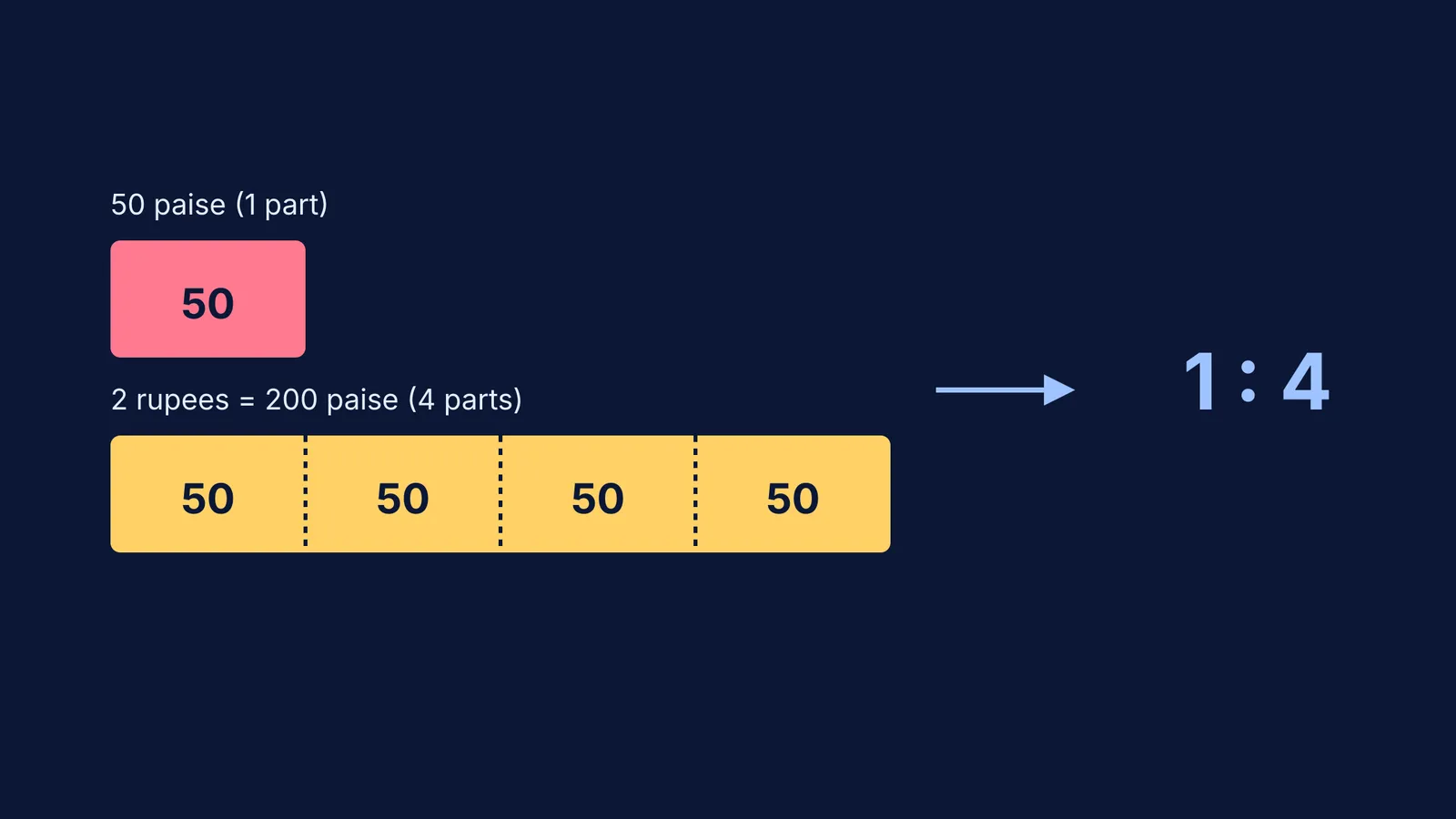
Multiply the 2 rupees by 100. You now have 200 paise.
By doing this, you ensure you have two quantities in the exact same unit—50 paise and 200 paise—and they are finally ready to be compared as a ratio.
What is the ratio of 50 paise to 2 rupees?
Once both numbers are in paise, write them as a fraction and simplify the numbers. The colon symbol (:) is standard, but treating it like a fraction makes the maths easier to follow.
Write the starting fraction: 50 / 200.
Divide both the numerator and the denominator by 10. This is the same as cancelling the trailing zeros, leaving you with 5 / 20.
Divide both top and bottom by 5, which is their greatest common divisor. This gives you 1 / 4.
So, 50 paise is exactly one-fourth of 2 rupees. The final ratio is written as 1:4.
Why does a ratio have no unit?
When you write the ratio 50 paise / 200 paise, you are comparing "paise" to "paise". In a fraction, matching units in the numerator and denominator cancel each other out, exactly as identical numbers do. According to the NCERT Class 6 Mathematics textbook, because a ratio compares quantities of the same kind by division, it is always a pure number [[2]](https://www.vedantu.com/ncert-solutions/ncert-solutions-class-6-maths-chapter-12).
Does the order of the numbers matter?
Yes, the order in which a ratio is asked is crucial. When a question asks for the ratio of 50 paise to 2 rupees, the 50 paise must be the numerator (the first number), and the 2 rupees must be the denominator. The resulting ratio is 1:4.
If the question had instead asked for the ratio of 2 rupees to 50 paise, the calculation would be reversed. You would divide 200 paise by 50 paise, and the answer would be 4:1. Reversing the order changes the entire meaning of the ratio. Writing 1:4 when the answer is 4:1 is a common mistake that will cost you marks in exams. Always map the first item in the sentence to the top of your fraction.
How do you apply the ratio rule to other measurements?
The rule of matching units applies to every ratio problem you will face in school. If the units differ, always convert the larger unit into the smaller one to avoid dealing with decimals. All of these standard conversions follow the same NCERT principles [[2]](https://www.vedantu.com/ncert-solutions/ncert-solutions-class-6-maths-chapter-12).
Weight: To find the ratio of 500 grams to 2 kilograms, remember that 1 kilogram is 1000 grams. Convert the 2 kilograms to 2000 grams. The ratio is 500:2000, which simplifies to 1:4.
Length: To compare 40 centimetres to 1.5 metres, convert the metres to centimetres. Since 1 metre is 100 centimetres, 1.5 metres becomes 150 centimetres. The ratio is 40:150, or 4:15.
Time: To find the ratio of 30 minutes to 2 hours, convert the hours to minutes. Since 1 hour is 60 minutes, 2 hours is 120 minutes. The ratio is 30:120, which simplifies to 1:4.
How does Fermi's AI tutor help with word problems?
Missing a unit conversion is a classic wrong-method mistake, whether you are comparing currency, working with weights, or solving quadratic word problems in Class 10: speed, age and area.
If you jump straight into dividing the numbers in an assignment without checking units, the Fermi Problem Library won't just print the final answer. Fermi's AI tutor notices where you went wrong, stops you, and asks you to check the units first. It teaches rather than answering—holding a line of reasoning across the session to make sure you grasp the lesson in the Concept Library before moving on to the final calculation.


