

On this page
You have just finished a long derivation and the answer looks tidy. Before you circle it, spend thirty seconds asking one question: does it come out in the right units? That habit is called dimensional analysis, and it needs no extra formulas.
What does it mean to check an answer with dimensions?
Every physical quantity can be written as a product of a few base quantities: mass [M], length [L], time [T] and, for circuits, current [I]. The International System of Units has seven base units, including the kilogram, metre, second and ampere. Every other unit is built from them: the SI Brochure from the BIPM lists the newton as kg m s⁻² and the joule as kg m² s⁻².
The rule that makes this useful is short. In a correct equation, every term you add or subtract has the same dimensions, and the argument of any sine, cosine, logarithm or exponential is dimensionless, as OpenStax University Physics explains/Book:_University_Physics_I_-_Mechanics_Sound_Oscillations_and_Waves_(OpenStax)/01:_Units_and_Measurement/05:_Dimensional_Analysis). If your expression for a time comes out in metres, it is wrong before you put in a single number.
Professionals get caught too. NASA lost the Mars Climate Orbiter, last heard from on 23 September 1999, because ground software used English units while the spacecraft's onboard software worked in metric, and the resulting trajectory errors sent it too close to Mars.
How do you check a mechanics answer with dimensions?
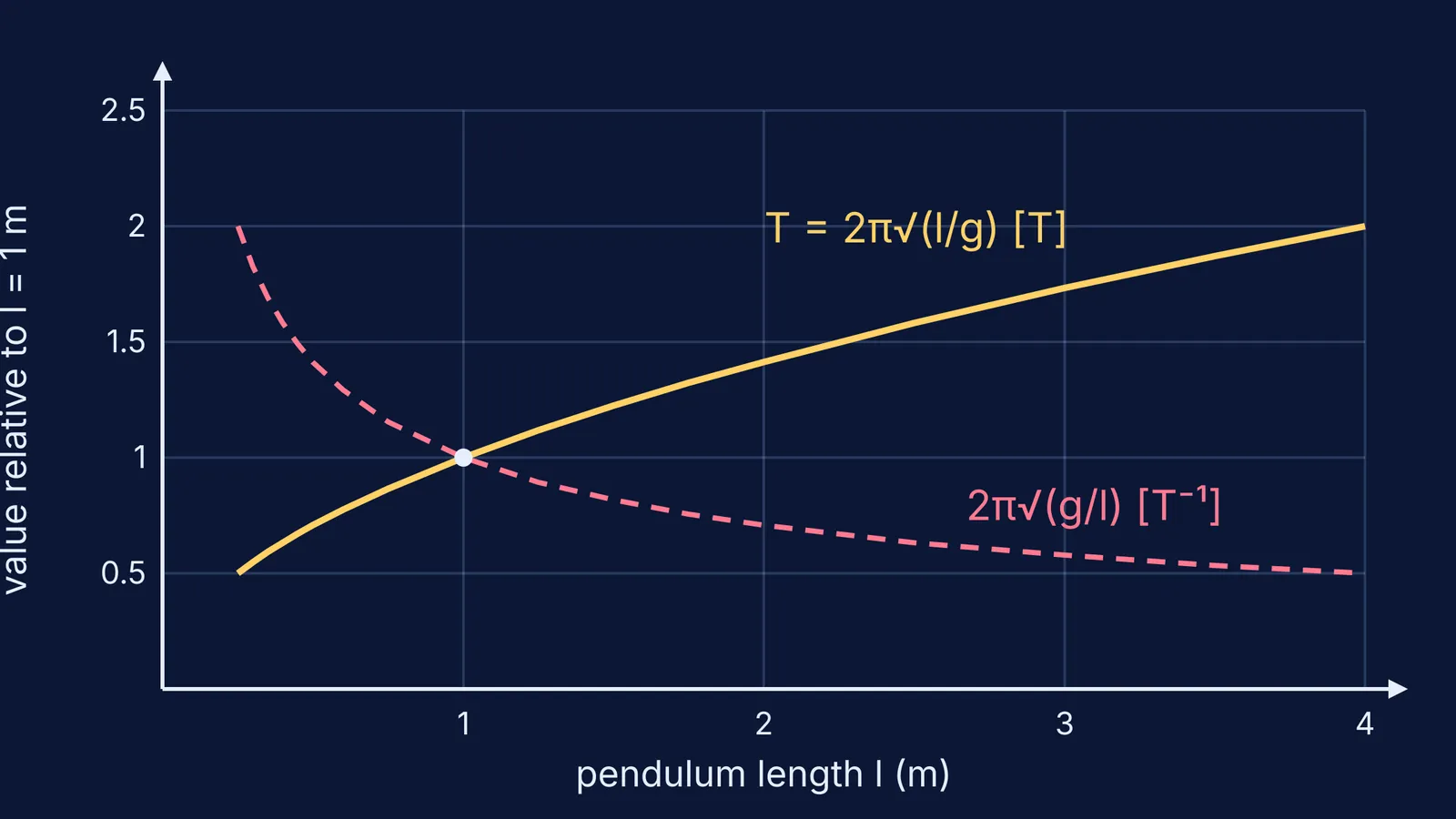
Take a simple pendulum. Suppose your working ends with T = 2π√(g/l) for the period.
Write each symbol's dimensions: g is [L T⁻²] and l is [L]. The 2π is a pure number, so drop it.
Simplify: g/l is [T⁻²], so √(g/l) is [T⁻¹].
Compare with what was asked: a period must be [T]. You got [T⁻¹], so the fraction is upside down.
The corrected T = 2π√(l/g) gives √[T²] = [T]. It also passes a common-sense test: a longer pendulum should swing more slowly, and now l sits on top.
Next, projectile range. Say you wrote R = u sin 2θ / g. Then u/g is [L T⁻¹] ÷ [L T⁻²] = [T]. A range must be a length, so a factor of u has gone missing. R = u² sin 2θ / g gives [L² T⁻²] ÷ [L T⁻²] = [L]. Notice that sin 2θ adds nothing: an angle is a pure number, as anything inside a sine must be.
How do you check an electricity answer with dimensions?
The method is the same for circuits. Turn each named unit into base units using Table 4 of the SI Brochure: the coulomb is A s, the farad is kg⁻¹ m⁻² s⁴ A², and the ohm is kg m² s⁻³ A⁻².
Capacitor energy. Suppose you wrote U = Q²C/2. Then Q²C has units A² s² × kg⁻¹ m⁻² s⁴ A² = kg⁻¹ m⁻² s⁶ A⁴, nothing like a joule. Try dividing instead: Q²/C gives A² s² × kg m² s⁻⁴ A⁻² = kg m² s⁻², exactly a joule. So U = Q²/(2C).
RC charging. The charge on a charging capacitor is q = Q(1 − e^(−t/RC)). Because an exponent must be dimensionless, RC has to be a time. Check: ohm × farad = (kg m² s⁻³ A⁻²)(kg⁻¹ m⁻² s⁴ A²) = s. If you had written e^(−tRC), the exponent would carry s², and you would know at once that something was wrong.
What can a dimension check not catch?
A dimension check is a filter, not a proof. It cannot see pure numbers, so it will not tell you whether a 2π or a ½ belongs, as OpenStax notes/Book:_University_Physics_I_-_Mechanics_Sound_Oscillations_and_Waves_(OpenStax)/01:_Units_and_Measurement/05:_Dimensional_Analysis). The SI Brochure warns that confusing frequency with angular frequency may cause an error of 2π, and notes that torque has the same dimension as energy. A dimension check cannot tell those two apart. It also misses sign errors and formulas with the wrong physics but the right units.
So when an answer passes, add two quick tests. Is the size sensible? Does it behave correctly at a limit, such as zero angle or very large resistance? If unit slips are your weak spot, our guides to significant figures and units and converting units with dimensions cover the next layer.
A 30-second dimension check for exam day
Box your final answer in symbols before substituting numbers.
Next to it, write the dimensions of every symbol in [M], [L], [T] and [I].
Check that every term you add or subtract matches.
Check that anything inside sin, cos, log or e is dimensionless.
Compare the result with the quantity the question asked for.
If it fails, look for an inverted fraction or a dropped power.
Fold this into your routine for checking answers in the last minutes of an exam.
If a check fails and you cannot find the faulty line, the Fermi Problem Library has worked problems with a step-by-step solver that explains the reasoning rather than printing an answer, so you can compare it with your working line by line. If the gap is the idea itself, such as what a farad measures, the Fermi Concept Library gives each concept its own lesson.


