

On this page
The compound interest formula is not just for bank accounts. In mathematics, it is the standard tool for modelling discrete exponential change. Whether you are tracking the number of bacteria in a petri dish, projecting the population of a growing city, or evaluating the resale value of a laptop, the underlying mathematics remains identical.
Because money, populations, and physical assets can all compound (grow) or discount (decay) by a fixed percentage over regular intervals, mastering this single algebraic structure allows you to solve a vast array of problems.
What is the population growth compound interest formula?
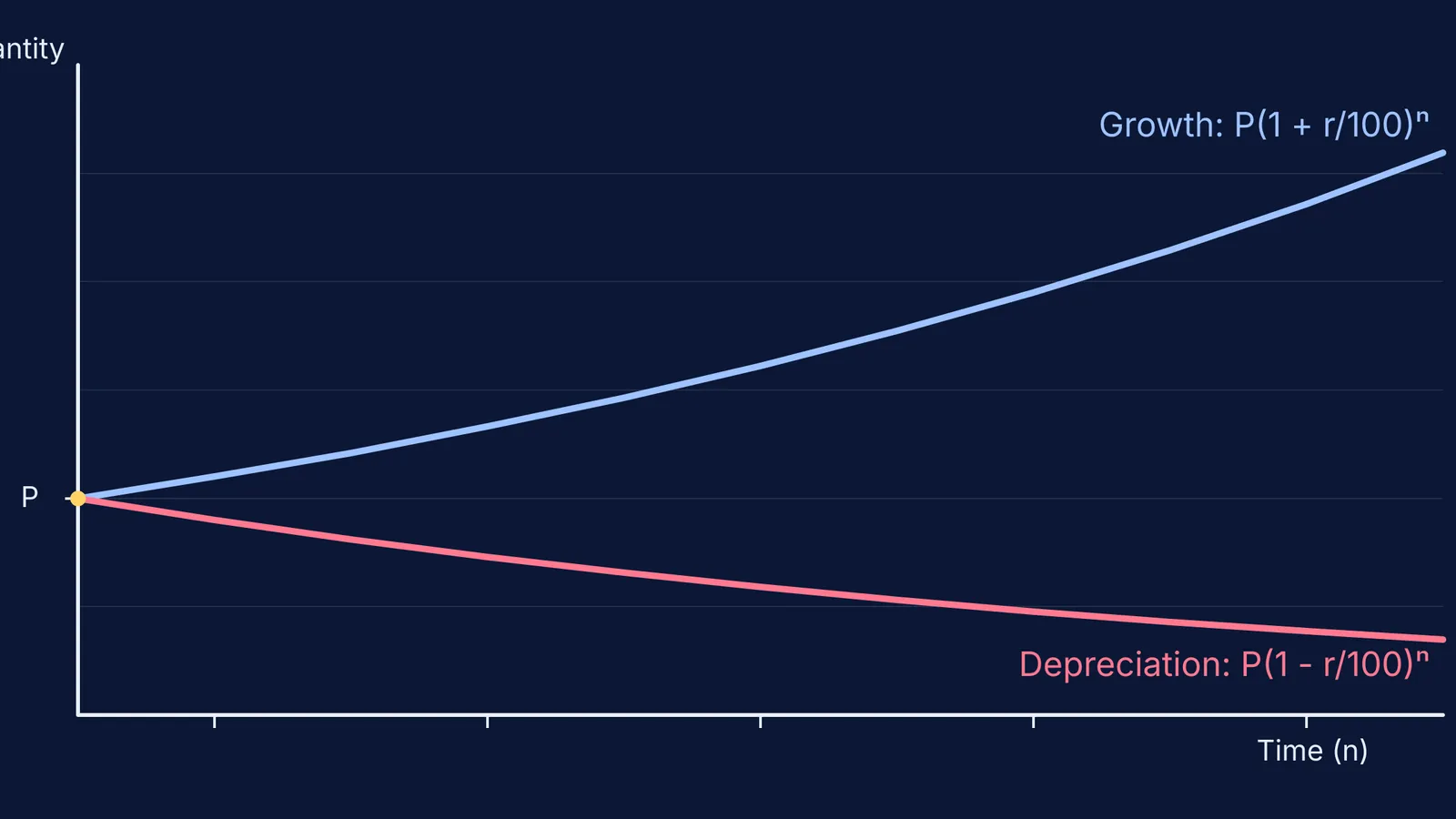
When a population grows at a constant percentage each year, it follows the rules of exponential population growth. The formula is a direct application of the standard compound interest equation:
Pₙ = P(1 + R/100)ⁿ
Here, P is the initial population, R is the annual growth rate, and n is the number of years. For example, if a town of 50,000 people grows at 4% annually, its population after two years is calculated as 50,000 × (1 + 4/100)². Just as interest in a savings account earns its own interest, the new population adds to the base that grows the next year. This compounding effect is why populations can explode in size over long periods.
To see how these exponential models behave when resources are limited, you can read our guide on Arithmetic vs geometric growth in plants: the growth equations. For continuous models used in physics and chemistry, see Population growth and cooling: exponential models via dy/dt = ky.
How to calculate depreciation with the formula
Items like vehicles, heavy machinery, and electronic gadgets lose value over time due to wear, tear, and obsolescence. In accounting, this is often calculated using the diminishing balance method (also known as the reducing balance method).
Because the asset's value decreases by a fixed percentage of its current worth each year, we simply change the plus sign in the compound interest formula to a minus:
Vₙ = V(1 - R/100)ⁿ
Here, V is the original value and R is the annual rate of depreciation. For instance, if a factory machine bought for ₹8,00,000 depreciates at a rate of 10% per year, its value after three years is 8,00,000 × (1 - 10/100)³ = ₹5,83,200. The subtraction ensures that the curve decays towards zero without ever crossing into negative numbers.
If you are unsure which mathematical framework applies to a new scenario, the Fermi Concept Library has every concept in physics, chemistry, biology, mathematics and computing, each with its own lesson and its place in the map.
Working backwards to an earlier year
Examinations frequently ask you to find the population of a town two years ago, given its current population and the annual growth rate. This draws on the concept of present value from finance, which determines what a future sum of money is worth today by discounting it.
Instead of multiplying to find a future amount, you rearrange the standard formula to divide the current value by the growth factor. If the present population P is known, the population n years ago (P₀) is:
P₀ = P / (1 + R/100)ⁿ
For example, if a city's current population is 44,100 and it has been reliably growing at 5% annually, you can find its population two years ago by dividing: 44,100 / (1 + 5/100)² = 40,000.
What if the growth rate changes every year?
Populations rarely grow at the exact same rate indefinitely, and assets might depreciate faster in their first year. If the rate changes from year to year—say, R₁ in the first year and R₂ in the second—you calculate the successive years by chaining the brackets together:
Final Value = P(1 + R₁/100)(1 + R₂/100)
This logic works equally well for depreciation. If a machine's value drops by 20% in its first year and 10% in its second year, the new value is V(1 - 20/100)(1 - 10/100). You can even mix growth and decay: if a town's population grows by 5% one year and then decreases by 2% the next due to sudden emigration, the combined formula simply becomes P(1 + 5/100)(1 - 2/100).
A checklist for setting up the formula
Before calculating your final answer, write down these three steps to avoid common mistakes:
Identify the direction: Does the value increase (population growth, appreciation) or decrease (depreciation, mortality)? Choose a + or - sign accordingly.
Check the time base: Does the rate's time period match the compounding interval? If the rate is per annum but compounded semi-annually, adjust R and n.
Locate the unknown: Are you finding a future value (multiply by the compounding factor) or a past value (divide by the compounding factor)? Set up the equation algebraically before plugging in the numbers.


