

On this page
Many logarithm questions in Class 11, JEE Main and board papers share one problem: the bases do not match. The change of base formula makes them match, so products of logs cancel like fractions and mixed-base equations become one equation in one unknown. Below: the formula, three worked examples, and a checklist for choosing a base.
What is the change of base formula?
A logarithm log_b x is the exponent y for which b^y = x, with x positive and the base b positive and not equal to 1, as Wolfram MathWorld defines it.
The change of base formula: for positive M, b and n with b ≠ 1 and n ≠ 1, log_b M = log_n M / log_n b (OpenStax College Algebra 2e, section 6.5).
In words: any log is the log of the number divided by the log of the base, and the new base n can be anything you like. The same OpenStax section notes that most calculators can evaluate only common and natural logs, so to find log₂5 you type log 5 / log 2, which gives about 2.32.
Two shortcuts follow straight from the formula, and they come up often in exam problems:
Flip rule: log_a b = 1 / log_b a, because log_b a = log a / log b, the reciprocal of log b / log a.
Power-of-base rule: log of b to base a^k equals (1/k) × log_a b, because log(a^k) = k log a.
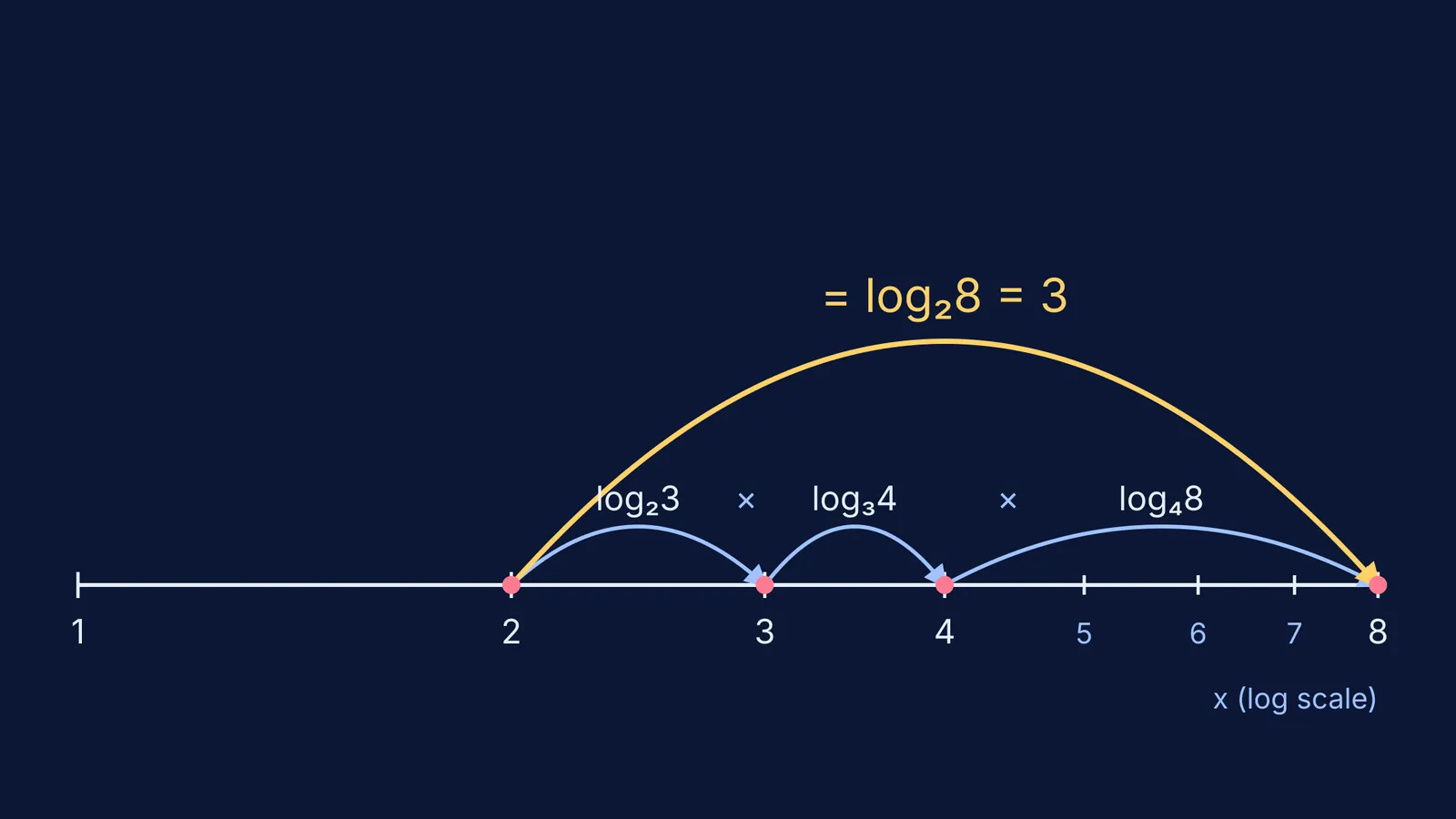
How do you simplify log₂3 × log₃4 × log₄8?
Write every factor in one base. Common logs (base 10) are fine, and you never need their values:
log₂3 = log 3 / log 2
log₃4 = log 4 / log 3
log₄8 = log 8 / log 4
Multiply: (log 3 / log 2) × (log 4 / log 3) × (log 8 / log 4). Each numerator cancels the next denominator.
What is left is log 8 / log 2, which is log₂8 = 3.
The pattern is a chain: log_a b × log_b c = log_a c, so the answer comes from the first base and the last argument. We wrote up why the loop version comes out to exactly 1 in the log chain product: why log a b × log b c × log c a = 1.
How do you solve log equations with different bases?
Pick one base, rewrite every term in it, then call that log t.
Example 1: bases that are powers of each other
Solve log₂x + log₄x = 6.
Since 4 = 2², the power-of-base rule gives log₄x = (1/2) log₂x.
Let t = log₂x. The equation becomes t + t/2 = 6, so 3t/2 = 6 and t = 4.
So x = 2⁴ = 16.
Check: log₂16 = 4 and log₄16 = 2, and 4 + 2 = 6.
Example 2: the base and argument swap places
Solve log_x 4 + log₄x = 5/2.
Domain first: x must be positive and x ≠ 1, because x is a base.
Let t = log₄x. By the flip rule, log_x 4 = 1/t.
The equation becomes t + 1/t = 5/2. Multiply by 2t: 2t² − 5t + 2 = 0, so (2t − 1)(t − 2) = 0, giving t = 1/2 or t = 2.
t = 1/2 gives x = 4^(1/2) = 2; t = 2 gives x = 16.
Check x = 2: log₂4 + log₄2 = 2 + 1/2. Check x = 16: log₁₆4 + log₄16 = 1/2 + 2. Both work.
For a full domain-first routine, see logarithmic equations and inequalities: domain first, then solve.
Which base should you switch to?
Before you start, ask:
Are all the bases powers of one number (2, 4, 8, 16 or 3, 9, 27)? Switch to the smallest one and use the power-of-base rule.
Does a base in one term appear as the argument in another? Use the flip rule and substitute t.
Is it a product where each argument is the next base? Write every factor as log b / log a and cancel the chain.
Do you need a decimal value? Switch to base 10 or base e so your calculator can do it.
None of the above? Use base 10; the answer never depends on the base you pick.
If the flip rule still feels like magic, rebuild it from the definition in the Fermi Concept Library. When a mixed-base method goes wrong in practice, the Fermi Problem Library has worked problems with a step-by-step solver that explains the reasoning rather than printing an answer, so you can see the line where your working split from the method.
For slips like writing log(a + b) as log a + log b, see logarithm rules: common mistakes and how to check them.


