

On this page
The algebra in a logarithm question is usually short. The traps sit around it: a root that makes an argument negative, a sign that should have flipped, a base that turns out to equal 1. One order of work catches all three.
What is the domain of a logarithmic equation?
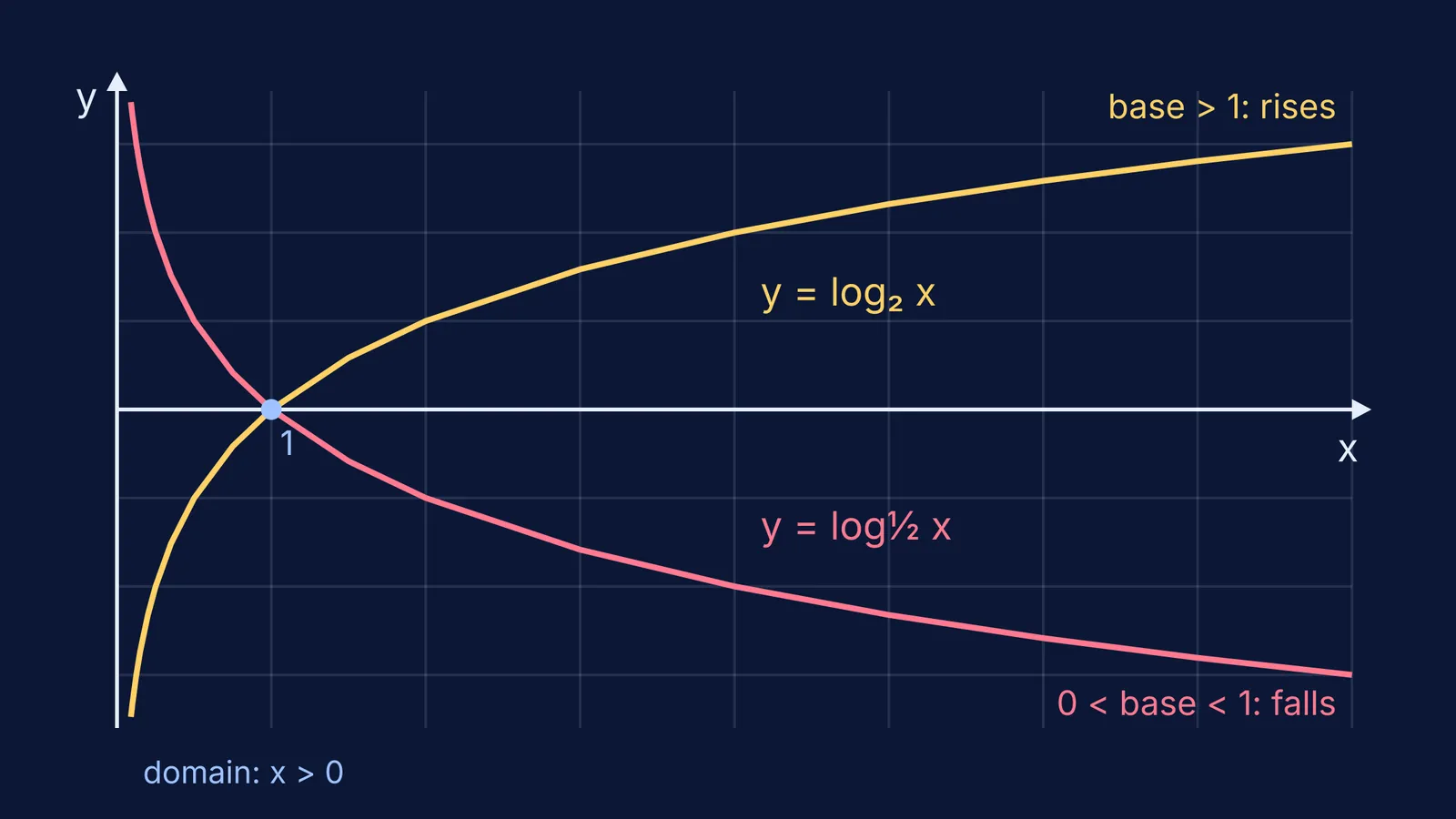
In OpenStax College Algebra 2e, for x > 0, b > 0 and b ≠ 1, y = log_b(x) means exactly the same as b^y = x. The same section states that the domain of a logarithm with base b is (0, ∞) and its range is all real numbers.
So for log_g(x) f(x), write these conditions first, before any algebra:
Argument positive: f(x) > 0.
Base positive: g(x) > 0.
Base not 1: g(x) ≠ 1.
With a number base such as 2, only the first applies. Intersect the conditions into one set, D. Every final answer must lie in D.
How do you solve a logarithmic equation without extra or lost roots?
The key tool is the one-to-one property from OpenStax's section on exponential and logarithmic equations: for a positive base b ≠ 1, log_b S = log_b T if and only if S = T. The same section advises that "when solving an equation involving logarithms, always check to see if the answer is correct or if it is an extraneous solution."
Worked example 1. Solve log₂(x) + log₂(x − 2) = 3.
Domain: x > 0 and x − 2 > 0, so D is x > 2.
Combine: log₂(x(x − 2)) = 3, so x(x − 2) = 2³ = 8.
Solve: x² − 2x − 8 = 0, so (x − 4)(x + 2) = 0, giving x = 4 or x = −2.
Filter: −2 is not in D. The answer is x = 4.
Combining logs widened the domain (x(x − 2) is also positive for x < 0), so x = −2 crept in. The opposite mistake loses roots. In log₁₀(x²) = 2, x² = 100 gives x = 10 or x = −10, and both work. Rewrite the left side as 2 log₁₀(x) first and you keep only x = 10. The safe identity is log(x²) = 2 log|x|.
Which way does the inequality sign go when the base is less than 1?
OpenStax notes that log_b(x) is increasing if b > 1 and decreasing if 0 < b < 1. A rising function keeps the order of inputs; a falling one reverses it. Inside the domain:
If b > 1, log_b f > log_b g means f > g.
If 0 < b < 1, log_b f > log_b g means f < g.
Worked example 2. Solve log_(1/2)(x − 1) > −2.
Domain: x − 1 > 0, so x > 1.
Rewrite the right side with the same base: −2 = log_(1/2)(4), because (1/2)^(−2) = 4.
The base 1/2 is below one, so flip: x − 1 < 4, giving x < 5.
Intersect with the domain: 1 < x < 5.
Test: at x = 3, log_(1/2)(2) = −1 > −2. At x = 9, log_(1/2)(8) = −3, which fails.
How do you solve logarithmic equations with a variable base?
All three domain conditions now apply, and in an inequality you cannot know whether to flip until you know which side of one the base is on. So split into two cases, as you do with equations and inequalities with modulus.
Worked example 3. Solve log_x(x + 6) = 2. Domain: x > 0 and x ≠ 1. By the definition, x² = x + 6, so x = 3 or x = −2. A base of −2 is not allowed, so x = 3.
Worked example 4. Solve log_x(x + 2) > 2. Domain: x > 0 and x ≠ 1, and 2 = log_x(x²).
Case x > 1 (no flip): x + 2 > x², so (x − 2)(x + 1) < 0, giving −1 < x < 2. With x > 1 this leaves 1 < x < 2.
Case 0 < x < 1 (flip): x + 2 < x², so (x − 2)(x + 1) > 0, giving x < −1 or x > 2. Nothing in (0, 1) survives.
Answer: 1 < x < 2.
With more factors, the wavy curve method for rational inequalities speeds up the sign chart.
A checklist before you write the final answer
Is D written from the original question?
Is every base a number, or do I need two cases?
Base above one: keep the sign. Below one: flip it.
Is each case intersected with its condition and with D?
Did I test one value inside and one outside?
Failing at step 1 or 3 points to the definition, not the algebra. The Fermi Concept Library gives each mathematics concept its own lesson, so you can rebuild the definition first. When a method goes wrong, the Fermi Problem Library has worked problems with a step-by-step solver that explains the reasoning rather than printing an answer.


