

On this page
The change-of-base rule is a powerful tool in logarithm algebra. When you face a long chain of multiplied logarithms in a multiple-choice question, this rule is usually the key to collapsing it.
Where did logarithms come from?
Logarithms were not originally invented as the inverses of exponents. The Scottish mathematician John Napier spent 20 years developing the first tables of logarithms, publishing his work in 1614 to simplify the grueling multiplications required for astronomy, surveying, and navigation. He discovered that by converting extremely large numbers into their logarithmic equivalents, you could turn highly complex multiplication and division problems into much faster, simpler addition and subtraction operations.
Today, while we no longer rely on printed logarithm tables, the modern change-of-base formula allows us to switch from one base to another mathematically. This is especially useful because most calculators only compute base 10 (the common logarithm, written as log) and base e (the natural logarithm, written as ln). Without the change-of-base rule, evaluating logarithms with unusual bases would be impossible on standard equipment.
What is the change-of-base formula?
The formula states that you can change the base of a logarithm from "a" to any new positive base "k" by turning it into a fraction: log_a b = (log_k b) / (log_k a)
For example, if you want to evaluate log_2 8 but your calculator only has the ln button, you apply the rule: log_2 8 = (ln 8) / (ln 2)
This single property is the engine that drives chain-rule problems.
How does the chain rule for logarithms work?
When you multiply logarithms where the argument of one is the base of the next, you form a chain.
If you have the expression log_a b × log_b c, you can apply the change-of-base formula using the natural logarithm for both of the terms independently:
The first term, log_a b, becomes the fraction (ln b) / (ln a)
The second term, log_b c, becomes the fraction (ln c) / (ln b)
Next, you multiply the two new fractions together: [(ln b) / (ln a)] × [(ln c) / (ln b)]
Because this is a standard fraction multiplication, the (ln b) term in the numerator of the first fraction and the (ln b) term in the denominator of the second fraction cancel each other out completely. You are left with a much simpler result: (ln c) / (ln a)
By running the change-of-base formula in reverse, you can rewrite this remaining fraction as a single logarithm with base "a": log_a c
This algebraic proof tells us that log_a b × log_b c = log_a c. The intermediate base "b" has vanished entirely, bridging the gap from "a" directly to "c".
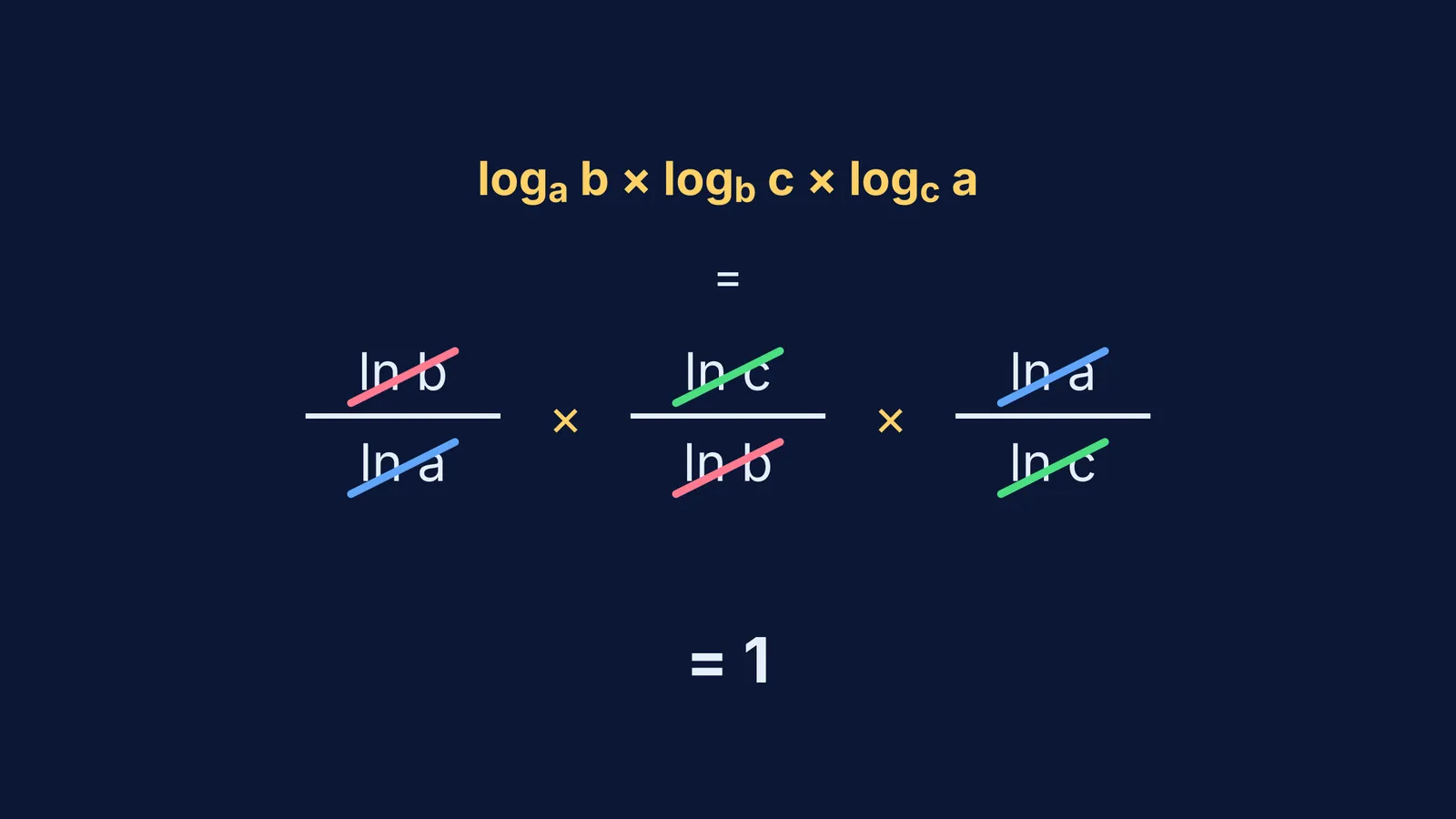
Why does log_a b × log_b c × log_c a = 1?
We can extend this same fraction trick to a cycle that circles all the way back to the beginning.
Take the product: log_a b × log_b c × log_c a
Convert every term to a fraction:
log_a b = (ln b) / (ln a)
log_b c = (ln c) / (ln b)
log_c a = (ln a) / (ln c)
Now multiply the three fractions together: [(ln b) / (ln a)] × [(ln c) / (ln b)] × [(ln a) / (ln c)]
Every term appears exactly once in the numerator and once in the denominator. The (ln b) terms cancel out, the (ln c) terms cancel out, and finally, the (ln a) terms cancel out. The entire expression collapses down to exactly 1.
How do you spot the log chain in competitive exams?
Examiners in high-pressure tests like JEE Main frequently disguise this property to test your conceptual understanding rather than just your calculation skills. If you see a long string of multiplied logarithms in an equation, your first instinct should be to look for the hidden chain.
Sometimes, the chain is perfectly aligned from left to right: log_2 3 × log_3 4 × log_4 5 × ... × log_31 32
By converting absolutely everything to fractions, every single intermediate number from 3 all the way to 31 appears once on top and once on the bottom. They cancel out in a cascading wave, leaving only the very first base and the very last argument: (ln 32) / (ln 2) = log_2 32 = 5.
Other times, the problem requires you to actively flip a term first using the reciprocal rule. If a problem gives you a term like 1 / (log_b a), you must recognise that it is identical to log_a b before you can connect the missing links in the multiplication chain. Once you rearrange the pieces, the chain reaction becomes obvious.
Just as you solve equations and inequalities with modulus by breaking them into simpler cases, or find matrix powers by spotting a predictable sequence, you can conquer any logarithmic product by breaking it into fractions and watching the sequence cancel out.
If you struggle to remember which way the fractions go, Fermi's AI tutor can write out the intermediate steps with you. When you bring a chain-product problem to the Fermi Problem Library, the step-by-step solver doesn't just print the final answer; it explains the reasoning by breaking the chain down into its change-of-base fractions. You can also review the foundational rules in the Fermi Concept Library to ensure you understand the underlying algebra.


