

On this page
When two genes are close together on the same chromosome, they tend to be inherited together—a phenomenon called genetic linkage. However, during meiosis, homologous chromosomes exchange pieces in a process called crossing over. This creates recombinant offspring with combinations of traits not seen in the parents. Learning to work with these frequencies is a key part of solving assertion-reason questions in genetics.
What is recombination frequency?
The recombination frequency is the percentage of offspring that inherit these new, crossed-over combinations. You calculate it using this standard formula:
Recombination frequency = (Number of recombinant offspring / Total number of offspring) × 100
This formula works because the number of recombinants directly reflects how often crossing over happens between the two genes. The closer the genes are, the less likely a crossover event will separate them. If genes are far apart on the same chromosome or sit on completely different chromosomes, they sort independently. For unlinked genes, the maximum recombination frequency is 50% (Genetic linkage - Wikipedia). If you see a frequency of 50%, you cannot assume the genes are on different chromosomes, only that they behave as if they are unlinked.
Why does 1% recombination equal 1 map unit?
In 1911, the American geneticist Alfred Sturtevant constructed the first genetic map of a chromosome (Alfred Sturtevant - Wikipedia). He realised that the frequency of crossing over between two genes reliably indicates their linear distance from each other.
He established a simple rule: a 1% recombination frequency is equal to 1 map unit (m.u.). This map unit is also called a centimorgan (cM), named in honour of his mentor, Thomas Hunt Morgan. While the map unit measures genetic linkage rather than exact physical length, one centimorgan in humans corresponds to approximately 1 million base pairs (Centimorgan - Wikipedia).
If you are stuck trying to figure out which phenotypes are parental and which are recombinants in your homework, the Fermi Problem Library has worked problems with a step-by-step solver that explains the reasoning rather than printing an answer.
How to solve a two-point test cross numerical?
In a two-point test cross, an individual heterozygous for two genes is crossed with a homozygous recessive individual. Exam boards love two-point test crosses because they clearly show the difference between independent assortment and genetic linkage. By using a homozygous recessive parent, you guarantee that the phenotype of the offspring directly shows the gametes produced by the heterozygous parent. This is similar to evaluating incomplete dominance in snapdragons, where you count the offspring to figure out the underlying inheritance pattern.
Example problem: You cross a plant heterozygous for tall stems and red flowers (TtRr) with a dwarf plant with white flowers (ttrr). The cross produces 1,000 offspring:
410 tall, red (Parental)
420 dwarf, white (Parental)
80 tall, white (Recombinant)
90 dwarf, red (Recombinant)
Identify the recombinants: The recombinants are the two smallest groups (tall white and dwarf red), which add up to 80 + 90 = 170.
Find the total offspring: The total is 410 + 420 + 80 + 90 = 1,000.
Calculate the percentage: (170 / 1,000) × 100 = 17%.
The recombination frequency is 17%. Therefore, the map distance between the stem height gene and the flower colour gene is 17 map units (or 17 cM).
How to order three genes from map distances?
Exam questions often give you the map distances between three genes and ask you to find their correct order on the chromosome. This is called a three-point mapping puzzle. Once you have the order, you can also draw the genetic map to scale, which helps you visualise the chromosome structure. This technique is exactly how early geneticists mapped out entire genomes before modern DNA sequencing existed.
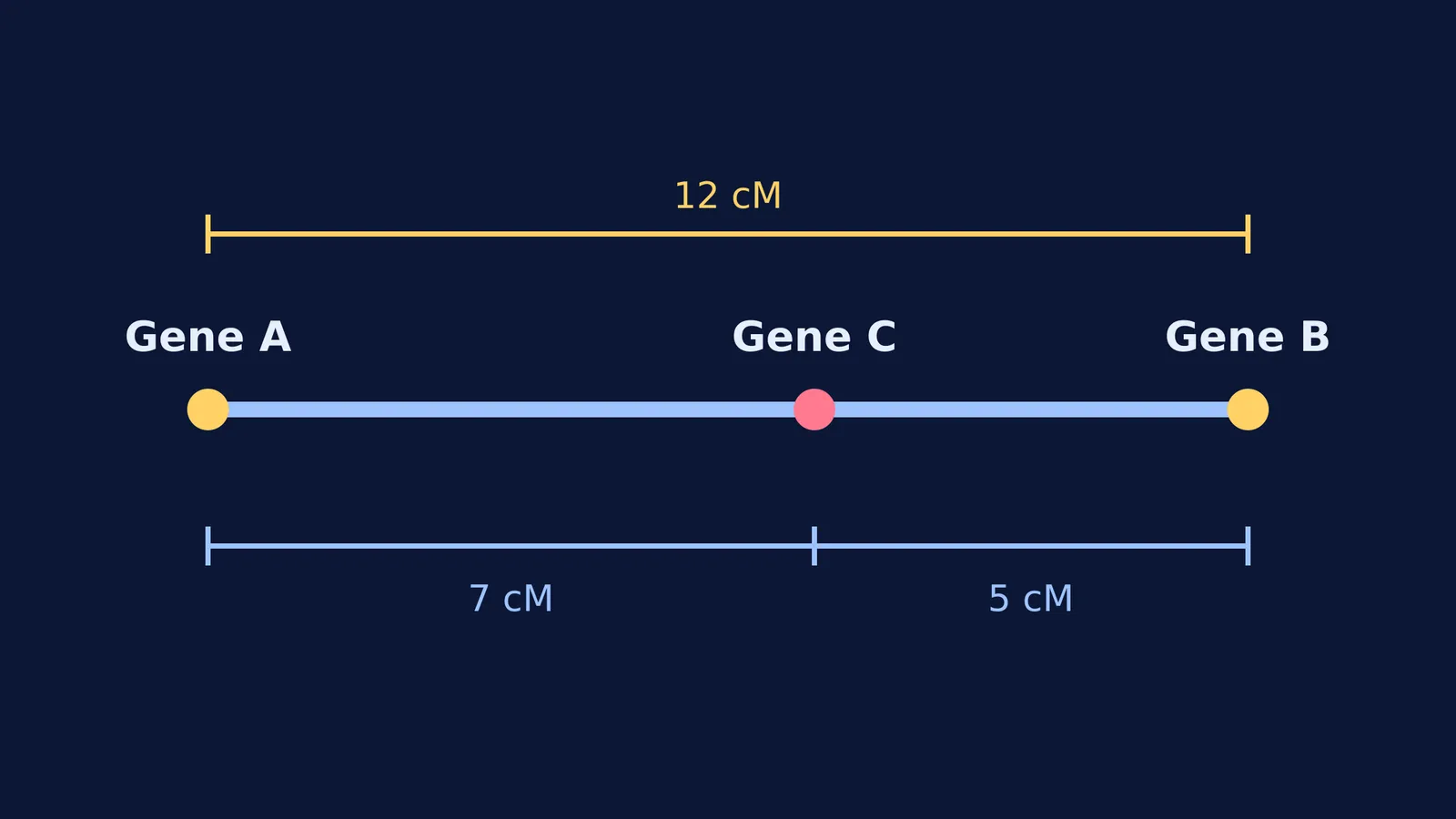
Example problem: You are given the following distances between three genes, A, B and C:
Distance between A and B = 12 cM
Distance between B and C = 5 cM
Distance between A and C = 7 cM
Find the largest distance: The largest distance is 12 cM between A and B. This means A and B must be at the two ends of this chromosome segment.
Place the third gene in the middle: Gene C must sit somewhere between A and B.
Check the math: The distance from A to C (7 cM) plus the distance from C to B (5 cM) equals the total distance from A to B (12 cM).
The correct order of the genes is A—C—B (or B—C—A, reading from the other end).
If you misplace a gene and the math stops working, Fermi's AI tutor holds a line of reasoning across a session, notices where a student is stuck, decides whether to explain, ask or show; writes on a board, draws the figure, runs the simulation, checks understanding as it goes.


