

On this page
Genetics assertion-reason questions in NEET-UG carry high weight and punish surface-level memorisation. The examiners know exactly where your intuition breaks down, and they build their traps around those conceptual gaps.
In studies on biology education, researchers repeatedly find the same errors. A widely cited study by Abraham et al. in *CBE—Life Sciences Education* identified a widespread misconception: the belief that if an allele is dominant, it must also be the most common in a population. When an exam question tests these boundaries—like linkage, probabilities, and dominance—relying on intuition rather than definitions will cost you marks.
Here are the most common traps in inheritance, and how to spot them.
Why do dominant alleles seem more common?
The most frequent trap in assertion-reason questions is the idea that a dominant allele is somehow stronger or more common. Dominance only describes what happens in a heterozygote: if you have one copy of the 'A' allele and one copy of the 'a' allele, and you only see the 'A' trait, then 'A' is dominant. It says absolutely nothing about how many people carry that allele.
For example, polydactyly (having extra fingers or toes) is a dominant trait, yet it is rare in the human population. Conversely, the allele for blood group O is recessive, but it is the most common blood type worldwide. If an assertion states, "Huntington’s disease affects a small portion of the population because it is a recessive disorder," you must spot the trap: the disease is rare, but it is caused by a dominant allele. The frequency of a trait depends on natural selection and allele frequencies, not on dominance.
If you find these definitions slipping away during practice, the Fermi Concept Library maps out every genetics concept and how it relates to the rest of the syllabus. Applying these rules to Mendelian disorders like sickle-cell anaemia and PKU is a high-yield way to lock in your understanding of dominance and recessiveness.
Does a dihybrid cross always yield 9:3:3:1?
When Mendel performed his dihybrid crosses, he found a phenotypic ratio of 9:3:3:1 in the F2 generation. Many students apply this ratio universally to any two genes.
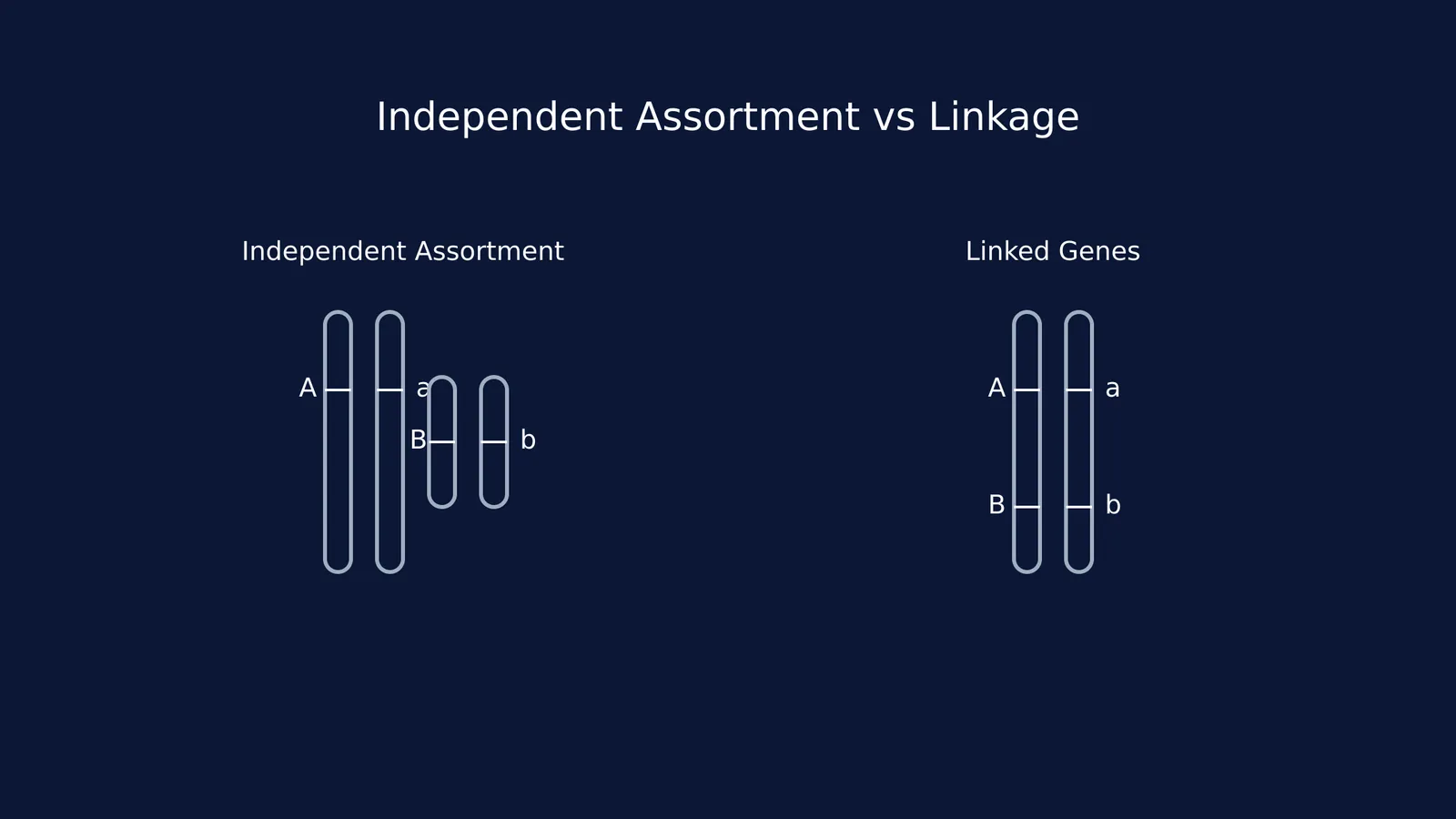
However, Mendel's ratio only holds true if the genes follow the Law of Independent Assortment—meaning they are located on different chromosomes, or are very far apart on the same chromosome. If two genes are physically close to each other on the same chromosome, they are linked. Linked genes tend to be inherited together.
Because they do not assort independently, a cross involving linked genes will deviate significantly from the 9:3:3:1 ratio. You will see a much higher frequency of parental phenotypes and a lower frequency of recombinant phenotypes (the new combinations). If a reason claims that "closely linked genes assort independently to produce a 9:3:3:1 ratio," you immediately know it is false.
How to check your reasoning in the exam hall?
When facing tricky assertion-reason questions, use this three-step checking method:
Check for universal rules: Ask yourself if the statement relies on a rule that has exceptions. The Law of Segregation is universally applicable during meiosis (barring nondisjunction), but the Law of Independent Assortment is not.
Separate probability from frequency: Do not confuse the probability of an outcome in one cross with how common the trait is in the general population. Each fertilization is an independent event.
Insert "because": Read the assertion, say "because", and then read the reason. Does the reason provide the physical or biological cause for the assertion? Both statements might be factually true on their own, but if the reason does not explain the assertion, the answer is the second option.
By recognising these traps, you can approach genetics problems logically rather than guessing. Revising the difference between a test cross vs back cross is an excellent way to track how these unknown alleles behave in practice. Remember that alleles are physical sequences of DNA on chromosomes, and visualizing their movement during meiosis is the most reliable way to find the right answer.


