On this page
Most students who are weak in physics are not short of hours. They spend those hours rereading notes and watching solutions, and then a fresh question still feels like a blank wall. This plan changes how you spend the time you already have.
First, the stakes. In the pattern NTA set for the NEET-UG 2026 re-exam, physics had 45 questions worth 180 marks, out of 720 for the whole paper. The same report on NTA's notice gives the marking: 4 marks for a correct answer, 1 mark taken away for a wrong one, and nothing for a question you leave blank. Check NTA's notice for your own exam year before you plan around these numbers.
Which NEET physics chapters give the most marks for effort?
NTA does not publish how many questions come from each chapter, so be careful with any chart that claims exact weightage. The syllabus itself is fixed. The NEET-UG 2026 physics syllabus from NMC has 20 units, from Physics and Measurement to Experimental Skills, and no physics chapter was removed from the 2025 list.
If you are starting from a low score, rank chapters by how short and predictable they are, not by how famous they are. These units have few formulas and questions that tend to look alike:
Physics and Measurement: units, dimensions, significant figures and errors. Mostly rules rather than long calculations.
Dual Nature of Matter and Radiation, Atoms and Nuclei: a handful of equations, such as the photoelectric equation and the de Broglie wavelength, used in direct ways.
Electronic Devices: diodes and logic gates. Truth tables, not long calculations.
Current Electricity and Ray Optics: more formulas, but a small set of question types that repeat.
Leave Rotational Motion and the harder parts of Mechanics until these feel steady. They matter, but they take longer to start paying back.
How do you go from knowing a formula to solving the question?
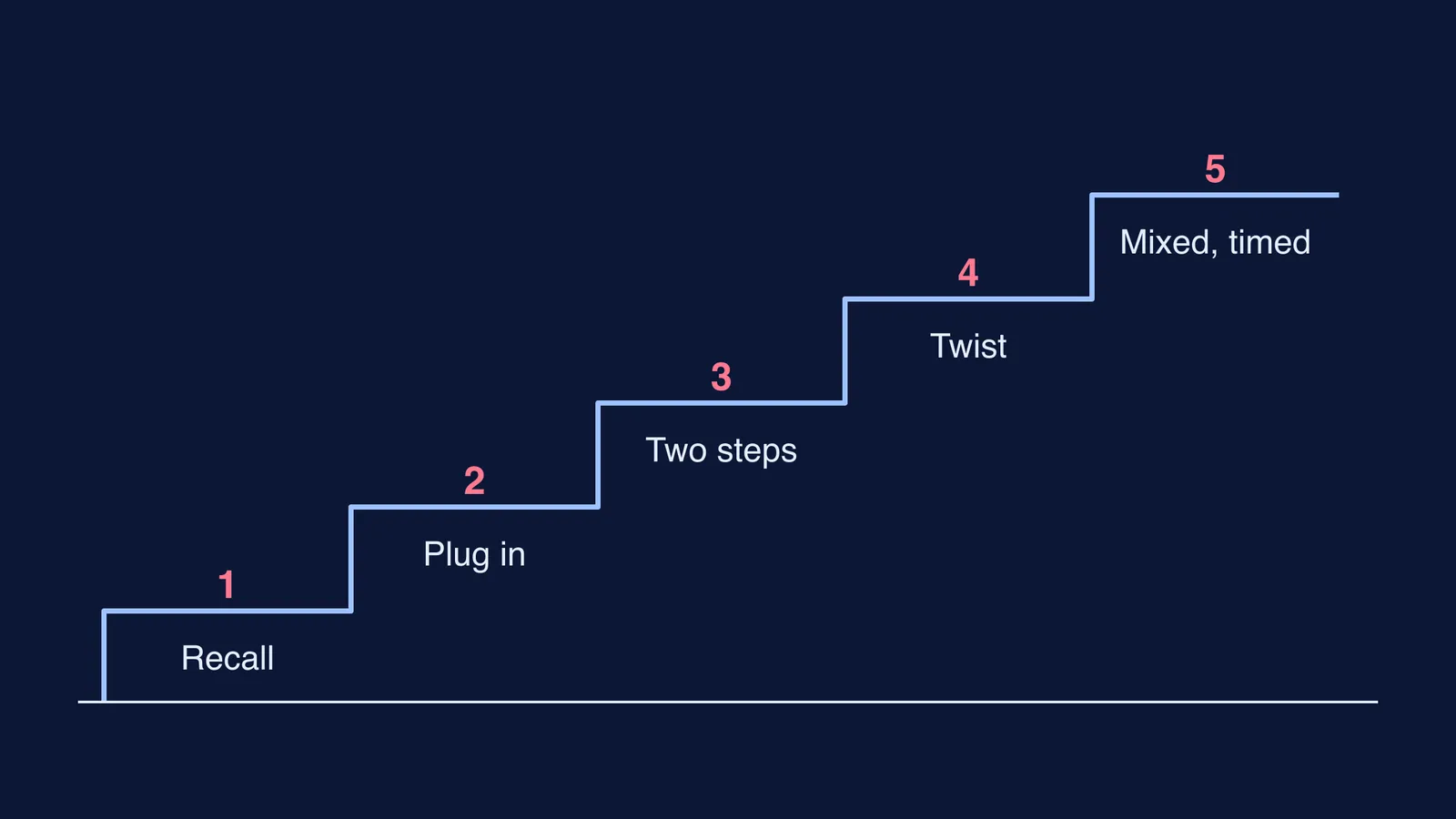
Psychologists who rated ten common study techniques found that practice testing and distributed practice had high utility, while rereading and highlighting had low utility. In a classic experiment, prior testing produced greater retention than restudying on tests given 2 days or a week later. So each rung of this ladder makes you produce something, not just read.
Recall: write the formula from memory, with what each symbol means and its SI unit.
Plug in: one direct question. A 4 ohm resistor across 12 V: I = V/R = 3 A.
Two steps: two 4 ohm resistors in series across 12 V. Add first (8 ohm), then divide: 1.5 A.
Twist: the same two resistors in parallel. The combined resistance is 2 ohm, so 6 A comes from the battery and 3 A flows through each.
Mixed and timed: NEET-style questions from different chapters, shuffled, with a timer running.
Stay on a rung until you get three questions in a row right without looking at the solution. When you get one wrong because you chose the wrong method, the Fermi Problem Library has a step-by-step solver that explains the reasoning rather than printing an answer. When the gap is the concept itself, go back to its lesson in the Fermi Concept Library before climbing again.
Rung 5 matters. In a study of 126 seventh-grade students practising maths over three months, interleaved practice, with problem types mixed together, gave higher test scores than blocked practice on a surprise test 1 day or 30 days later. The exam mixes chapters, so your practice should too.
What does a weekly plan look like?
About 90 minutes of physics a day, alongside your chemistry and biology:
Monday: new chapter, rungs 1 and 2. Make a one-page formula sheet from memory, then check it.
Tuesday: rungs 3 and 4 on Monday's chapter.
Wednesday: 20 mixed questions from all chapters done so far (rung 5). Mark every mistake as concept, method or careless.
Thursday: fix Wednesday's mistakes. Redo each one the next day without looking.
Friday: second new chapter, rungs 1 to 3.
Saturday: one timed 45-question physics paper. Then rewrite last week's formula sheet from memory.
Sunday: rest, or catch up. Nothing new.
How long before your physics score moves?
Give the plan four weeks before you judge it, and judge it on your Saturday papers, not on how the week felt. Count right answers and wrong answers separately: fewer wrong answers is progress too, because each one costs a mark.
If exam worry is stopping you from sitting down to study at all, talk to someone you trust, or call Tele MANAS on 14416 for free support.
If you don't know where to begin this week, Fermi's AI tutor can work out what you already know and build a plan for the session, so you sit down to a clear next step.