On this page
For most students, the way into IIT Madras's online BS in Data Science is not JEE but a four-week qualifier. Here is how it works, what the cut-offs mean in practice, and a plan that fits around boards or college.
How does the IIT Madras online BS work?
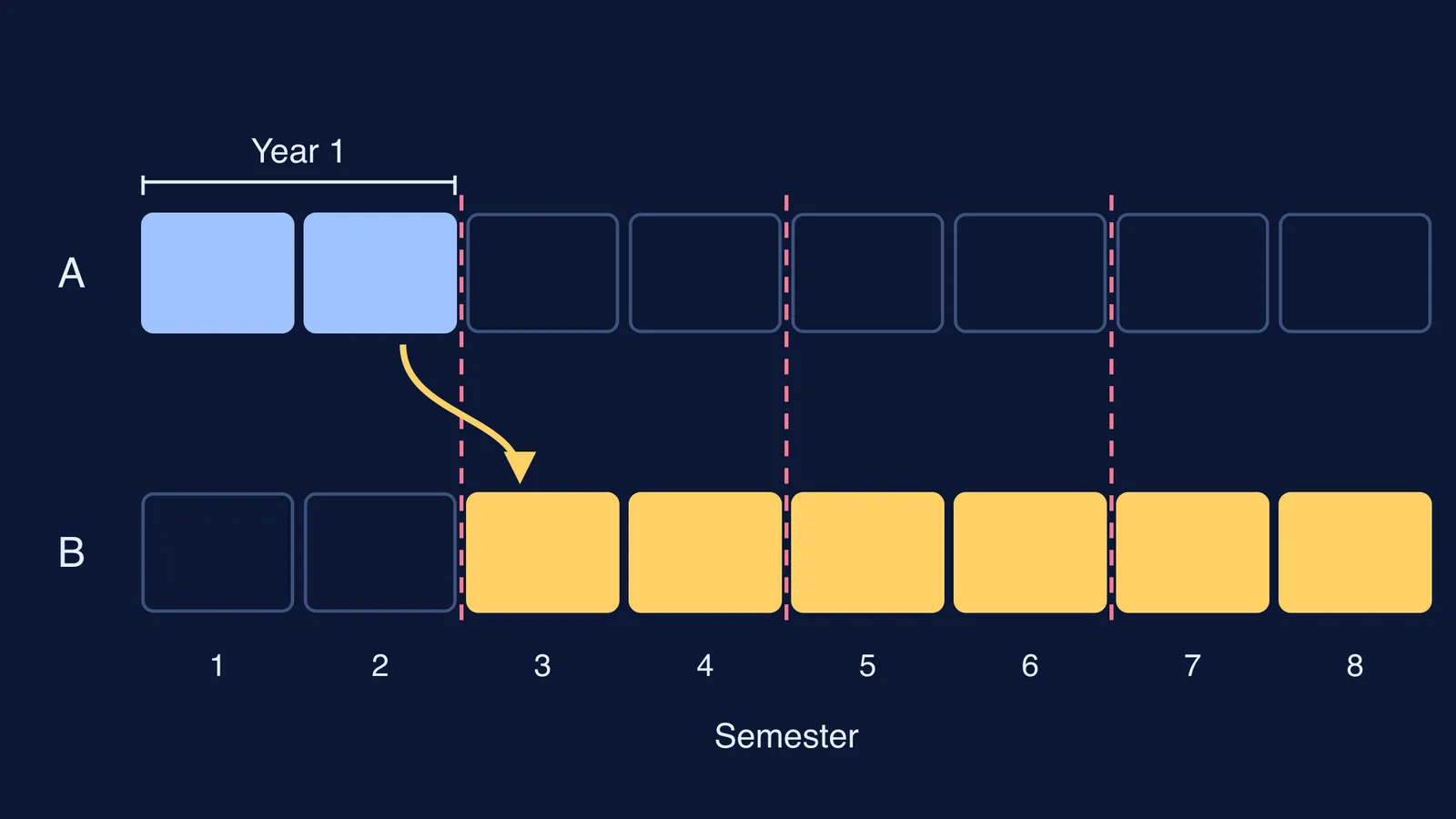
The programme, the IIT Madras BS Degree in Data Science and Applications, is online-first: pre-recorded and live sessions, weekly online assignments and in-person quizzes (IIT Madras programme page). You can exit at the foundation, diploma or BSc level, or go on to the four-year BS. IIT Madras says more than 20,000 of its students do the programme along with another degree (IIT Madras programme page).
Each year has three terms, starting in January, May and September, with 12 weeks of coursework in each (IIT Madras academics). The foundation level is 8 courses, and IIT Madras expects about 10 hours per course per week at that level (IIT Madras academics).
Who can apply for the IIT Madras BS qualifier?
Anyone who has passed Class 12 or equivalent can apply, whatever their age or academic background, and applicants are expected to have studied Maths and English in Class 10 (IIT Madras admissions). Students who have appeared for their Class 11 final exams can apply too; if they qualify, they join after passing Class 12. Students qualified to appear for the current year's JEE Advanced can skip the qualifier and join directly.
The application fee is ₹4,000 for General and OBC candidates and ₹2,000 for SC, ST and PwD candidates, or ₹1,000 for SC/ST candidates who are also PwD (IIT Madras admissions). Deadlines change every term, so read the dates on that page before you plan anything.
What happens in the four-week qualifier?
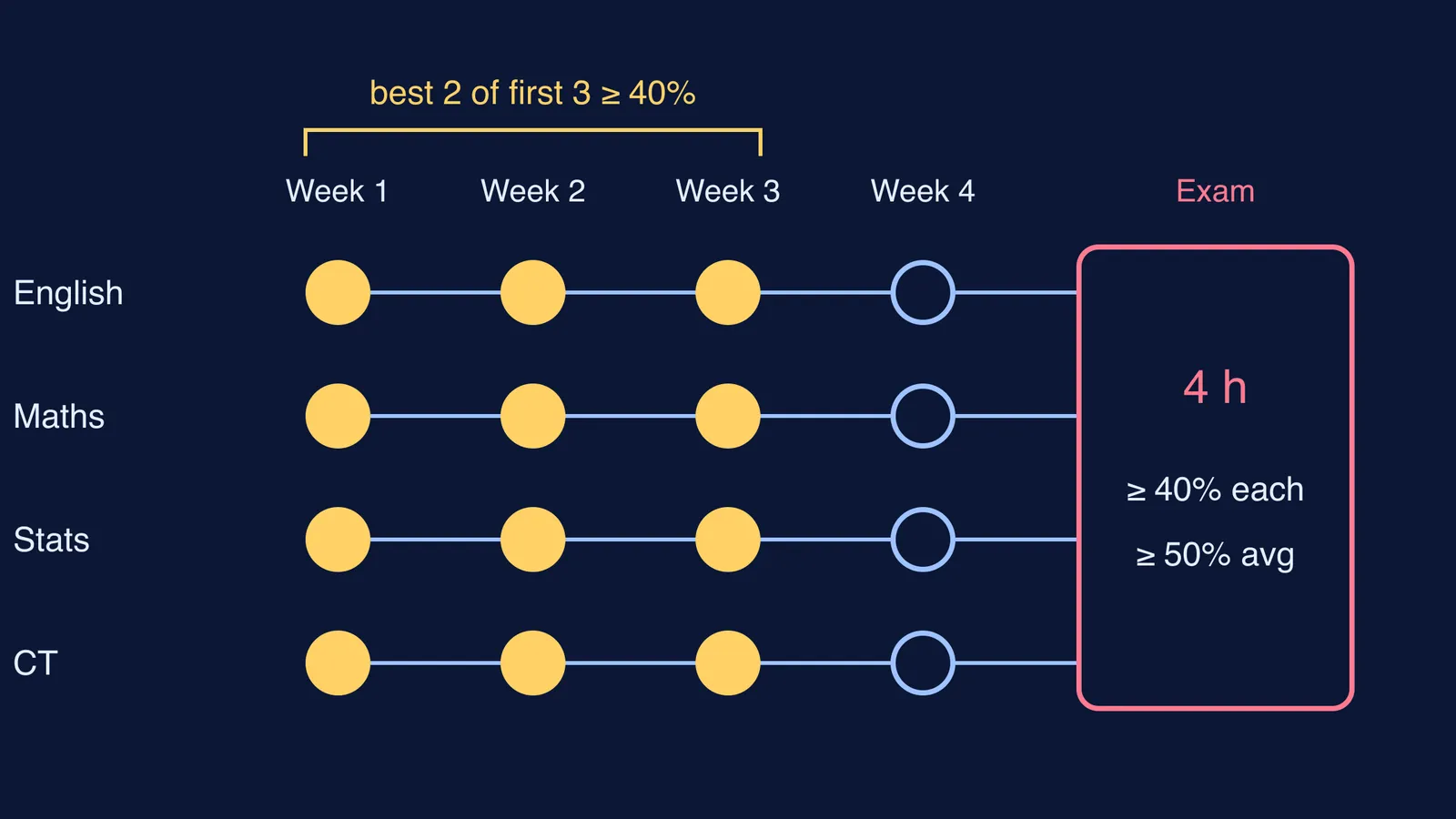
You get four weeks of lecture videos, assignments and live sessions in four courses: English I, Mathematics for Data Science I, Statistics for Data Science I and Computational Thinking (IIT Madras admissions). There are two gates (General cut-offs shown; they are lower for OBC-NCL/EWS and SC/ST/PwD candidates).
Assignments: in each course, the average of your best 2 of the first 3 assignment scores must be at least 40%.
Exam: a 4-hour in-person exam on all four courses, where you need at least 40% in every course and at least 50% on average.
If you do not clear the exam or miss it, you get one re-attempt in the same term without redoing the assignments, for ₹2,000 (General/OBC). A pass stays valid for 3 terms if you have already appeared for or cleared your Class 12 boards, or 6 terms if you have not yet appeared for them (IIT Madras admissions).
Here is a worked example. Say your Maths assignments come back 60, 35 and 70. The best two are 60 and 70, an average of 65, so you clear the first gate even with one bad week.
In the exam you score English 72, Maths 48, Statistics 38 and Computational Thinking 66. Your average is 56, above 50. But Statistics is under 40, so you do not pass. Two more marks in Statistics would have mattered more than ten more in English.
How should you prepare for the qualifier with boards or college?
Each course page lists its syllabus week by week; start with the opening weeks. In Maths, weeks 1 to 4 cover sets, relations and functions, straight lines, quadratics and polynomials (Mathematics for Data Science I). Statistics covers types of data, describing categorical and numerical data, and correlation (Statistics for Data Science I). Computational Thinking covers variables, iteration, filtering, procedures and nested iterations (Computational Thinking). English covers sounds, parts of speech, sentences and spoken English (English I).
Here is our plan, built around the two gates: about an hour on weekdays and a longer block at the weekend.
Before week 1: mark every topic in the four syllabi green (know it), amber (shaky) or red (new). Check the exam cities on the academics page.
Weeks 1 to 3: watch each week's lectures within two days of release and submit every assignment early. Only the best 2 of the first 3 count, so a missed week leaves you no slack.
Every weekend: redo the questions you got wrong, without notes. Give most of the time to whichever course is closest to 40%.
Week 4: sit one timed 4-hour practice at a desk, using the assignment questions, and score it course by course, not just overall.
Last three days: only your weakest course, and proper sleep.
If a red topic is in Maths, such as functions or quadratics, the Fermi Concept Library has a lesson for every concept in mathematics and computing. When you keep losing marks to the wrong method, the Fermi Problem Library has a step-by-step solver that explains the reasoning rather than printing an answer.
What should you compare it with?
If you are still choosing a route, see our guide to data science degrees after 12th and the maths they need, and our comparison of a distance degree and a regular degree. For more on the qualifier for Class 12 students, read how the IIT Madras BS qualifier works.
Pick your term, colour your syllabus tonight, and start with the reddest topic.