

On this page
Data science has moved from a postgraduate specialization into direct undergraduate entry points across Indian institutions. According to a joint industry study by NASSCOM and Deloitte, India's AI talent pool must expand to over 1.25 million professionals by 2027 to meet industry needs. While annual talent supply grows at roughly 15%, enterprise demand is climbing at 25% to 35%, creating an acute shortage of graduates with genuine mathematical grounding. If you are completing Class 12, entering this field requires choosing between traditional engineering, pure mathematical science, and accredited online degrees.
Which degree routes lead to data science after 12th?
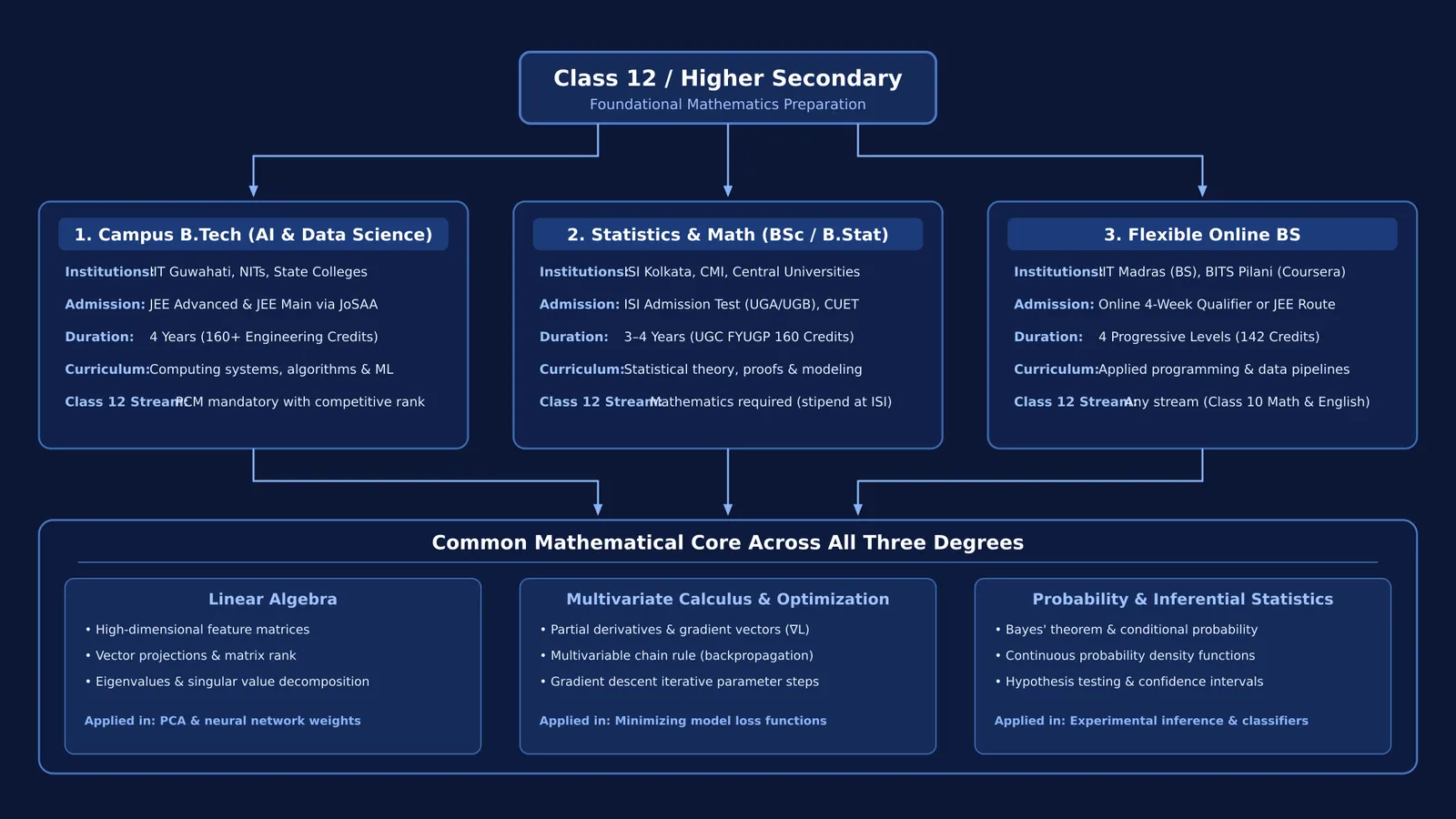
Today, three distinct academic pathways lead directly into data science careers in India:
Campus B.Tech degrees in Artificial Intelligence and Data Science: Offered by institutes such as the Mehta Family School of Data Science and Artificial Intelligence at IIT Guwahati, several NITs, and state engineering colleges. These four-year programmes require Physics, Chemistry, and Mathematics (PCM) in Class 12, admitting students through JEE Advanced and JEE Main counselling. Coursework integrates computing systems, algorithm design, and data pipelines.
Pure statistics and mathematics degrees: Quantitative institutes like the Indian Statistical Institute offer the B.Stat (Honours) in Kolkata, admitted via the ISI Admission Test (UGA objective and UGB subjective papers) with a monthly ₹5,000 student stipend. ISI also conducts a Bachelor of Statistical Data Science (B.SDS), admitting via JEE Main or CUET-UG scores with at least 75% aggregate marks. Under the UGC Curriculum and Credit Framework for Undergraduate Programmes, universities offer four-year BSc Honours tracks requiring 160 credits with research.
Flexible accredited online BS degrees: The IIT Madras BS in Data Science and Applications admits students who studied Mathematics and English in Class 10 from any Class 12 stream. The programme requires 142 credits across four levels, admitting students through a JEE Advanced qualifier route or an in-house four-week foundation test. Similarly, the BITS Pilani B.Sc in Computer Science on Coursera admits students with 60% in Class 12 mathematics or via an online qualifier exam.
What mathematics is actually required for data science?
Students often assume data science is mostly about memorizing Python libraries or writing SQL queries. In reality, algorithms are applied mathematics. When you begin your first semester at college, coursework pivots immediately onto three core mathematical foundations:
Linear Algebra: Datasets are structured as matrices, and features are vectors in high-dimensional space. Understanding matrix multiplication, vector projections, matrix rank, eigenvalues, and singular value decomposition (SVD) is necessary to understand dimensionality reduction and deep neural network weights.
Multivariate Calculus and Optimization: Training machine learning models requires minimizing a loss function. Computing partial derivatives, the gradient vector ∇L, and applying the multivariable chain rule drive backpropagation in neural networks. Optimization algorithms step along the negative gradient vector to find weights that minimize error.
Probability and Inferential Statistics: Data distributions, expectation, variance, continuous probability density functions, and hypothesis testing form the backbone of experimental analysis. Classifiers frequently calculate class predictions using conditional probability and Bayes' theorem.
If you want to connect these theoretical equations to visual dynamic models, the Fermi Simulation Lab provides interactive simulations for the ideas that are easier to see than to read.
How do B.Tech, BSc and online degree paths compare?
Each route offers distinct tradeoffs in cost, structure, and daily focus:
B.Tech programs provide direct access to on-campus placement drives, engineering labs, and structured peer cohorts, but they require high competitive ranks in JEE and typically cost between ₹8 lakh and ₹12 lakh over four years at institutes such as IIT Guwahati.
Specialized BSc and B.Stat degrees offer deep training in mathematical proofs, probability theory, and experimental design. They are well suited for quantitative research, algorithmic trading, and securing competitive research internships for science undergraduates.
Online BS programs remove entrance quotas and offer low total tuition (around ₹3.15 lakh to ₹3.5 lakh for the full IIT Madras degree). They allow students to study at their own pace or pursue a concurrent physical degree, but they demand strong personal time management to complete weekly assignments and clear in-person proctored term exams.
The Fermi Problem Library offers worked problems with a step-by-step solver that explains the reasoning rather than printing an answer, helping you master multi-step mathematical derivations.
How should you prepare in Class 11 and 12?
You do not need to wait for college admissions to build your mathematical foundation:
Strengthen core school mathematics: Pay extra attention to NCERT vectors, matrices, determinants, probability distributions, limits, and derivatives. Conceptual fluency matters far more than memorizing software syntax prematurely.
Code formulas from scratch: Write simple Python scripts calculating variance, Euclidean distance, or linear regression slopes using basic arithmetic loops rather than importing machine learning packages.
Complete an end-to-end data project: Download an open public dataset from data.gov.in or Kaggle. Clean missing entries, compute summary statistics, formulate an initial hypothesis, and plot clear visual distributions.
When working through challenging calculus or linear algebra problems, Fermi's AI tutor can work out what you already know and build a plan for the session, keeping your conceptual foundation solid.


