On this page
If your child is unhappy where they landed, the honest answer is that moving between colleges in India is possible, but narrow, and each university sets its own rules. What decides it is the affiliating university, the regulator for the course, and whether a seat is free in the same branch at the college your child wants.
Can my child change college after first year?
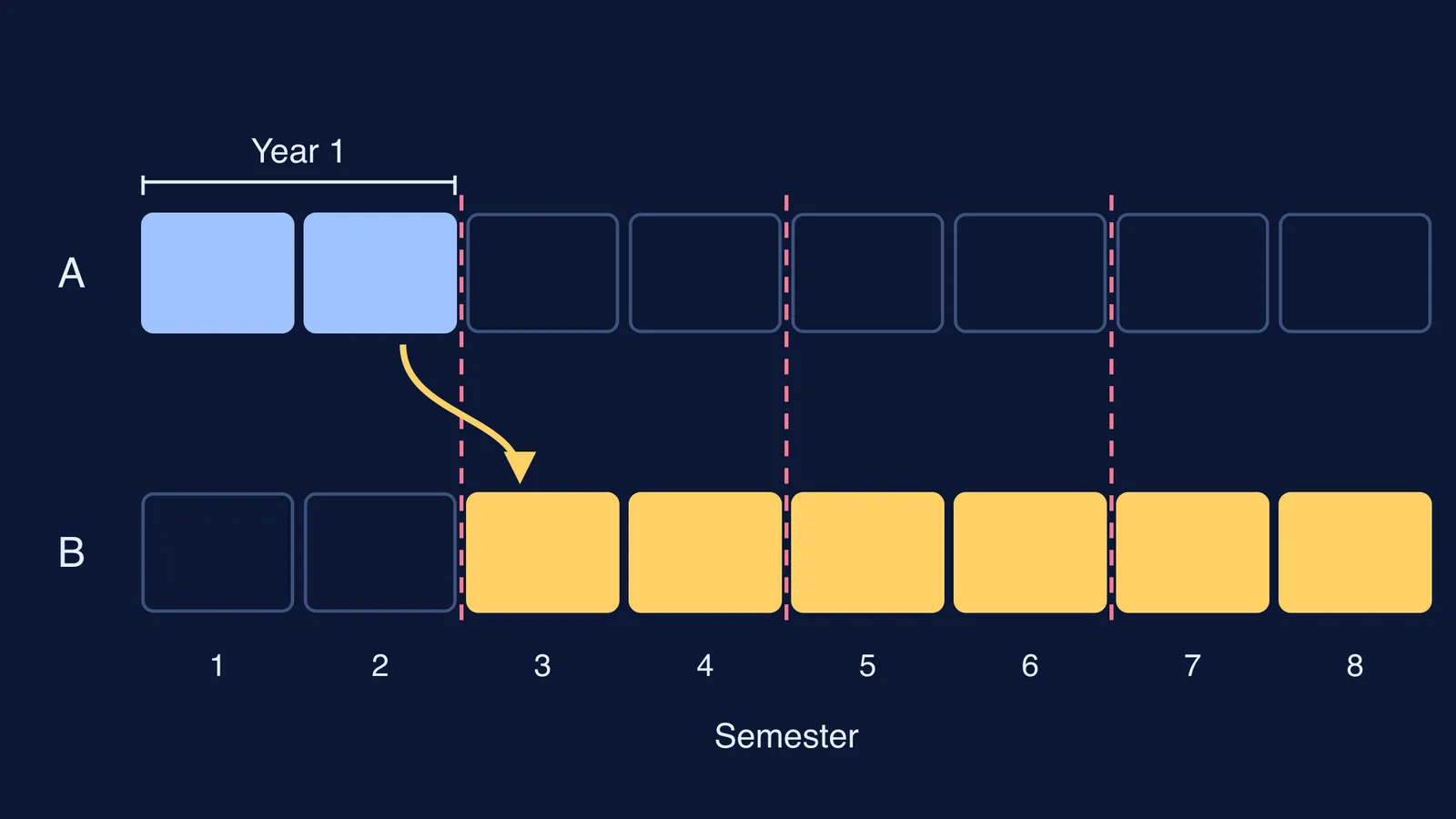
Often not before then, and only at set points. Anna University's published rules are a clear example: a student on its B.E., B.Tech and other listed programmes must complete the first year, and transfer requests are considered only at the start of the third, fifth or seventh semester (Anna University, transfer of students between engineering colleges). Its other conditions are worth asking your own university about:
Same branch only; a transfer cannot also be a branch change.
A vacancy must exist in that branch at the new college, within its sanctioned strength.
The application needs the consent of the principals of both colleges.
Government and aided colleges exchange students only with each other, and self-financing colleges only with self-financing ones.
The student keeps attending the present college until the transfer order is issued.
Forwarding an application gives no right to a transfer; the university can accept, reject or withhold it without giving reasons.
Moving to a college under a different university, or in another state, can be harder. Ask the new university in writing whether it admits students into second year this way at all, and ask the present one how it issues a migration certificate.
What about MBBS and other medical courses?
Medicine is stricter. Regulation 18 of the National Medical Commission's Graduate Medical Education Regulations, 2023 banned the migration of MBBS students between colleges outright (Medical Dialogues). On 4 February 2026 a Delhi High Court bench declared that regulation invalid and directed the NMC to frame a policy that permits migration with conditions and safeguards (LawTrend). The court said migration could be allowed in extremely exceptional circumstances and only in the most deserving cases, so check the NMC's own notices for the current rule before counting on one.
Will my child lose credits if they change college?
If you want a refresher first, read our explainer on how the college credit system works, from credits to CGPA.
The Academic Bank of Credits (ABC) is the Ministry of Education's platform for storing, accumulating, transferring and redeeming academic credits, and students create an APAAR ID through DigiLocker (Academic Bank of Credits). The UGC regulations that set it up, notified on 28 July 2021, carry three catches worth knowing (UGC Academic Bank of Credits Regulations, 2021):
Credits stay valid for a period the institutions set, up to a maximum of seven years.
A student who builds a degree from courses at several institutions must earn at least 50% of the credits from the institution that awards it.
ABC accepts credit records only when the institution sends them, not documents sent in by the student.
Even with ABC, the new college decides which of your child's courses match its own syllabus. A first-year subject it does not recognise may have to be taken again. A backlog matters too: for transfers involving autonomous colleges, Anna University expects the student to have passed all examinations held so far and to produce the evidence.
Is a transfer the right fix?
If it is the branch rather than the college, read about sliding and minors when your child is unhappy with the allotted branch. If the plan is to sit counselling again for a better seat, check whether you can join a later counselling round after joining a college. If it is loneliness, ragging, health or money, talk to the college's counselling centre, the anti-ragging committee or a doctor first; a new campus will not fix those on its own.
A step-by-step transfer checklist
Write the reason in one sentence, and what would count as fixed.
Find your university's transfer or migration rules on its official site and note the window.
Shortlist colleges under the same university, in the same branch and the same category.
Email each one to ask whether it expects a vacancy in that branch next year.
Activate your child's APAAR ID and check that first-year credits appear.
Clear any backlog before applying, and keep the mark sheets ready.
Ask for the present principal's consent, then the new principal's.
Apply through the university, pay its fee and keep copies of everything.
Keep attending classes until the written transfer order arrives.
Only then collect the transfer certificate, and ask the new college which subjects must be repeated.
If a first-year maths or physics paper is the backlog in the way, the Fermi Concept Library has a lesson for every concept in physics and mathematics, so your child can rebuild one topic at a time before the supplementary exam.