On this page
Transitioning from school or entrance exams like JEE and NEET into university introduces a new academic currency. Instead of tracking aggregate marks across five subjects, colleges evaluate degree progress through academic credits, grade points, and weighted averages. Understanding how these pieces connect is vital from your first semester at college to keep graduation on schedule.
What is a college credit and how is it measured?
An academic credit measures the instructional workload of a course. Under the UGC Curriculum and Credit Framework for Undergraduate Programmes, universities in India define one credit as one hour of lecture or tutorial, or two hours of laboratory practical or fieldwork weekly over a 15-week semester (comprising 90 working days). One credit equals 15 hours of lecture instruction or 30 hours of laboratory work across the semester.
International frameworks follow an equivalent model. In the United States, under federal regulation 34 CFR § 600.2, one credit hour approximates one hour of classroom instruction and two hours of out-of-class study weekly over a 15-week semester—representing 45 hours of student effort per credit, or 180 total hours for a four-credit course. Under the UGC framework, credits similarly govern full-time course scheduling.
How are SGPA and CGPA calculated?
Colleges evaluate performance using the Choice Based Credit System (CBCS) 10-point scale established in the UGC CBCS guidelines. Percentage marks convert into letter grades with fixed grade points: O (10), A+ (9), A (8), B+ (7), B (6), C (5), P (4), and F (0).
Semester Grade Point Average (SGPA) measures your standing in a single term. Under UGC grading guidelines, SGPA is the credit-weighted average of course grade points:
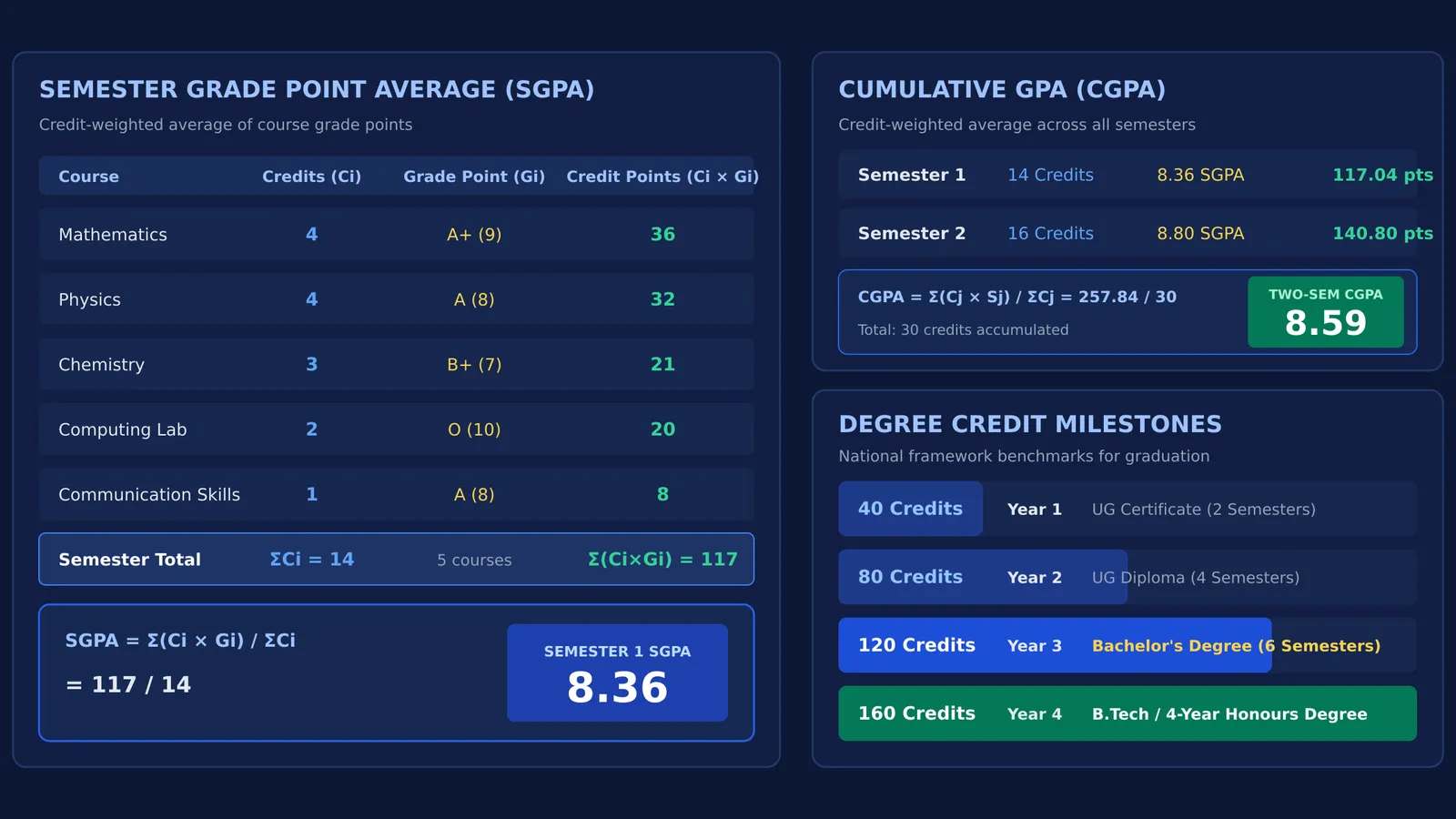
SGPA = Σ(Ci × Gi) / ΣCi
Here, Ci is the credit value of course i, and Gi is the grade point earned. Multiplying Ci by Gi yields credit points. Consider a student taking five courses under the UGC CBCS model:
Mathematics (4 credits) at Grade A+ (9 points): 36 points
Physics (4 credits) at Grade A (8 points): 32 points
Chemistry (3 credits) at Grade B+ (7 points): 21 points
Computing Lab (2 credits) at Grade O (10 points): 20 points
Communication Skills (1 credit) at Grade A (8 points): 8 points
Summing the credits gives ΣCi = 14, while credit points total Σ(Ci × Gi) = 117. Dividing 117 by 14 gives an SGPA of 8.36.
Cumulative Grade Point Average (CGPA) measures performance across all completed semesters. Under UGC guidelines, CGPA weights each semester's SGPA (Sj) by its credit total (Cj):
CGPA = Σ(Cj × Sj) / ΣCj
If Semester 1 has 14 credits at 8.36 SGPA and Semester 2 has 16 credits at 8.80 SGPA, total points equal (14 × 8.36) + (16 × 8.80) = 257.84 across 30 credits, giving a CGPA of 8.59.
Why does course credit weighting matter for your GPA?
Because GPA formulas weight grade points by course credits, high-credit subjects act as heavy levers on your transcript. A poor grade in a 4-credit core subject depresses your SGPA four times more than the same grade in a 1-credit seminar under UGC evaluation rules. Conversely, securing an O grade in a 4-credit course adds 40 credit points directly to your numerator.
This structure means revision hours must scale with credit weight. When working through demanding high-credit mathematics and physics courses, passive reading frequently leaves conceptual gaps undetected. The Fermi Problem Library has worked problems with a step-by-step solver that explains the reasoning rather than printing an answer, helping students build methodical problem-solving routines before examinations.
What do credit requirements mean for graduation?
Graduating requires accumulating a prescribed threshold of cleared credits. The UGC Curriculum and Credit Framework for Undergraduate Programmes establishes that a three-year bachelor's degree requires a minimum of 120 credits across six semesters, while a four-year honours or research degree requires 160 credits across eight semesters. Students must average 40 credits per academic year to graduate on time.
Technical degrees follow comparable benchmarks. Under AICTE guidelines, a four-year B.Tech degree requires 160 credits, distributed across humanities (12 credits), basic sciences (24 credits), engineering sciences (24 credits), professional core subjects (48 credits), electives (36 credits), and project work or internships (16 credits).
Earning credits requires at least a passing grade (Grade P, worth 4 points under UGC guidelines). Failing a course pulls down your SGPA and leaves a credit deficit that must be cleared during re-examinations or summer terms. For students looking to solidify foundational principles before taking higher-level electives, Fermi Courses offers university-level courses taught by working scientists, with the AI tutor available on every lecture.
How should you plan your semester credits?
Managing college credits requires treating your degree like a multi-year academic budget:
Balance theory with practicals: Target 20 to 22 credits per semester under AICTE guidelines, pairing heavy 4-credit theory lectures with 2-credit laboratory practicals to keep weekly workloads manageable.
Map prerequisites early: Advanced departmental electives require foundational prerequisites; register under the UGC framework so that essential gateway courses are completed on schedule.
Adopt active study habits: Independent coursework demands learning how to read a scientific paper. Testing yourself regularly and spacing revision sessions produce far more durable retention than rereading notes.
Monitor your Academic Bank of Credits: Under national policy, your earned credits are stored in the digital Academic Bank of Credits (ABC), enabling credit mobility and recognized multi-entry or exit pathways.
Understanding credit mechanics transforms university degree requirements into an actionable roadmap. For families navigating college academic demands together, see our guide on how parents can help children learn without adding pressure.