

On this page
A mass on a spring is the standard example of simple harmonic motion (SHM) in Class 11 physics, and it is easy to simulate. The catch is that watching a block bounce teaches you very little on its own. This guide gives you five predictions to write down and then check, with numbers you can work out first.
Why predict before you press play?
In 2004, Catherine Crouch, Eric Mazur and colleagues compared different ways of showing physics demonstrations to students (American Journal of Physics, 2004). Students who only watched a demonstration understood the concept no better than students who never saw it. Students who predicted the outcome before seeing it showed significantly greater understanding.
A simulation is a demonstration you control, so the same habit is worth trying. Before every run, write one line: what you expect and why. Then run it. If you were wrong, that line tells you exactly which idea to fix.
What does the period of a mass-spring system depend on?
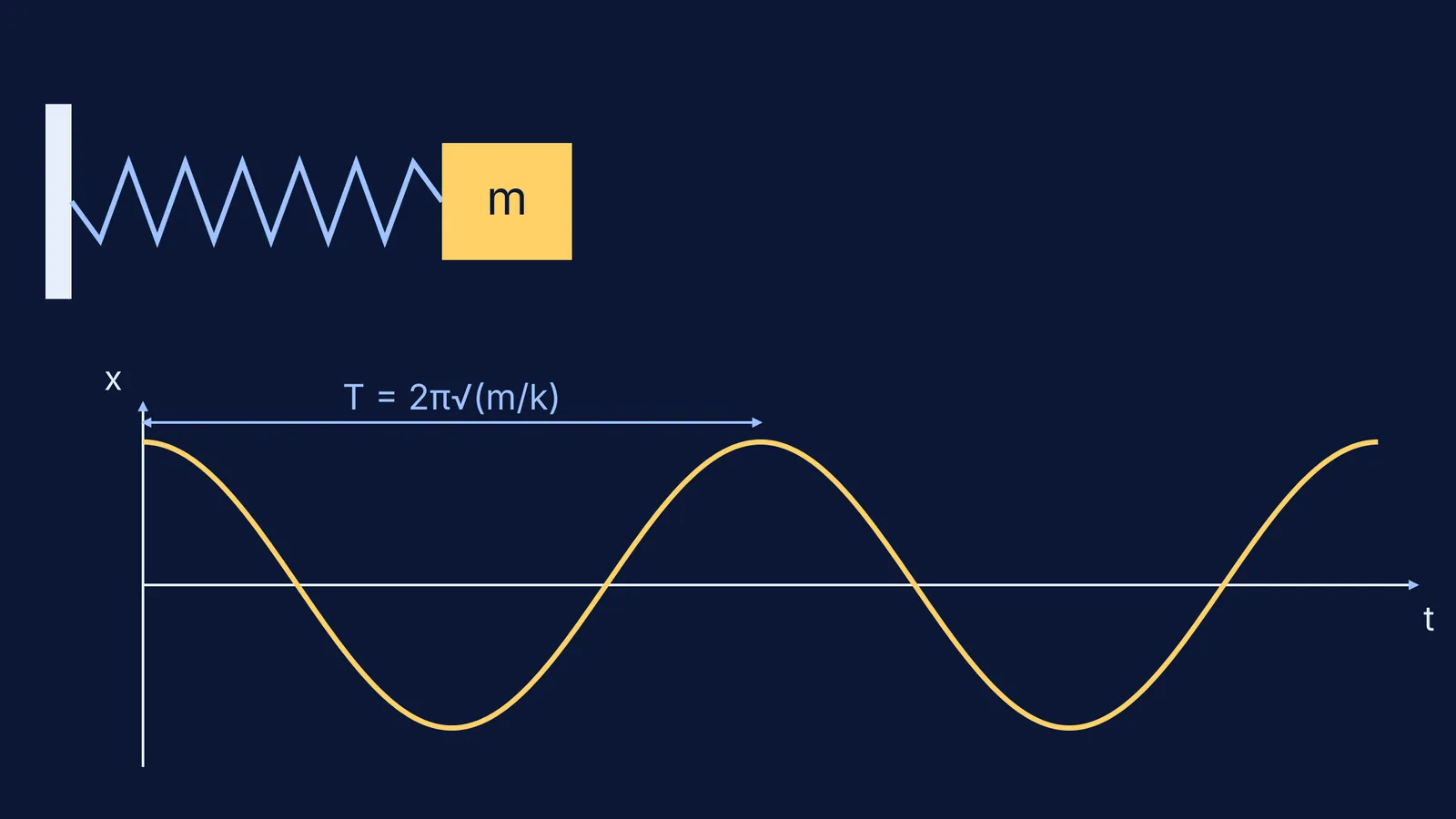
In simple harmonic motion, the acceleration, and so the net force, is proportional to the displacement and acts in the opposite direction (OpenStax University Physics, 15.1). For a block on a light spring, the period is T = 2π√(m/k), where m is the mass and k is the spring constant, and it does not depend on amplitude (same source).
Set up a simulation with m = 0.5 kg and k = 50 N/m. Then ω = √(k/m) = 10 rad/s and T = 2π/10 ≈ 0.63 s. Now test these:
Quadruple the mass to 2 kg. Prediction: T doubles to about 1.26 s, because T grows with √m, not with m. Time ten oscillations and divide by ten to check.
Double the stiffness to 100 N/m. Prediction: T drops by a factor of √2, to about 0.44 s.
Pull the block 10 cm instead of 5 cm. Prediction: the period stays at about 0.63 s. The block travels twice as far but at twice the speed, so the timing comes out the same.
If you can run two blocks side by side, start them at 5 cm and 10 cm and watch them pass the centre together.
How does energy move between kinetic and potential?
The total energy of a block and spring is E = ½kA², where A is the amplitude (OpenStax University Physics, 15.2). With no damping, the energy goes back and forth between kinetic and potential: at the turning points it is all potential, and at the equilibrium position it is all kinetic (same source).
Predict the energy and top speed. With k = 50 N/m and A = 5 cm, E = ½ × 50 × 0.05² ≈ 0.063 J. At A = 10 cm, E = 0.25 J, because energy goes with the square of the amplitude. The maximum speed is Aω (same source): 0.5 m/s for the 5 cm pull and 1.0 m/s for the 10 cm pull.
If your simulation shows energy bars, the kinetic bar should peak at the centre and the potential bar at each end, always adding to the same total. If the total shrinks, damping is switched on.
For more practice with spring energy and oscillation timing, try our walkthrough of elastic potential energy in a stretched wire and the companion piece on how a seconds pendulum's period changes with length and g.
What does damping change in simple harmonic motion?
In a real system, a damping force removes energy, usually as thermal energy, so the amplitude gets smaller over time (OpenStax University Physics, 15.5). For a damping force proportional to velocity with constant b, the amplitude decays as e^(−bt/2m) (same source). An underdamped system keeps oscillating as it dies away, a critically damped system (b = √(4mk)) returns to equilibrium as quickly as possible without oscillating, and an overdamped system returns more slowly, also without oscillating (same source).
Add light damping, b = 1 kg/s, to the 0.5 kg block. Prediction: the amplitude halves after about ln 2 ≈ 0.69 s, roughly one period, while the period itself barely changes. Damping lowers the angular frequency to √(k/m − (b/2m)²) (same source), which here is √99 ≈ 9.95 rad/s instead of 10. Then raise b to 10 kg/s, the critical value for this block, and predict that it will slide back to the centre without overshooting.
How do you write up what you found?
A one-page log is enough for revision:
The change you made (one variable at a time)
Your prediction, with the formula you used
What the simulation showed
If you were wrong, the sentence that fixes your idea
Try this with the Fermi Simulation Lab, our interactive simulations for ideas that are easier to see than to read. If a result puzzles you, Fermi's AI tutor can run the simulation with you and check your understanding as it goes. Once springs make sense, take the same predict-then-check habit to the tension in a simple pendulum's string.


