

On this page
After months of intense preparation, opening the seat allotment portal to find an unexpected branch—such as Civil, Chemical, Metallurgy, or Mining—can feel devastating for a student aiming for Computer Science. For parents, watching a child struggle with disappointment is painful. Before rushing into a panic or forfeiting the seat, pause. An allotted seat is not a four-year trap. Today's engineering admissions and academic frameworks offer structured mechanisms to upgrade, pivot, and specialise. Understanding counselling mechanics, recent policy changes around branch transfers, and minor degree options gives families a calm, practical path forward.
Should you choose Slide or Float in JoSAA counselling?
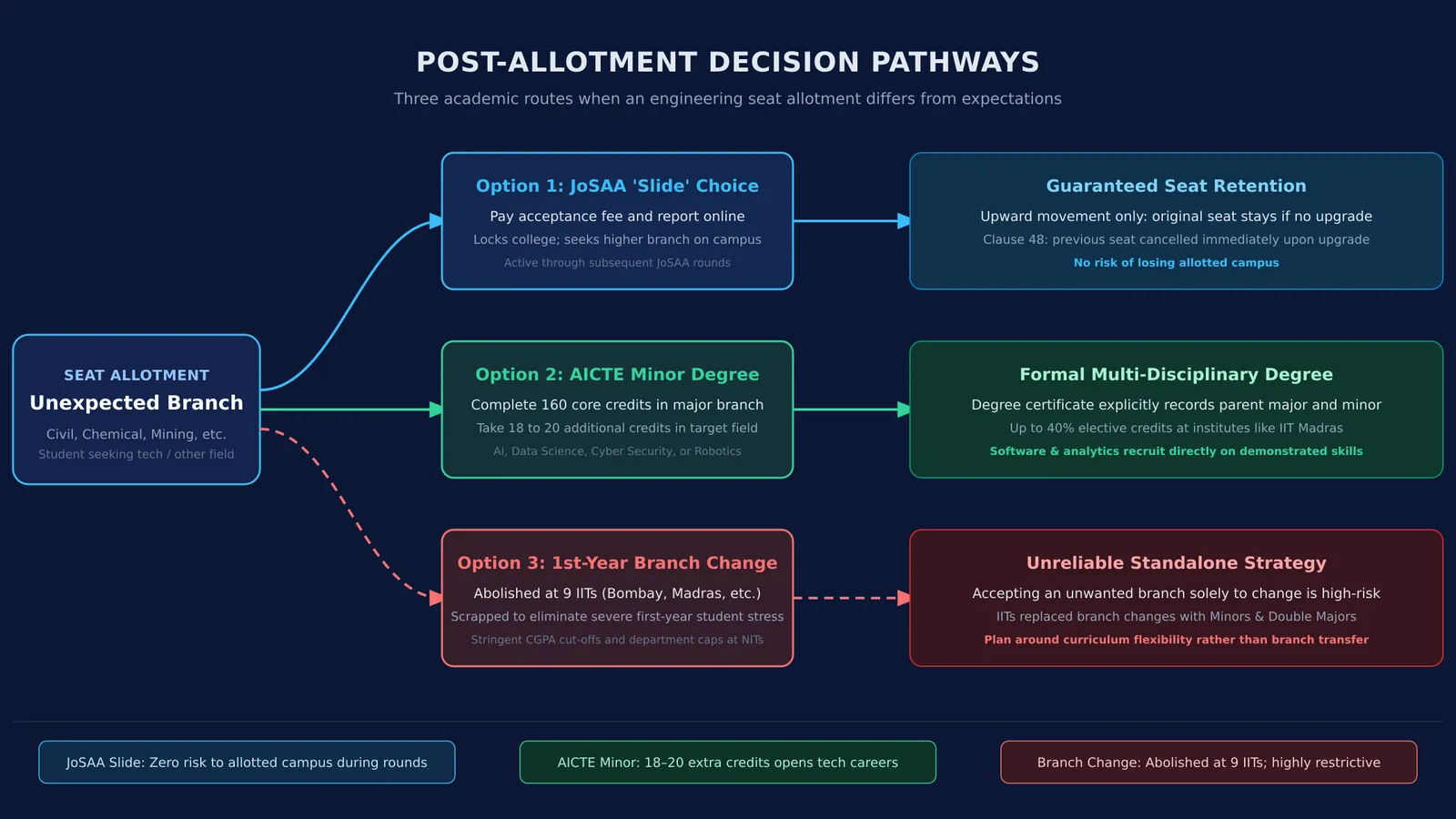
If your child received an engineering seat through JoSAA but wants a different programme, their first opportunity to adjust lies in counselling. During online reporting, candidates choose one willingness option: Freeze, Float, or Slide. Freeze confirms the allotted institute and branch, ending further rounds. Float accepts the seat while seeking higher-preference choices across any institute. Slide accepts the seat but considers the student only for higher-preference branches within the same institute.
To keep Float or Slide active, candidates must complete online reporting, upload certificates, and pay the Seat Acceptance Fee—Rs. 35,000 for General, GEN-EWS, and OBC-NCL students, or Rs. 17,500 for SC, ST, and PwD candidates. Missing this deadline cancels the seat entirely. As explained in our guide to JoSAA counselling basics, upgrades are strictly upward and irreversible under Clause 48 of JoSAA Business Rules. If an upgrade is granted, the earlier seat is immediately cancelled. After JoSAA rounds conclude, families can also enter CSAB special rounds, which reallocate over 15,000 vacant seats across the NIT and IIIT system.
Can a student still change branches after the first year?
Historically, coaching centres advised students to take any branch at a prestigious institute and change to Computer Science after first year via a high Cumulative Grade Point Average (CGPA). Today, banking on that route is dangerous. At least nine Indian Institutes of Technology have completely abolished first-year branch changes to reduce academic stress. Following recommendations from its Academic Stress Mitigation Committee, IIT Bombay scrapped branch change starting with its 2023 batch. IIT Madras discontinued it for the 2024–25 academic year, joining IIT Kharagpur, IIT Hyderabad, IIT Jammu, IIT Mandi, IIT Dhanbad, IIT Dharwad, and IIT Bhubaneswar.
These institutes acted because the intense competition for top grades caused severe psychological strain, while only a small fraction of applicants successfully secured transfers. Although many National Institutes of Technology (NITs) still permit branch changes, they enforce stringent cut-offs—typically requiring exceptional academic standing and capping the number of students allowed to leave any single department. Entering your first semester at college assuming you will switch branches is therefore an unreliable gamble.
How do minor degrees and open electives solve the branch dilemma?
Fortunately, engineering curricula have introduced substantial flexibility. Under model curriculum guidelines issued by AICTE, a standard B.Tech degree requires 160 credits. By completing 18 to 20 additional credits in another discipline, students earn a formal Minor Degree. A student in Mechanical or Civil Engineering can earn a recognized Minor in Artificial Intelligence, Data Science, or Robotics, formally printed on their degree.
Institutes increasingly encourage cross-disciplinary learning. IIT Madras restructured its curriculum so that up to 40% of credits can be taken as electives, and IIT Kharagpur offers a Double Major option. Tech recruiters evaluate applicants on coding competence, projects, and coursework rather than parent branch labels alone. For students tackling demanding computing or mathematics coursework alongside their major, the Fermi Concept Library covers core concepts across mathematics and computing, while Fermi's AI tutor works out what a student already knows, builds a plan for the session, and teaches through unfamiliar problem sets.
What should parents say when their child is devastated?
When an allotment falls short of expectations, teenagers often interpret it as personal failure. Supportive parenting means listening before offering solutions:
Acknowledge their disappointment: Validate their feelings rather than saying "at least you got a seat."
Separate branch from career: Point out that software, analytics, and consulting roles recruit across branches based on demonstrated skill.
Review the first-year syllabus: Foundational first-year courses—calculus, physics, and introductory programming—are largely identical across engineering disciplines, giving students time to explore.
Weigh options calmly: Decide whether to choose Slide in counselling, target an AICTE minor degree, or consider a repeat year only if their specific interest cannot be pursued otherwise.
If your child experiences severe distress or panic, mental health must come first. Our guide on supporting teenagers through academic stress provides practical coping steps. Parents and students across India can also dial Tele MANAS at 14416 or 1800-891-4416 for free, 24/7 support from trained mental health counsellors.


