

On this page
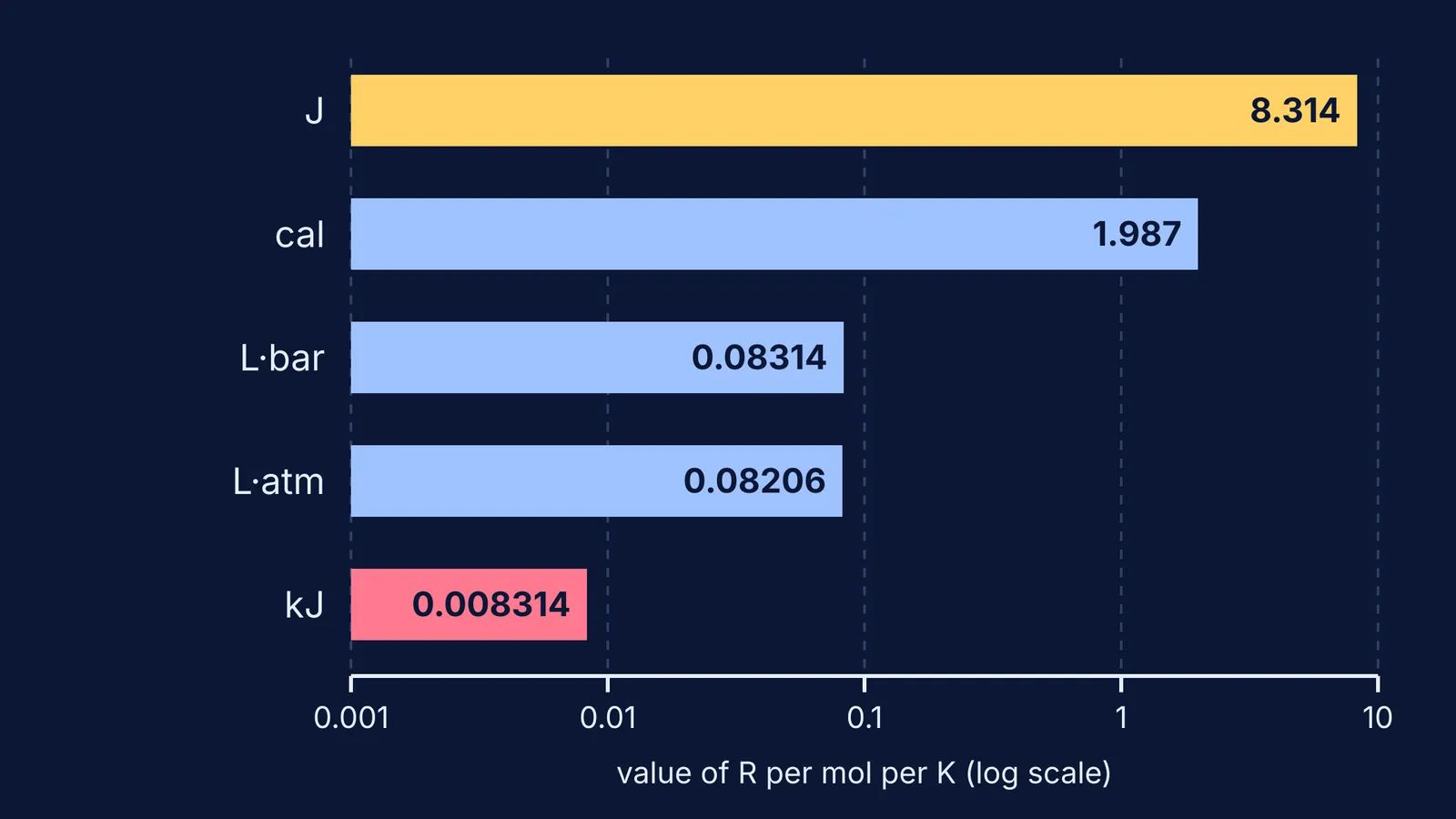
R is one constant written in different units. The number you plug in depends on the units used by the rest of your equation. Pick the wrong one and your answer won't be slightly off: it will be off by a factor of 100, 1,000 or worse.
Why does R have so many values?
The molar gas constant has an exact value: R = 8.314 462 618... J mol⁻¹ K⁻¹, according to the NIST CODATA 2022 value for R. It is the product of two constants NIST also lists as exact: the Boltzmann constant, 1.380 649 × 10⁻²³ J K⁻¹, and the Avogadro constant, 6.022 140 76 × 10²³ mol⁻¹.
Everything else is a unit conversion. The NIST Guide to the SI conversion factors give 1 atm = 101 325 Pa, 1 bar = 100 000 Pa, 1 L = 10⁻³ m³ and 1 thermochemical calorie = 4.184 J, all exact. A joule is a pascal times a cubic metre, so dividing gives the values in your textbook:
8.314 J mol⁻¹ K⁻¹ (the same as Pa m³ mol⁻¹ K⁻¹)
8.314 × 10⁻³ kJ mol⁻¹ K⁻¹
0.08314 L bar mol⁻¹ K⁻¹
0.08206 L atm mol⁻¹ K⁻¹, often rounded to 0.0821
1.987 cal mol⁻¹ K⁻¹, often rounded to 2
Which value of R should you use?
Read the units of every other quantity first. Then pick the R that cancels them.
Pressure in atm and volume in litres: 0.0821 L atm. Pressure in bar: 0.08314 L bar.
Pressure in Pa and volume in m³, or any energy in joules (ΔG°, Ea, work, ΔU): 8.314.
Energy given in kJ: convert it to J, or use 8.314 × 10⁻³.
Energy in calories, as in older papers and reference books: 1.987, or 2 if the question says so.
If the question states a value of R, use that value.
In every case, temperature goes in kelvin.
Worked example: PV = nRT with litres
Take 2.00 mol of gas at 300 K in 10.0 L, and find P = nRT/V.
With 0.08206: P = 2.00 × 0.08206 × 300 / 10.0 = 4.92 atm.
With 0.08314: P = 4.99 bar. This is the same pressure, because 1 atm is 1.01325 bar (NIST conversion factors).
With 8.314 and V still in litres: 499. That is neither atm nor bar. It is kPa, because a joule per litre is a kilopascal.
For more practice, see ideal gas problems and the units trap.
How does the wrong R change a ΔG° = −RT ln K answer?
The relation is ΔG° = −RT ln K, or ΔG° = −2.303 RT log K. The LibreTexts chapter on free energy and equilibrium/15%3A_Thermodynamics_of_Chemical_Equilibria/15.06%3A_Free_energy_and_Equilibrium) works it with R = 8.314 J K⁻¹ mol⁻¹, with ΔG° written in joules.
Say ΔG° = −20.0 kJ mol⁻¹ at 298 K.
Correct: ln K = 20 000 / (8.314 × 298) = 8.07, so K ≈ 3.2 × 10³ (log K = 3.51).
Leaving ΔG° as 20.0 with R = 8.314: ln K = 0.0081, so K ≈ 1.01. The reaction now looks evenly balanced, when products are strongly favoured.
Using 0.0821: ln K ≈ 818, which is nonsense, because L atm does not match the joules in ΔG°.
See Gibbs energy and spontaneity, worked out for the sign rules.
What goes wrong in Arrhenius problems?
Start from k = A e^(−Ea/RT), as given on the LibreTexts Arrhenius page. For two temperatures it becomes ln(k₂/k₁) = (Ea/R)(1/T₁ − 1/T₂).
Say the rate doubles from 27 °C to 37 °C.
In kelvin (300 K and 310 K): 1/300 − 1/310 = 1.075 × 10⁻⁴ K⁻¹. Ea = 8.314 × ln 2 / (1.075 × 10⁻⁴) = 53 600 J mol⁻¹, or 53.6 kJ mol⁻¹.
With Celsius left in: 1/27 − 1/37 = 0.0100, so Ea = 576 J mol⁻¹. That is about 93 times too small.
With R = 1.987: Ea = 12.8 kcal mol⁻¹. That is the same energy as 53.6 kJ mol⁻¹, so it is fine as long as you label the unit.
The full method is in the Arrhenius equation: finding activation energy from rate data.
A 30-second check before you press equals
Write the units of R next to the number, not just 8.314.
Cancel the units against every other quantity on paper.
Convert °C to K, and kJ to J (or R to kJ).
If your answer is off by about 100 or 1,000, suspect kPa against bar, or kJ against J.
If unit slips keep costing you marks, the Fermi Problem Library has worked problems with a step-by-step solver that explains the reasoning rather than printing an answer, so you can see where each unit cancels. For gaps in the ideas behind the equations, the Fermi Concept Library gives each chemistry concept its own lesson.
Whenever you write R, write its units too.


