

On this page
Escape velocity is defined as the minimum initial velocity required for an object to escape the surface of a planet and never return. When launched at this exact speed, the object travels an infinite distance before finally coming to rest.
Because gravity stretches out infinitely, the object must have enough initial kinetic energy to overcome the gravitational pull at every step of the journey. For Earth, this escape speed is approximately 11.2 km/s.
How do we derive the escape velocity formula?
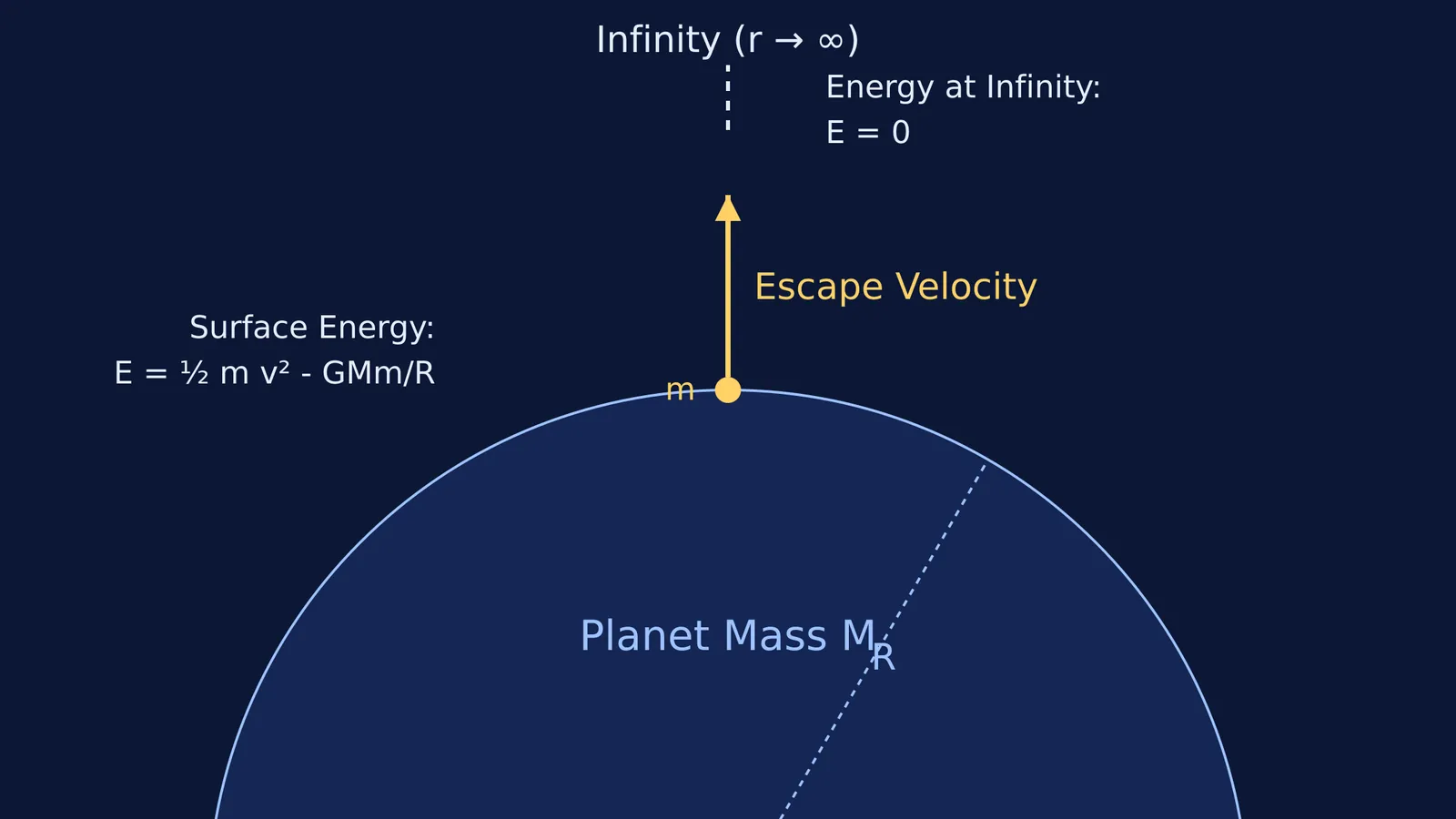
The derivation relies on the principle of conservation of mechanical energy. We track the object at two extreme points: the moment of launch from the planet's surface, and the moment it reaches an infinite distance.
1. Energy at the surface Consider a planet with mass *M* and radius *R*. You launch an object of mass *m* straight up from its surface with the escape velocity *vₑ*.
The object's initial kinetic energy is `K = ½ m vₑ²`.
Its initial gravitational potential energy is `U = −GMm / R`, where *G* is the universal gravitational constant.
The total initial energy is the sum of these two:
`E_initial = ½ m vₑ² − GMm / R`
2. Energy at infinity At an infinite distance (*r* → ∞), the planet's gravitational pull drops to zero, so the potential energy `U` becomes zero. Because we are finding the minimum speed required to escape, the object gives up the last of its kinetic energy just as it reaches infinity, meaning `K` is also zero.
The total final energy is therefore:
`E_final = 0`
3. Setting total energy to zero By conservation of energy, the total energy remains constant throughout the journey. We equate the initial energy to the final energy: `½ m vₑ² − GMm / R = 0`
Now, we solve for *vₑ*: `½ m vₑ² = GMm / R`
The mass of the escaping object (*m*) cancels out on both sides: `vₑ² = 2GM / R`
Taking the square root gives the standard formula: `vₑ = √(2GM / R)`
If you are exploring these energy principles, the Fermi Concept Library can help you step through the physics of gravitation and conservation laws with interactive lessons.
How do you rewrite the formula as √(2gR)?
In many textbook problems, you are given the acceleration due to gravity (*g*) instead of the planet's mass. We know that gravity at the surface is given by: `g = GM / R²`
Rearranging this gives: `GM = gR²`
Substitute `gR²` into our escape velocity formula in place of `GM`: `vₑ = √(2(gR²) / R)`
Simplify the fraction by cancelling one *R*, and you arrive at the alternate form: `vₑ = √(2gR)`
This makes calculations much simpler if you already know the surface gravity and radius. For Earth, plugging in `g ≈ 9.8 m/s²` and `R ≈ 6.4 × 10⁶ m` gives the familiar value of 11.2 km/s. If you are stuck on orbital mechanics questions like this, the Fermi Problem Library has a step-by-step solver that explains the reasoning for every substitution.
Does escape velocity depend on the object's mass?
No. Notice that the small mass *m* cancelled out during the derivation. Whether you are launching a tiny dust particle or a massive rocket, the escape velocity from Earth remains exactly the same. The only variables that matter are the mass and radius of the planet you are escaping from.
Also, unless you count air resistance, the angle of your launch does not change the escape velocity. As long as the object does not hit the ground, the conservation of energy guarantees that starting with `vₑ` provides exactly enough energy to break free.
A practical framework for solving escape velocity problems
When you face a gravitation problem in an exam like JEE or NEET, follow this four-step checklist to avoid common mistakes:
Identify the starting point: The formula `√(2GM/R)` assumes you are starting at the planet's surface. If the object is already in orbit at a height *h*, your starting radius is `R + h`.
Check the given variables: Decide whether it is faster to use the `G` and `M` form or the `g` and `R` form. If the question gives you ratios of planet densities and radii, rewrite the mass as volume times density before comparing them.
Set up the energy equation: Instead of jumping straight to the final formula, write out `K_initial + U_initial = K_final + U_final`. This prevents sign errors, especially if the final state is not at infinity (for example, finding the maximum height reached).
Remember the constants: For quick estimates, memorise that Earth's escape velocity is roughly 11.2 km/s. If your answer is wildly different, check your units.
This energy approach is identical to the logic used in electrostatics. For a direct comparison, see our guide on the Work to assemble point charges: the pairwise kq₁q₂/r sum. Similarly, understanding the energy bounds of a trajectory helps when studying the Equation of trajectory of a projectile: finding u and θ from it.


