On this page
James Joseph Sylvester was a London-born mathematician who named the matrix and coined the word invariant, for a quantity that stays the same when you change variables. If you are meeting matrices in Class 12, you are using his vocabulary.
Who coined the word matrix?
Sylvester introduced the word "matrix" into mathematics in 1850, in a paper in the Philosophical Magazine, according to Jeff Miller's Earliest Known Uses of Some of the Words of Mathematics. The word already meant "the place from which something else originates". For Sylvester, that something was determinants.
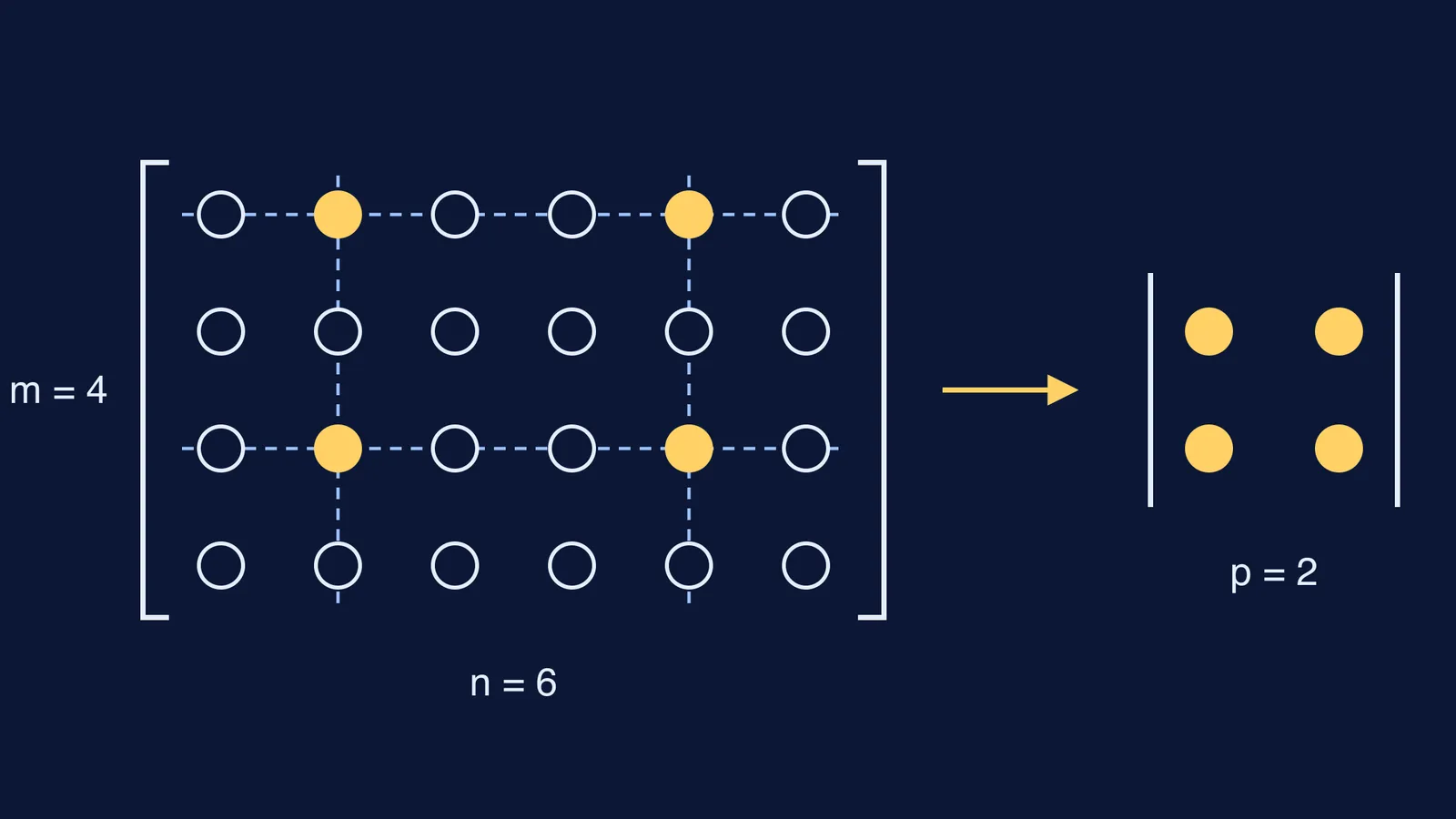
His own definition, quoted on the same page: "we must commence, not with a square, but with an oblong arrangement of terms consisting, suppose, of m lines and n columns. This will not in itself represent a determinant, but is, as it were, a Matrix out of which we may form various systems of determinants".
So a matrix began as a source of determinants, not as something you add and multiply. The MacTutor history of matrices and determinants credits Arthur Cayley's 1858 Memoir on the theory of matrices with the first abstract definition of a matrix and its algebra. That half of the story is in Arthur Cayley and the matrix algebra you use in Class 12.
How many determinants hide inside one matrix?
Sylvester's recipe: fix a number p, choose any p lines and any p columns, and take the square where they cross. Each square has a determinant; today we call these minors. Here is the count for a matrix with 3 rows and 4 columns.
p = 1: each entry on its own, so 3 × 4 = 12.
p = 2: choose 2 of 3 rows (3 ways) and 2 of 4 columns (6 ways), so 18.
p = 3: all 3 rows (1 way) and 3 of 4 columns (4 ways), so 4.
p = 4: impossible, as there are only 3 rows.
That is 34 determinants from a rectangle that has no determinant of its own. The rule for each p is C(m, p) × C(n, p). The adjoint of a 3×3 matrix needs C(3, 2) × C(3, 2) = 9 of them, which is why finding minors and cofactors of a 3x3 matrix takes the time it does.
Who was James Joseph Sylvester?
The MacTutor biography of Sylvester gives the outline. Born in London on 3 September 1814, he came second in the Cambridge mathematical tripos in 1837 but could not graduate: students had to sign the Thirty-Nine Articles of the Church of England, and Sylvester, being Jewish, refused. He worked as an actuary, then studied law, and at Lincoln's Inn met Arthur Cayley; they became lifelong friends. In 1877 he took a chair at Johns Hopkins University, and in 1878 founded the American Journal of Mathematics, the first mathematical journal in the United States. At 68 he became Savilian professor of Geometry at Oxford. He died in London on 15 March 1897.
What is an invariant, and why did Sylvester care?
An invariant is a quantity that does not change when you transform the variables. Sylvester coined the word in 1851, writing of "the two well-known hyperdeterminants, or, as I propose henceforth to call them, the two Invariants", as recorded in Miller's entry for invariant.
In the same 1851 paper he named the discriminant, the expression that tells you when an equation has two equal roots, according to Miller's entry for discriminant. You know one: b² − 4ac.
Watch it behave as an invariant. Replace x with x + h in ax² + bx + c, which slides the parabola sideways. You get ax² + (2ah + b)x + (ah² + bh + c), with discriminant (2ah + b)² − 4a(ah² + bh + c). Expand it and every h term cancels, leaving b² − 4ac. Sliding a parabola never changes how many roots it has, and the algebra agrees.
How can you use Sylvester's ideas in Class 12?
Write the order m × n before you multiply or invert. Sylvester started from the shape.
Count the minors a question needs with C(m, p) × C(n, p) before you start, so you know the work ahead.
When something is transformed, ask what stays the same. Adding a multiple of one row to another leaves a determinant unchanged, which is why row operations simplify it.
If minor, cofactor or rank is still hazy, the Fermi Concept Library gives every mathematics concept its own lesson and its place in the map. When a determinant goes wrong, the Fermi Problem Library has a step-by-step solver that explains the reasoning rather than printing an answer, so you can see which step slipped.