On this page
In July 1823, Johann Wolfgang Döbereiner, professor of chemistry at the University of Jena, found that dust-like platinum makes hydrogen and oxygen combine into water by mere contact (University of Jena: Goethe and chemistry). He turned it into a table lighter that still shows clearly what a catalyst does.
What was Döbereiner's lamp?
It was a tabletop lighter. A Science Museum example is made of glass, tin and brass; its catalogue says it used zinc, sulfuric acid, hydrogen and platinum to make "heat strong enough to set tinder on fire" (Science Museum Group collection).
George Kauffman wrote in Platinum Metals Review that Döbereiner's work on platinum black and hydrogen led to this lighter, the Feuerzeug, and to Berzelius' concept of catalysis (Kauffman, 1999).
Sales figures disagree: the Science Museum says more than 20,000 were sold in Germany and Britain in the 1820s, while Wikipedia's page on the lamp, citing a catalysis textbook, says "it is said" that over a million were sold. That page calls the lamp the first commercial application of heterogeneous catalysis.
How did the hydrogen and platinum lighter work?
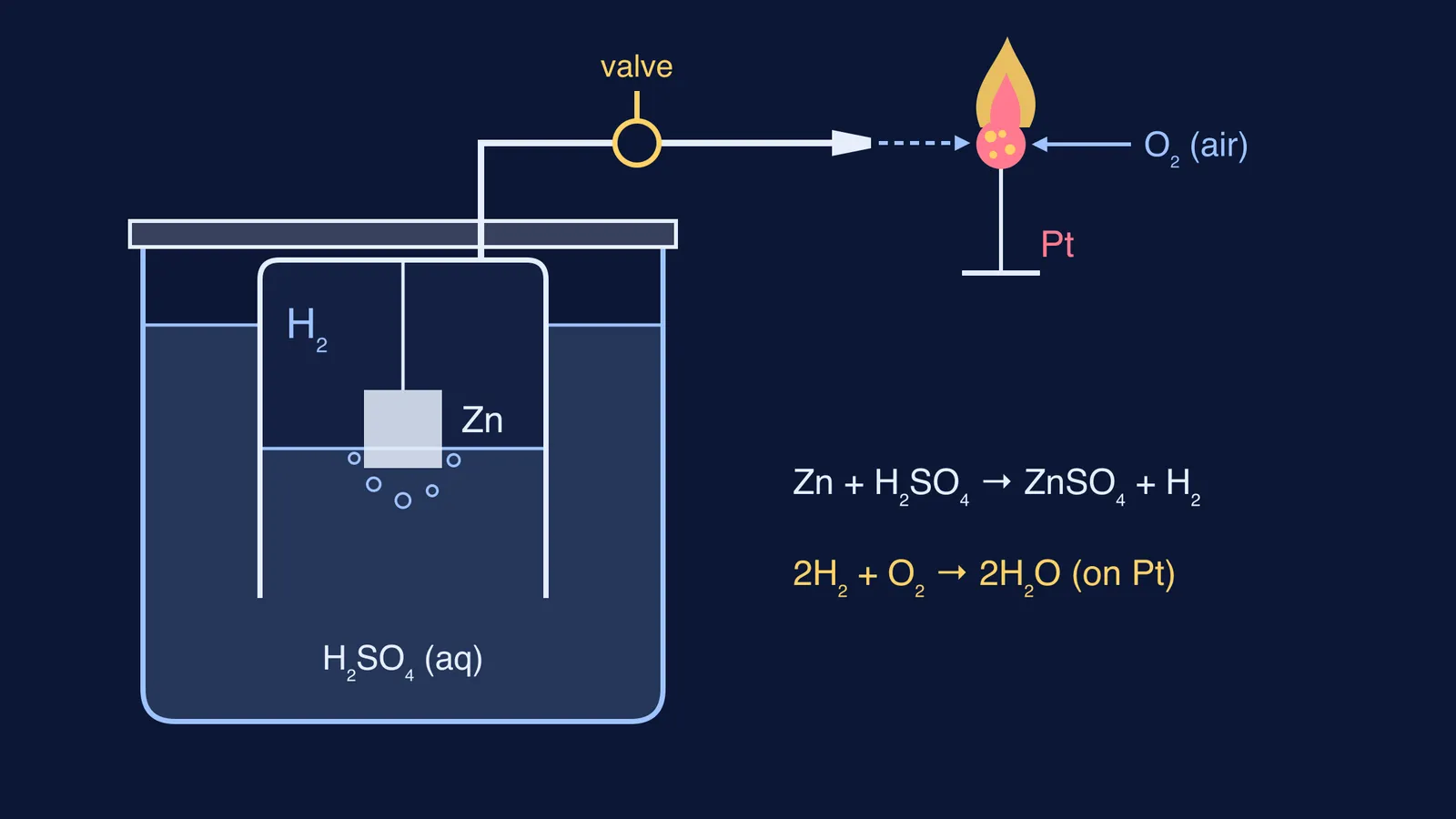
The University of Jena's description gives the cycle:
A glass bell, open at the bottom, stands upside down in a jar of dilute sulfuric acid. A lump of zinc hangs inside it on a wire.
Where acid touches zinc, hydrogen forms: Zn + H₂SO₄ → ZnSO₄ + H₂.
The hydrogen collects at the top of the bell and pushes the acid down, away from the zinc, so the reaction stops by itself.
Opening the valve sends a jet of hydrogen from a nozzle onto a piece of platinum sponge. In Döbereiner's experiment the jet came from 4 cm away, already mixed with air (University of Bristol).
On the platinum, hydrogen and oxygen react: 2H₂ + O₂ → 2H₂O. The heat makes the sponge glow red, then white, and the jet catches fire.
Close the valve and the flame goes out. Acid rises back to the zinc and refills the bell with hydrogen for next time.
Why did platinum make hydrogen burn?
Hydrogen and oxygen can sit mixed at room temperature without reacting: the reaction must first climb an energy barrier.
Jaime Wisniak's history of catalysis traces the idea. Humphry Davy reported in 1817 that coal gas and oxygen combined without flame on hot platinum or palladium wire. Döbereiner's platinum sponge lit hydrogen at room temperature in 1823. Michael Faraday argued in 1834 that gas touching platinum is held as closely as if it were liquid. In 1835 Jöns Jakob Berzelius coined the word catalysis for substances that bring about a reaction by their mere presence.
In modern terms, hydrogen binds to the platinum and, as the Bristol explainer puts it, the hydrogen-hydrogen bond is weakened, so the molecule can be oxidised: a route with lower activation energy. The platinum itself comes out unchanged.
To put a number on a lower barrier, see how many times the rate rises when a catalyst lowers activation energy, or read it off energy profile diagrams: ΔH, Ea and the catalyst. The Fermi Simulation Lab has interactive simulations for the ideas that are easier to see than to read.
Worked example: how much hydrogen does 1 g of zinc make?
Take 1.00 g of zinc reacting completely with excess acid.
Moles of zinc: the standard atomic weight of zinc is 65.38 (CIAAW), so n = 1.00 / 65.38 = 0.0153 mol.
Moles of hydrogen: Zn and H₂ are 1 : 1 in the equation, so 0.0153 mol H₂.
Volume at 25 °C (298.15 K) and 1 bar (100,000 Pa): V = nRT/P, with R = 8.314 J mol⁻¹ K⁻¹ (NIST CODATA). V = 0.0153 × 8.314 × 298.15 / 100,000 = 3.79 × 10⁻⁴ m³, about 379 mL.
Heat when it burns: the standard enthalpy of formation of liquid water is −285.83 kJ/mol (NIST Chemistry WebBook), so 0.0153 × 285.83 = 4.37 kJ. In a flame the water leaves as steam, so the heat actually given off is lower.
The platinum does not change the 4.37 kJ, only how easily the reaction starts. For making the gas, see laboratory preparation of hydrogen from zinc and dilute acid. For mole problems like this, the Fermi Problem Library has worked problems with a step-by-step solver that explains the reasoning rather than printing an answer.
What should you remember about catalysts for exams?
Five points to take away:
A catalyst speeds up a reaction and is not used up: one sponge lit the lamp many times.
It lowers activation energy but does not change ΔH.
Heterogeneous catalysis: catalyst and reactants are in different phases (solid platinum, gaseous hydrogen and oxygen).
Finely divided catalysts work better because more surface is exposed.
The lamp lit itself because the reaction is exothermic and heat built up in the sponge.