

On this page
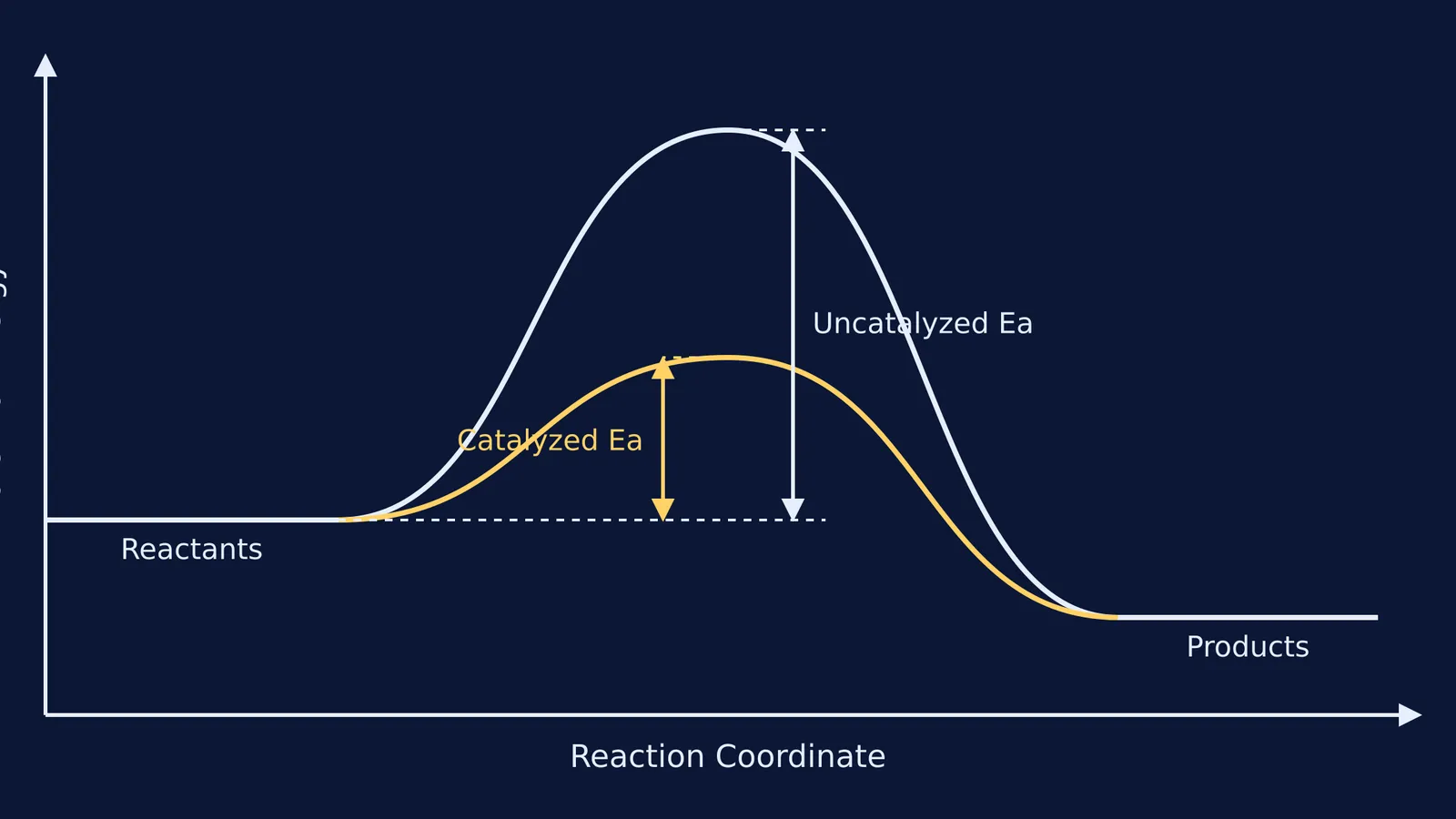
When a catalyst is added to a chemical reaction, it provides an alternative pathway with a lower activation energy (Ea). This means more colliding molecules have enough energy to react, which speeds up the process [[1]](https://openstax.org/books/chemistry-2e/pages/12-7-catalysis). But how much faster does it get?
Because of the mathematical relationship between activation energy and temperature, the increase is not linear. Lowering the barrier by just a little bit causes an exponential leap in the reaction rate.
Why does lowering activation energy increase the rate?
Think of activation energy as a high wall that molecules must jump over to react. Without a catalyst, only a tiny fraction of the fastest-moving molecules can clear the wall. A catalyst effectively knocks down part of the wall. Because the number of molecules with a given amount of energy drops off sharply as you look for higher energies, lowering the energy requirement allows a massive new group of molecules to participate.
Mathematically, the speed of a reaction is driven by its rate constant (k), which is related to but distinct from the overall speed (see the difference between rate of reaction and rate constant). According to the Arrhenius equation, the rate constant is k = A × e^(−Ea/RT), where R is the ideal gas constant (8.314 J/(mol·K)) and T is the absolute temperature in Kelvin [[2]](https://openstax.org/books/chemistry-2e/pages/12-5-collision-theory).
The term e^(−Ea/RT) represents the fraction of molecular collisions that have enough kinetic energy to overcome the activation barrier and turn into products [[2]](https://openstax.org/books/chemistry-2e/pages/12-5-collision-theory). When a catalyst lowers Ea, the negative exponent becomes less negative, making this fraction significantly larger.
How to calculate the ratio of rate constants?
To find out exactly how many times faster a catalyzed reaction is compared to an uncatalyzed one at the same temperature, you compare their rate constants (k_cat and k_uncat).
When you are asked to compare these rates, you usually do not need the pre-exponential factor (A). This factor depends on collision frequency and orientation, and for a typical textbook calculation, it is assumed to be roughly the same for both pathways. By dividing the Arrhenius equation for the catalyzed reaction by the equation for the uncatalyzed reaction, the factor A cancels out completely. This gives a simple and powerful ratio formula [[2]](https://openstax.org/books/chemistry-2e/pages/12-5-collision-theory):
Ratio = k_cat / k_uncat = e^(ΔEa / RT)
Here, ΔEa is the difference in activation energy between the two pathways. When using this formula, you must ensure your units match. The gas constant R uses joules (if you are unsure which version to pick, read our guide on Which value of R to use: matching units in chemistry), so you must convert kilojoules (kJ) to joules (J) before dividing.
How much does a 20 kJ/mol drop increase the rate?
Suppose a catalyst lowers the activation energy of a reaction by 20 kJ/mol at a standard room temperature of 298 K. Here is how to find the rate increase factor step by step, using the Arrhenius constants [[2]](https://openstax.org/books/chemistry-2e/pages/12-5-collision-theory).
Identify the values:
ΔEa = 20 kJ/mol = 20,000 J/mol T = 298 K R = 8.314 J/(mol·K)
Calculate the denominator (RT):
RT = 8.314 × 298 = 2,477.57 J/mol
Divide the energy drop by RT:
ΔEa / RT = 20,000 / 2,477.57 ≈ 8.072
Calculate the exponential:
e^8.072 ≈ 3,205
Interpret the result:
Because the exponent is approximately 8, the multiplier is e raised to the power of 8. The catalyzed reaction is approximately 3,205 times faster than the uncatalyzed reaction.
It is easy to make a mistake in this calculation by forgetting to convert kilojoules to joules, which leaves you with e^0.008 instead of e^8.072. If you want to build a stronger foundation in kinetics, the Fermi Concept Library maps out every concept in physics, chemistry, biology, mathematics and computing, each with its own lesson and its place in the map.
What happens at higher temperatures?
Temperature (T) sits in the denominator of the exponent. As a result, the term ΔEa / RT becomes smaller as the temperature rises.
This means that while a catalyst always speeds up a reaction, its relative advantage (k_cat / k_uncat) is highest at lower temperatures. At very high temperatures, a larger baseline fraction of molecules already has the required thermal energy, so the alternative pathway provides a less dramatic multiplier.
This is why industrial chemical processes often rely on catalysts to avoid the massive cost and danger of heating reactors to extreme temperatures. Instead of pouring in heat to give molecules more energy, a catalyst lowers the energy requirement so the reaction runs quickly at a safe, practical temperature.
If you are working with experimental data and need to calculate the base Ea yourself before finding the ratio, you can learn How to Find Activation Energy From an Arrhenius Plot.


