

On this page
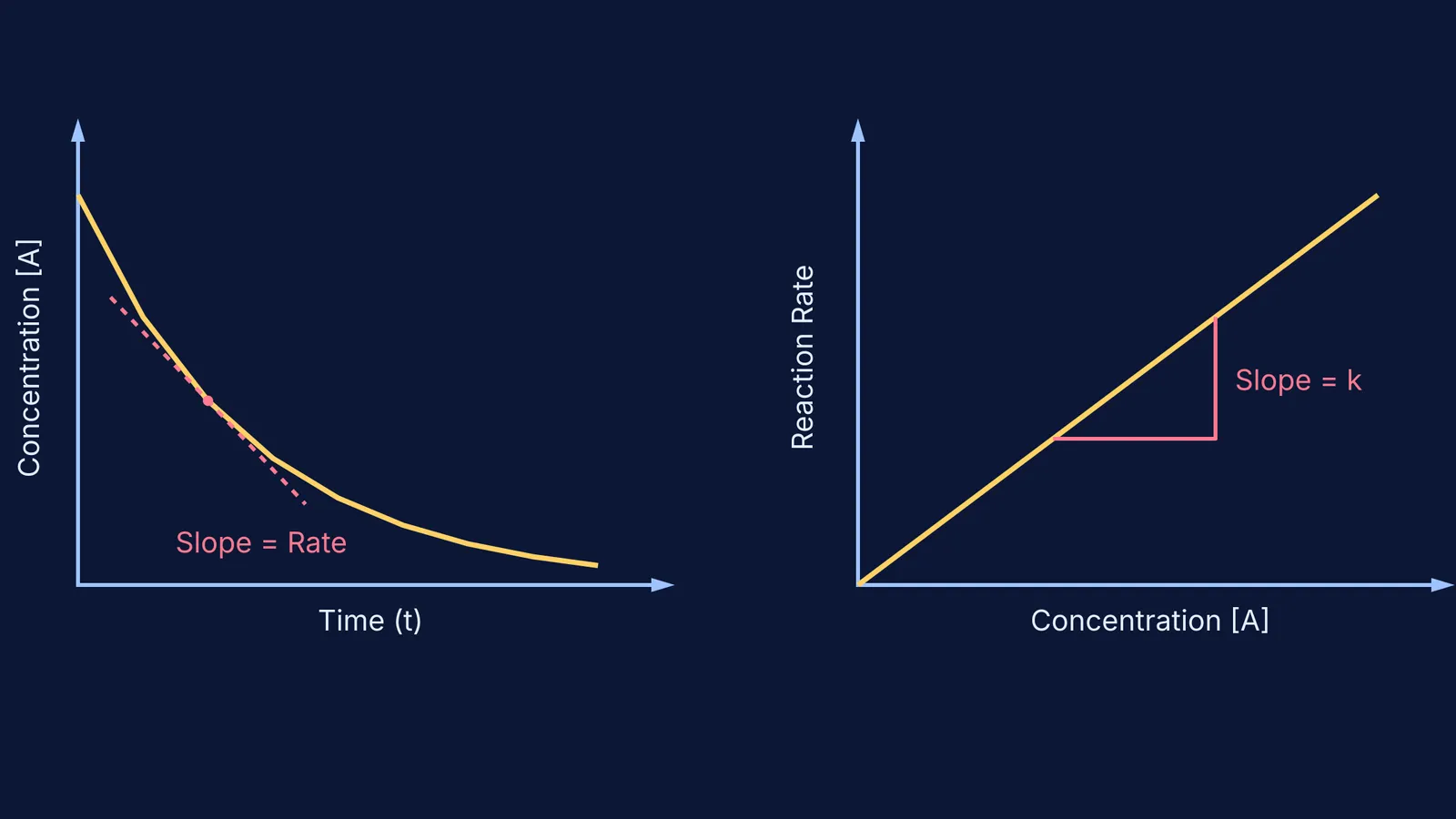
In short The rate of reaction is the speed at which reactants turn into products, and it typically slows down over time as those reactants are used up. The rate constant (k) is a fixed value for a given reaction and temperature, remaining entirely independent of concentration.
Chemical kinetics can feel like a blur of similar-sounding terms. When you look at a rate law equation like Rate = k[A]², it is easy to confuse the rate of the reaction on the left with the rate constant (k) on the right.
Though they are tied together by that equation, they measure different things. One is a speedometer reading that drops as the journey goes on; the other is a built-in property of the reaction itself.
What is the rate of reaction?
The rate of reaction measures how fast a chemical change occurs at a given moment. It is defined as the change in the concentration of a reactant or product over a specific period of time (OpenStax Chemistry 2e).
Because it tracks the actual physical speed of the reaction, the rate depends heavily on how much reactant is present. In most reactions, as the reactants are consumed, their concentration drops, causing the rate of reaction to slow down over time. It is always measured in units of concentration over time, such as mol L⁻¹ s⁻¹.
What is the rate constant (k)?
The rate constant is the proportionality constant in a rate law equation. It links the speed of the reaction to the concentrations of the reactants.
Unlike the reaction rate, the rate constant is completely independent of reactant concentrations. It does not drop as the reactants are used up, nor does it change over time. The only things that can change a rate constant are a change in temperature or the addition of a catalyst. (This is why you will often see questions about the temperature coefficient of rate, which describes how k increases as the temperature rises).
If you are stuck trying to picture these abstract ideas, the Fermi Concept Library contains every concept in physics, chemistry, biology, mathematics and computing, each with its own lesson and its place in the map.
What is the difference between rate of reaction and rate constant?
If you are revising for JEE or NEET, the differences between these two terms form a classic comparison question. Here is how they break down:
Dependence on concentration: The rate of reaction depends on the concentration of reactants and changes as they are consumed. The rate constant is independent of concentration.
Dependence on time: The rate of reaction usually decreases as time passes. The rate constant stays the same from the beginning to the end of the reaction.
Units: The rate of reaction always has the exact same units (mol L⁻¹ s⁻¹). The units of the rate constant change depending on the overall order of the reaction.
When you mix up these properties during numericals, it is easy to pick the wrong formula. The Fermi Problem Library has worked problems with a step-by-step solver that explains the reasoning rather than printing an answer, which helps catch these mistakes.
How do you find the units of the rate constant?
Because the rate of reaction always has units of mol L⁻¹ s⁻¹, the rate constant's units must adapt to balance the equation. You can find the units of k for any reaction using a single framework.
If the overall order of the reaction is n, the units of k follow this rule: Unit of k = (mol L⁻¹)^(1−n) s⁻¹
Here is a quick checklist of how that applies to the most common reaction orders, assuming time is in seconds:
Zero-order (n = 0): 1 − 0 = 1. The units are mol L⁻¹ s⁻¹ (the same as the reaction rate).
First-order (n = 1): 1 − 1 = 0. The concentration terms cancel out, leaving just s⁻¹.
Second-order (n = 2): 1 − 2 = −1. Flipping the concentration units gives L mol⁻¹ s⁻¹.
Third-order (n = 3): 1 − 3 = −2. The units become L² mol⁻² s⁻¹.
Once you have the order, you never need to memorise the units for k. If you are studying integrated rate law graphs, checking the units of the rate constant given in a problem is often the fastest way to identify the reaction's order before you even plot a point.


