

On this page
When Henry Cavendish isolated "inflammable air" in 1766, reported in the Philosophical Transactions of the Royal Society, he established the standard method for preparing hydrogen in the laboratory: reacting metals with dilute mineral acids. In secondary school chemistry—from CBSE acids, bases and salts in Class 10 to ICSE practicals—this experiment illustrates single displacement, gas handling, and critical laboratory safety.
What is the chemical reaction behind laboratory hydrogen preparation?
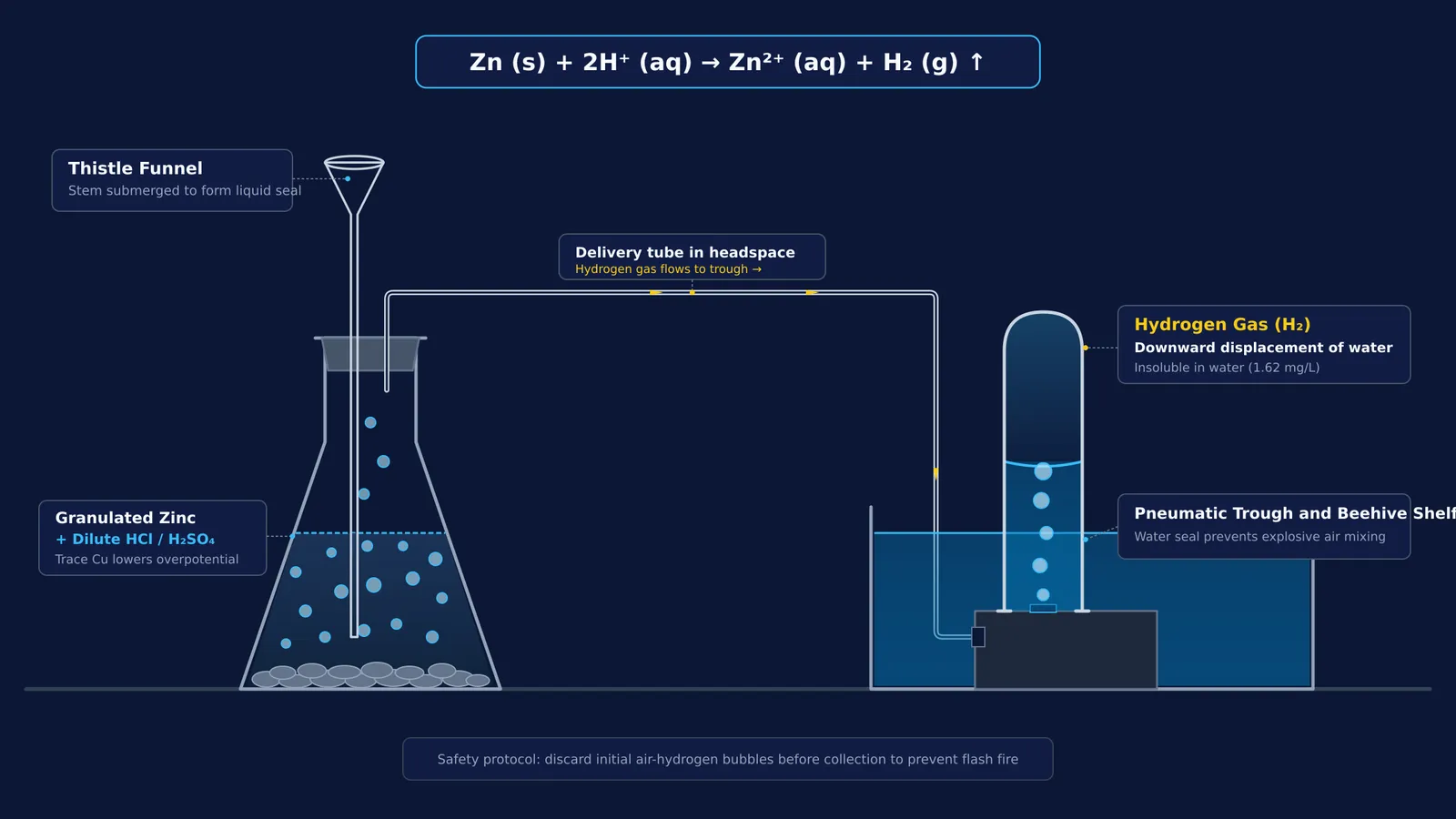
Hydrogen gas is generated by reacting moderately reactive granulated zinc with dilute hydrochloric acid (HCl) or dilute sulphuric acid (H₂SO₄):
Zn(s) + 2HCl(aq) → ZnCl₂(aq) + H₂(g)
Zn(s) + H₂SO₄(aq) → ZnSO₄(aq) + H₂(g)
Zinc sits above hydrogen in the activity series. Zinc atoms oxidise by losing two electrons (Zn → Zn²⁺ + 2e⁻, standard oxidation potential +0.76 V), while aqueous protons reduce to form hydrogen gas (2H⁺ + 2e⁻ → H₂, standard reduction potential 0.00 V). With a net standard cell potential of +0.76 V, the displacement is thermodynamically spontaneous, as catalogued in the Journal of Physical and Chemical Reference Data. Both zinc chloride and zinc sulphate remain soluble in water, allowing clean gas evolution without passivating precipitates.
Why is granulated zinc preferred over pure zinc or zinc dust?
Granulated zinc—irregular pellets prepared by pouring molten zinc into cold water—is chosen over pure zinc or fine powder for two specific reasons:
Pure zinc reacts too slowly: Highly pure zinc has a high hydrogen overvoltage, so gas bubbles adhere stubbornly to the smooth metal surface and choke further reaction. Commercial granulated zinc contains small traces of copper and other metal impurities. As shown by El Wakkad and colleagues in the Journal of the Chemical Society, copper exhibits a significantly lower hydrogen overpotential than zinc. Microscopic Zn-Cu galvanic couples form across each pellet: zinc oxidises at anode sites while hydrogen nucleates and escapes rapidly from copper cathode sites.
Zinc dust reacts too violently: Fine powder creates excessive surface area, causing an uncontrollable exothermic surge that can blow stoppers off the flask or spray acid through the tubing.
Why is nitric acid strictly avoided during preparation?
Dilute nitric acid (HNO₃) cannot be used to prepare hydrogen gas. Nitric acid is a powerful oxidising agent with a standard reduction potential of +0.96 V for nitrate reduction to nitric oxide, recorded in the Journal of Physical and Chemical Reference Data.
Instead of evolving hydrogen gas, nitric acid immediately oxidises the formed hydrogen into water (H₂O). In turn, nitric acid reduces to nitrogen oxides—primarily nitric oxide (NO) or reddish-brown nitrogen dioxide (NO₂):
3Zn(s) + 8HNO₃(aq) → 3Zn(NO₃)₂(aq) + 2NO(g) + 4H₂O(l)
Consequently, the reaction yields toxic nitrogen oxides rather than hydrogen gas.
Why is hydrogen gas collected over water instead of air?
Hydrogen is roughly 14.4 times lighter than air, with a molecular mass of 2.016 g/mol recorded in the PubChem Compound Database. While its low density might suggest upward delivery in air, doing so creates a severe fire hazard.
Safety data in the PubChem Compound Database shows hydrogen forms an explosive mixture in air across a broad flammability range of 4.0% to 75.0% by volume. Air displacement inevitably traps oxygen inside the collection vessel.
Instead, hydrogen is collected by downward displacement of water over a beehive shelf:
Negligible solubility: Hydrogen is virtually insoluble in water (only 1.62 mg/L at 21 °C, as documented in the PubChem Compound Database).
Air exclusion: The inverted water-filled jar prevents contact with atmospheric oxygen during collection.
Visual monitoring: The descending water level shows exactly how much gas has accumulated.
Why must the first bubbles be discarded before testing?
Before effervescence begins, the flask, thistle funnel, and delivery tube contain air. The first bubbles emerging into the water trough consist of displaced air mixed with hydrogen.
If collected and ignited, this air-hydrogen mixture detonates violently, risking glassware fracture or flashback into the generator. Allowing initial bubbles to escape into the trough purges air completely from the system before collection begins.
Once purged, pure hydrogen collected in an inverted jar burns quietly at the rim with a pale blue flame and a soft "pop": 2H₂(g) + O₂(g) → 2H₂O(l). For students studying systematic salt analysis in the chemistry practical, the Fermi Concept Library covers every concept in chemistry with its own lesson and place in the map, linking practical observations directly to electrode potentials and reduction tendencies.
What does an effective laboratory preparation checklist look like?
Follow this protocol during practicals to ensure steady generation and safety:
Submerge the funnel: Ensure the thistle funnel stem dips well beneath the acid surface to maintain an airtight liquid seal.
Seal all joints: Check rubber bungs and tubing connections for airtight fits to prevent invisible hydrogen leakage.
Discard purge gas: Allow early gas bubbles to escape until all displaced air is purged before placing the collection jar on the beehive shelf.
Keep flames away: Extinguish open flames and position burners well clear of the generator flask.
Invert before testing: Hold collection jars mouth-downward so buoyant hydrogen does not spill out into the room.
The Fermi Problem Library provides worked problems with a step-by-step solver that explains the reasoning rather than printing an answer.


