On this page
Every Class 11 student meets the puzzle: if sodium chloride is ionic, why does aluminium chloride behave so differently? In 1923 a Polish chemist in Munich, Kazimierz Fajans, answered it. A small, highly charged ion can pull its neighbour's electron cloud out of shape, and that distortion makes an ionic bond partly covalent. Here is who he was, what he published, and how to use his rules on an exam question.
Who was Kazimierz Fajans?
Fajans was born in Warsaw on 27 May 1887 and died in Ann Arbor, Michigan, on 18 May 1975, according to his entry in the Complete Dictionary of Scientific Biography. He took his doctorate at Heidelberg in 1909 and spent 1910–1911 in Ernest Rutherford's laboratory in Manchester.
His first fame came from radioactivity. In 1913 he stated the displacement law: alpha emission moves an element two places left in the periodic table, beta emission one place right. With his student Oswald Göhring he then found the first isotope of element 91, later named protactinium.
In 1917 Richard Willstätter brought him to Munich, and in 1932 he became director of his own Institute for Physical Chemistry. Hitler's rise to power forced him out in 1935. After some months in Cambridge he took a professorship at the University of Michigan, which he held from 1936 to 1957.
What did Fajans publish in 1923?
The rules come from a paper in Die Naturwissenschaften, volume 11, pages 165–172, titled *Struktur und Deformation der Elektronenhüllen in ihrer Bedeutung für die chemischen und optischen Eigenschaften anorganischer Verbindungen* (DOI 10.1007/BF01552365). In English: the structure and deformation of electron shells, and what they mean for the chemical and optical properties of inorganic compounds.
The key word is deformation. Fajans treated ions not as hard balls but as electron clouds a neighbouring ion can distort. A footnote in the paper records how colleagues Zintl and Volmer read the colour of silver bromide: as loosened bromide electrons, and as a sign that AgBr is not a perfect ionic lattice. In 1924 he and Georg Joos followed with a study of the molar refraction of ions, an optical measure of how easily electron clouds deform (Zeitschrift für Physik, DOI 10.1007/BF01327574).
What are Fajans' rules?
A cation's ability to distort an anion is called its polarising power, and the anion's tendency to be distorted is called its polarisability (Chemistry LibreTexts: Polarizability/Physical_Properties_of_Matter/Atomic_and_Molecular_Properties/Polarizability)). The more the anion's electrons are drawn towards the cation, the more they are shared, and the more covalent the bond. Covalent character goes up when:
The cation is small. LiBr is more covalent than KBr.
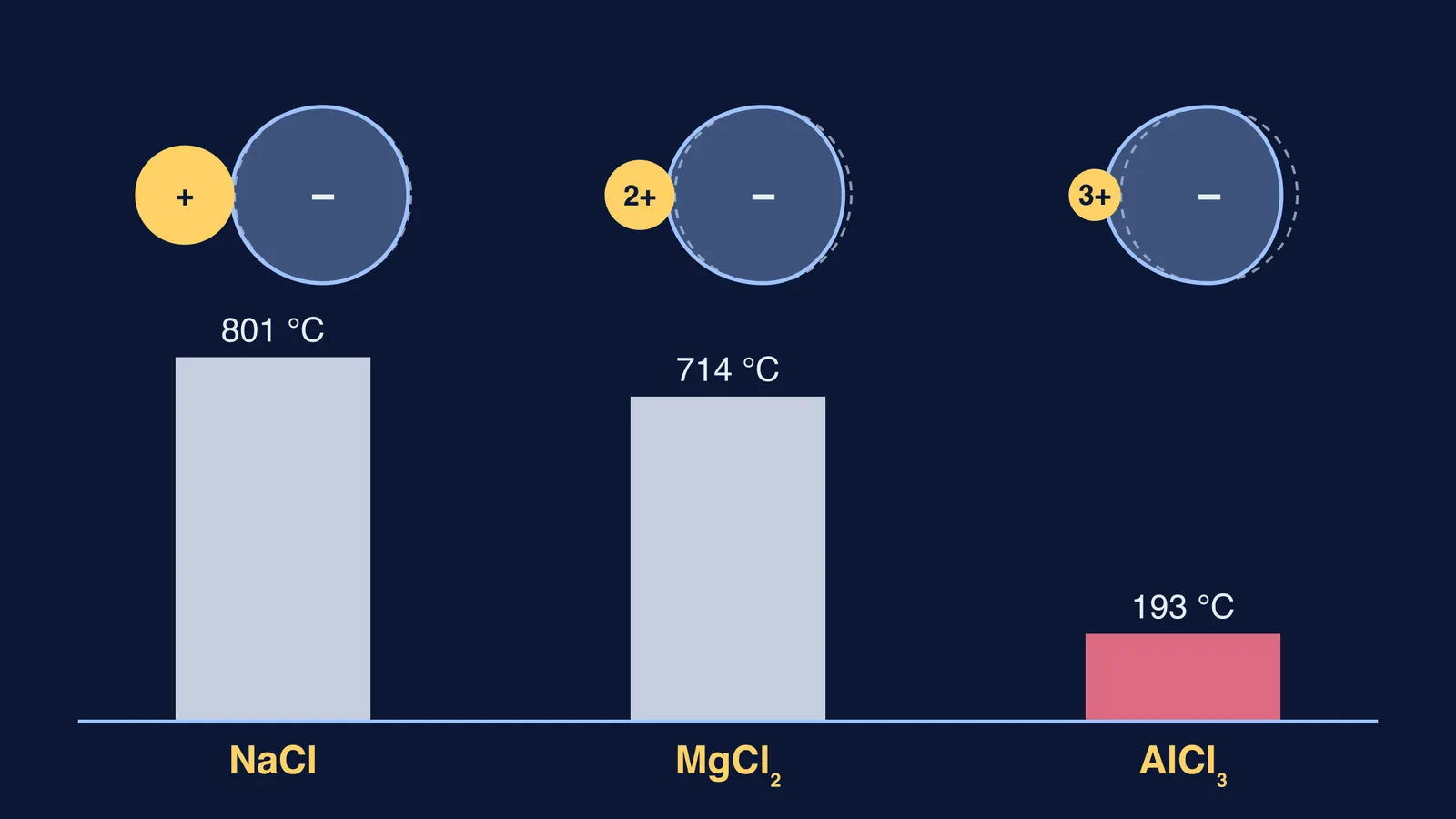
The cation carries a high charge. Covalent character rises from NaCl to MgCl₂ to AlCl₃.
The anion is large. It rises from AlF₃ to AlCl₃ to AlBr₃, and iodides are the most covalent halides.
The cation lacks a noble-gas configuration. ZnCl₂ is more covalent than MgCl₂ although Zn²⁺ (74 pm) and Mg²⁺ (72 pm) are almost the same size.
The fourth rule works because a noble-gas shell shields the nucleus better, so it gives the cation less polarising power (Fajans' rules, Wikipedia).
How do you apply Fajans' rules to an exam question?
Try the classic: arrange NaCl, MgCl₂ and AlCl₃ by covalent character, then check the answer against a real property.
Fix the anion. All three are chlorides, so only the cation changes.
Compare charge and size. Charges climb from 1+ to 2+ to 3+, while Shannon ionic radii shrink from 102 pm for Na⁺ to 72 pm for Mg²⁺ to 53.5 pm for Al³⁺ (Shannon 1976, DOI 10.1107/S0567739476001551). Both changes raise polarising power.
Predict. Covalent character: NaCl < MgCl₂ < AlCl₃.
Check. PubChem lists melting points of 800.7 °C for sodium chloride, 714 °C for magnesium chloride and 192.6 °C for aluminium chloride, and notes that anhydrous aluminium chloride sublimes readily at 178 °C.
A low melting point and easy sublimation are what you expect from a solid with strong covalent character, so the data agree with the prediction. When a question mixes ions, change one thing at a time, and look twice at ions with a full d-shell such as Zn²⁺.
If the ionic side of the story is shaky, start with the conditions for ionic bond formation, worked through with NaCl. For a property that tracks bond type, read why ionic compounds dissolve in water but not in kerosene. And for the covalent side, see how Heitler and London explained the covalent bond in 1927, four years after Fajans's paper.
If polarising power and polarisability still feel like two separate facts, the Fermi Concept Library covers every concept in physics, chemistry, biology, mathematics and computing. To practise orderings like this one, the Fermi Problem Library has a step-by-step solver that explains the reasoning rather than printing an answer.
Next time a question asks which compound is more covalent, fix one ion, compare the other, and ask Fajans's question: how hard is that cation pulling?