

On this page
Stir a spoon of table salt into a glass of water and it disappears. Stir the same salt into kerosene and it sits at the bottom. The difference comes down to two things water has and kerosene lacks: molecules with a clear positive and negative end, and a high dielectric constant.
What holds an ionic crystal together?
Sodium chloride is a lattice of Na+ and Cl− ions, each pulled on by its oppositely charged neighbours in every direction. Pulling one mole of it apart into separate ions costs about 788 kJ, according to the lattice energy given in this LibreTexts chapter on enthalpy of solution. Any liquid that dissolves salt has to pay back most of that energy bill.
Why do ionic compounds dissolve in water?
Water does two jobs at once.
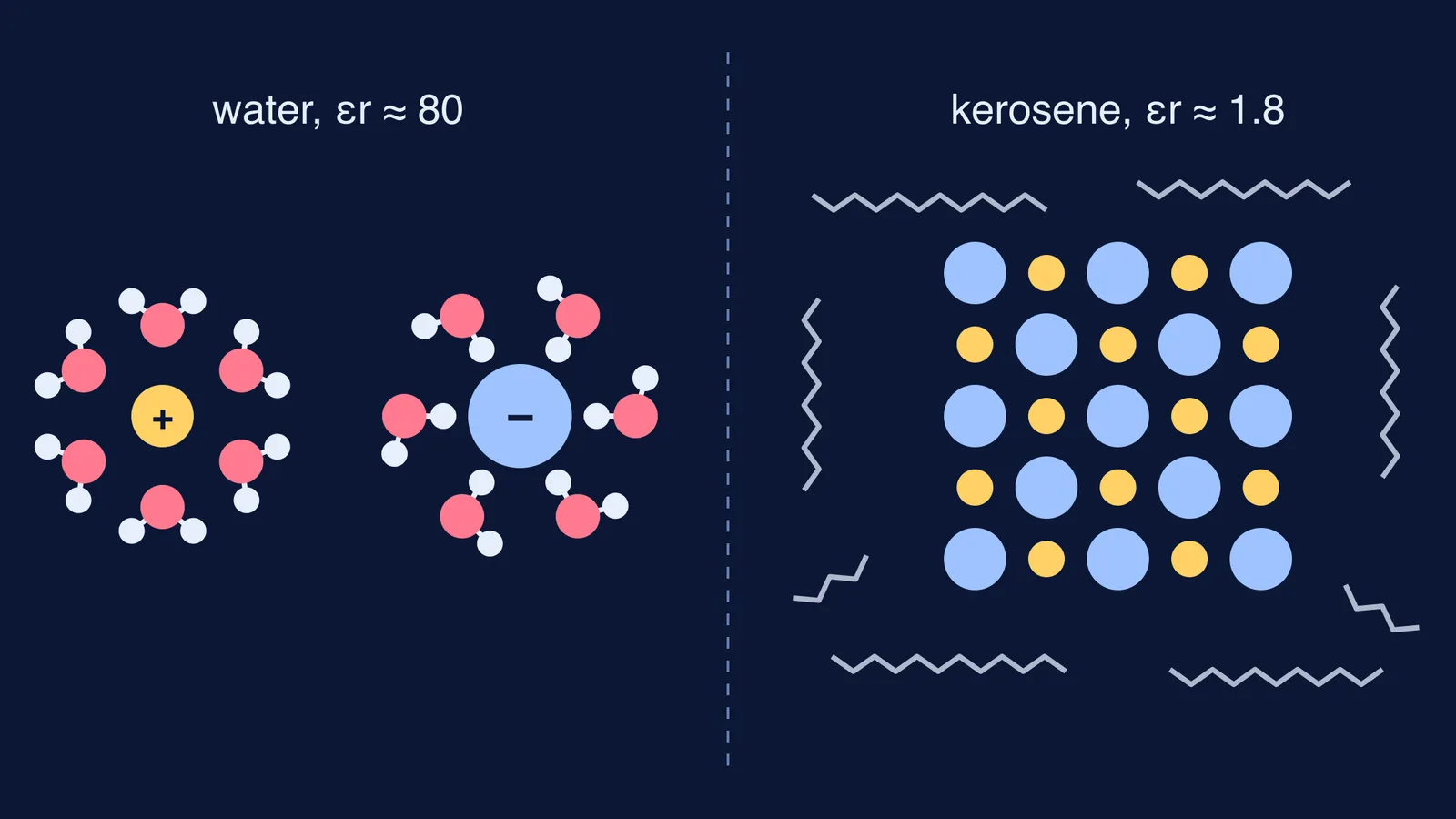
First, it grabs the ions. A water molecule is bent and polar: the oxygen end carries a slight negative charge and the hydrogen ends a slight positive charge. As ChemPRIME's section on hydration of ions/11%3A_Reactions_in_Aqueous_Solutions/11.04%3A_Hydration_of_Ions) explains, the oxygen side of water is attracted to positive ions and the hydrogen ends to negative ions. This clustering is called hydration, and every ion-dipole attraction releases energy. The same source notes that few molecules are both small enough and polar enough to cluster around ions the way water does, which helps explain why water dissolves so many ionic solids.
Second, it weakens the pull between ions that have already left the crystal. In a medium, Coulomb's law becomes F = q1q2 / (4πε0εr r²), so the force is smaller than in a vacuum by a factor of εr, the relative permittivity or dielectric constant (Vedantu's JEE notes on relative permittivity). Water's dielectric constant is 80.1 at 20 °C, according to the Engineering ToolBox table of liquid dielectric constants. So once a Na+ and a Cl− drift apart in water, their attraction is about 80 times weaker than it would be in a vacuum, and they are far less likely to snap back together.
Why can't kerosene dissolve salt?
Kerosene is made of hydrocarbon chains. Carbon and hydrogen share electrons almost evenly, so its molecules have no strong charged ends to point at an ion. That means very little hydration-like energy to pay for the lattice.
Kerosene's dielectric constant is only 1.8 at 21 °C, from the same Engineering ToolBox table, so it barely softens the attraction between ions either. With nothing to pay the 788 kJ bill, the crystal stays whole. This is the like-dissolves-like rule with the physics showing; our post on how polarity decides what dissolves in what covers the rule itself.
Worked example: the energy balance for sodium chloride
Use the figures from the LibreTexts enthalpy of solution chapter and the Engineering ToolBox dielectric table:
Break the lattice: about +788 kJ/mol.
Hydrate the ions: Na+ releases about 406 kJ/mol and Cl− about 363 kJ/mol, so about −769 kJ/mol in total.
Add them: 788 − 769 = +19 kJ/mol. The measured enthalpy of solution is +3.9 kJ/mol; the LibreTexts chapter puts the gap down to the high lattice energy value used. Either way, hydration almost cancels the lattice energy.
Compare the solvents: 80.1 ÷ 1.8 ≈ 44. At the same distance, two ions attract each other about 44 times more strongly in kerosene than in water.
In kerosene, step 2 releases very little energy. The cost stays close to +788 kJ/mol, and the salt does not dissolve.
If step 3 is slightly positive, why does salt dissolve at all? Because ions spreading through the water raise the disorder (entropy) of the system, and that tips a near-zero energy balance towards dissolving. The same balance explains why some ionic solids barely dissolve even in water: when the lattice term wins, the solid stays put. Our explainer on lattice energy versus hydration enthalpy works through more cases.
If any step here feels shaky, the Fermi Concept Library covers every concept in chemistry, including lattice energy and hydration, each with its own lesson and its place in the map.
How do you write this as a give-reasons answer?
A three-point answer covers both effects and the comparison. The numbers come from the Engineering ToolBox dielectric table.
Water is polar. Its molecules surround the ions, oxygen towards cations and hydrogen towards anions, and this hydration releases almost enough energy to make up for the lattice energy.
Water has a high dielectric constant (about 80), which weakens the attraction between ions so they stay apart.
Kerosene is non-polar, with a dielectric constant of about 1.8. It cannot solvate the ions or make up for the lattice energy, so the compound does not dissolve.
Before you write, check:
Did you name both effects, hydration and dielectric constant?
Did you say which end of the water molecule faces which ion?
Did you say "lattice energy" rather than "water breaks the ionic bond"?
To practise with worked problems, try the Fermi Problem Library, whose step-by-step solver explains the reasoning rather than printing an answer. For the physics behind εr, read our guide to what dielectric constant means.


