

On this page
Put a sheet of paper between the plates of a capacitor and it holds more charge at the same voltage. Fill the gap with water and, going by the OpenStax table of dielectric constants/University_Physics_II_-_Thermodynamics_Electricity_and_Magnetism_(OpenStax)/08:_Capacitance/8.06:_Molecular_Model_of_a_Dielectric), it holds about 80 times more. The number that tells you how much is the dielectric constant, K.
What is dielectric constant, or relative permittivity?
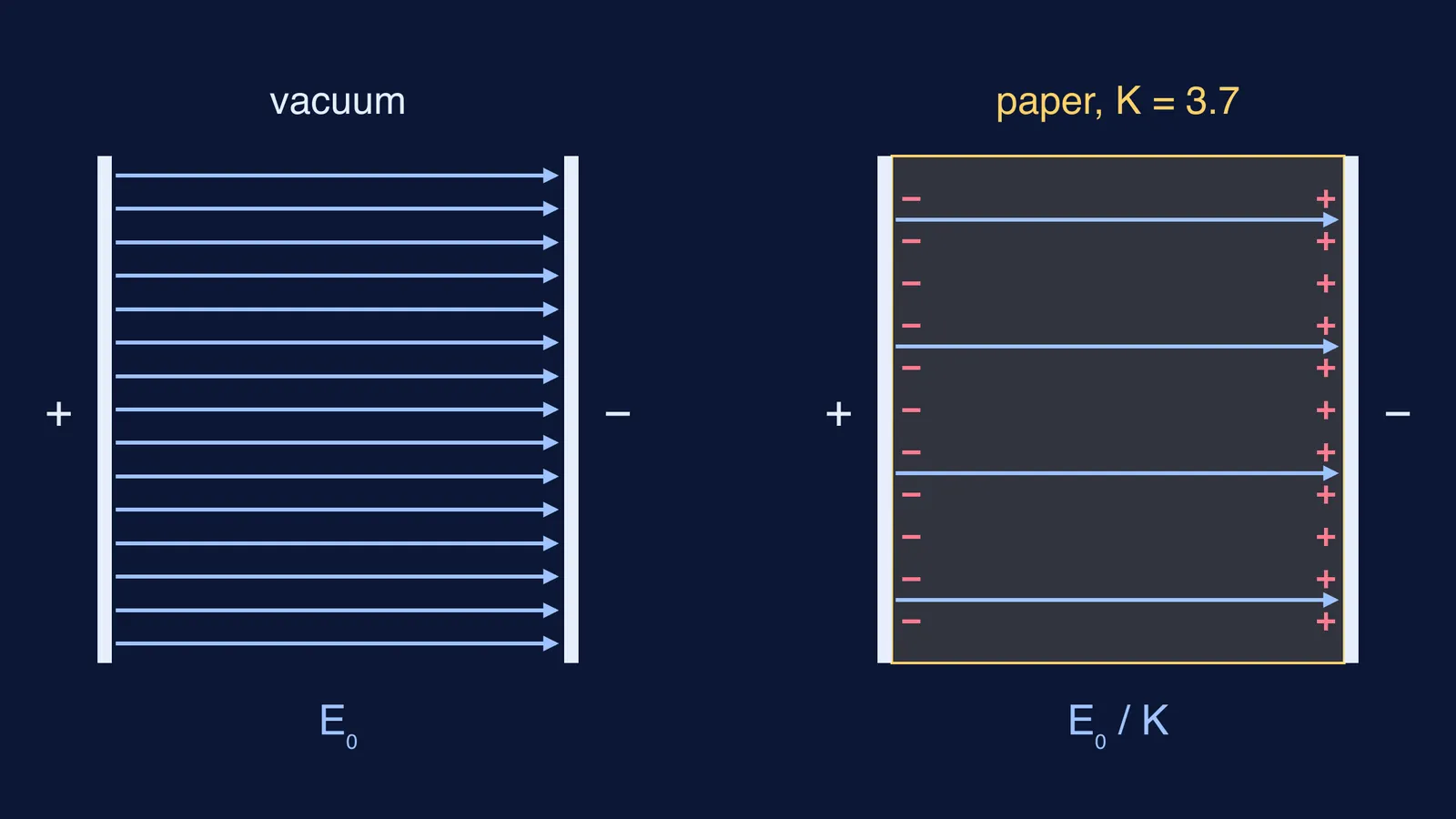
When you put an insulator (a dielectric) in an electric field, its molecules polarise: their charges shift slightly, and polar molecules turn to line up with the field. That builds a small opposing field inside the material. HyperPhysics defines the dielectric constant as the factor K by which the effective field is decreased by this polarisation, and notes that the capacitance is multiplied by the same factor.
Relative permittivity is the same number written as ε_r = ε/ε₀: the material's permittivity divided by the permittivity of vacuum. The CODATA 2022 value of the vacuum permittivity ε₀, published by NIST, is 8.8541878188 × 10⁻¹² F/m. Because K is a ratio of two permittivities, it has no unit, and vacuum has K = 1.
Three relations carry the whole idea, set out in OpenStax University Physics, section 8.5/University_Physics_II_-_Thermodynamics_Electricity_and_Magnetism_(OpenStax)/08:_Capacitance/8.05:_Capacitor_with_a_Dielectric) and section 8.6/University_Physics_II_-_Thermodynamics_Electricity_and_Magnetism_(OpenStax)/08:_Capacitance/8.06:_Molecular_Model_of_a_Dielectric):
C = KC₀: capacitance is K times its vacuum value when the dielectric fills the gap.
V = V₀/K: for an isolated charged capacitor, the voltage drops by the same factor.
E = E₀/K: the field inside the material is K times weaker than the field the plate charges alone would make.
What are the dielectric constants of air, paper, glass and water?
The OpenStax table of representative dielectric constants at room temperature/University_Physics_II_-_Thermodynamics_Electricity_and_Magnetism_(OpenStax)/08:_Capacitance/8.06:_Molecular_Model_of_a_Dielectric) gives these values:
Vacuum: 1
Dry air at 1 atm: 1.00059
Paper: 3.7
Glass: 4 to 6 (Pyrex glass: 5.6)
Water: 80
The HyperPhysics table of dielectric constants at 20 °C lists water at 80.4 and glass at 5 to 10, so treat glass as a range that depends on its type. OpenStax notes that an air-filled capacitor behaves essentially like an empty one, which is why problems treat air as vacuum.
Why is water so high? OpenStax explains that a water molecule is polar, with a slightly negative oxygen end and slightly positive hydrogen end, so it is easy to align along an applied field.
Two charges in water feel a force about 80 times weaker than in vacuum; we worked that through in the force between two charges in water.
Worked example: how much does K raise capacitance?
Take a parallel-plate capacitor with square plates 10 cm by 10 cm (A = 0.01 m²) and a 1 mm gap. Using the NIST value of ε₀, the vacuum capacitance is C₀ = ε₀A/d = 8.854 × 10⁻¹² × 0.01 / 0.001 ≈ 88.5 pF. Now fill the gap, using the OpenStax values/University_Physics_II_-_Thermodynamics_Electricity_and_Magnetism_(OpenStax)/08:_Capacitance/8.06:_Molecular_Model_of_a_Dielectric) and C = KC₀:
Dry air (K = 1.00059): about 88.6 pF.
Paper (K = 3.7): about 328 pF.
Pyrex glass (K = 5.6): about 496 pF.
Water (K = 80): about 7,080 pF, or 7.08 nF.
Only the material changed. Capacitance depends on geometry and material, not on the charge you put in, as we showed in why capacitance does not depend on charge or voltage.
Does the field always drop by K when you insert a dielectric?
No. It depends on what is held fixed. Take the capacitor above charged to 100 V, so E₀ = V/d = 100,000 V/m, and slide in paper with K = 3.7 from the OpenStax table/University_Physics_II_-_Thermodynamics_Electricity_and_Magnetism_(OpenStax)/08:_Capacitance/8.06:_Molecular_Model_of_a_Dielectric).
Battery disconnected (Q fixed): E falls to E₀/K ≈ 27,000 V/m, V falls to about 27 V, C rises 3.7 times, and the stored energy Q²/2C falls by the factor K.
Battery connected (V fixed): V stays at 100 V, so E = V/d stays at 100,000 V/m. The battery pushes more charge on: Q rises 3.7 times, and so do C and the stored energy CV²/2.
So K always weakens the field made by a given charge. When a battery is attached, it tops up the charge until the field is back where it was.
How do you check you really understand K?
Try this self-check without notes:
Can you explain why the field inside the slab is weaker, using the word polarisation?
With Q fixed, can you predict what happens to V, E, C and U? Can you redo it with V fixed?
Can you explain why water's K is so much larger than paper's?
If one of these trips you up, the Fermi Concept Library covers every concept in physics, chemistry, biology, mathematics and computing, each with its own lesson and its place in the map. For practice, the Fermi Problem Library has worked problems with a step-by-step solver that explains the reasoning rather than printing an answer.


