

On this page
When you drop common salt into a glass, the solid crystals vanish into the liquid. It happens so often that we rarely pause to wonder why a tightly bound lattice of positive and negative ions breaks apart at all. The secret lies in a single property of the liquid: its high dielectric constant.
What is the dielectric constant of water?
The force between two charged objects is described by Coulomb's law. In a vacuum, this electrostatic attraction or repulsion is at its maximum. But when you place those same charges inside a medium, the material itself responds to the electric field and weakens it. The factor by which the medium reduces the force is called its dielectric constant, or relative permittivity (often denoted as K or ε_r). This constant compares the permittivity of the medium to the permittivity of free space, measuring how well the material can store electrical energy in an electric field.
The dielectric constant of water is approximately 80 at room temperature (Wikipedia). This is unusually high compared to most common liquids. For example, the relative permittivity of ethanol is 24.3, and for benzene, it is just 2.3 (Wikipedia).
How does the Coulomb force change in a medium?
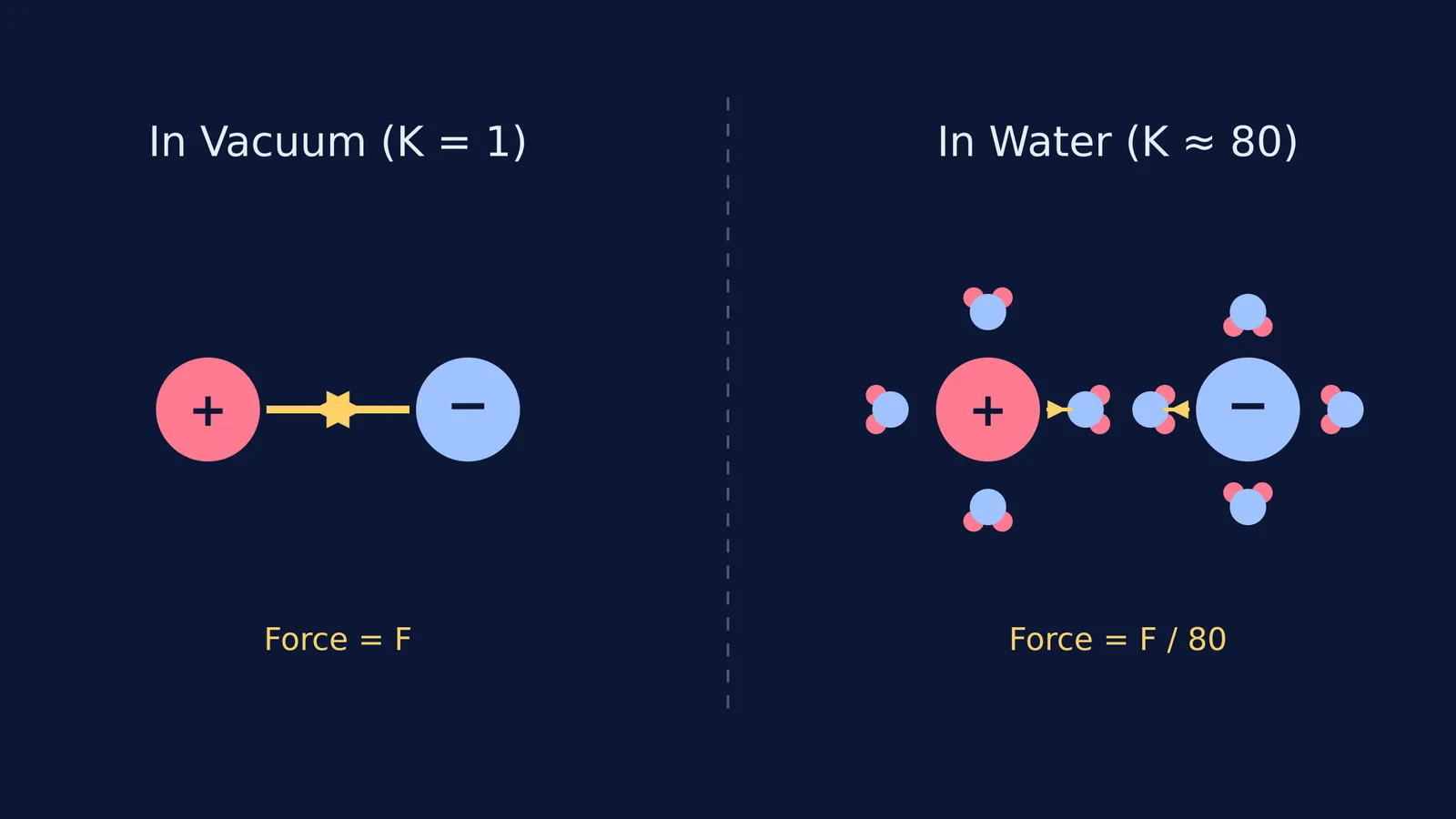
Because water's dielectric constant is roughly 80, the force between two charges submerged in it drops by a factor of 80. According to Coulomb's law, the force in a medium is F = 1 / (4πε₀K) × (q₁q₂ / r²). The factor K sits in the denominator, meaning the net force is inversely proportional to it.
Water molecules are highly polar. They have a bent shape, with an oxygen atom that is far more electronegative than the two hydrogen atoms. This causes the oxygen to pull the shared electrons towards itself, possessing a partial positive charge near the hydrogen atoms and a partial negative charge near the oxygen atom. This creates a permanent electric dipole moment within every molecule.
When an electric field from a dissolved ion acts on them, these molecules physically rotate. Their dipoles align against the external field, effectively screening the charges from one another. This internal cancellation is why the net force plunges so drastically. For a macroscopic volume of water, billions of these tiny dipoles act together to oppose the field. This same shielding effect is crucial when you calculate the work to assemble point charges in different environments, or when finding where the potential is zero near two charges.
Why does water dissolve salts so easily?
In a dry crystal of sodium chloride (NaCl), the sodium (Na⁺) and chloride (Cl⁻) ions are locked together by strong electrostatic forces. When placed in water, that attractive force becomes 80 times weaker. The thermal energy of the water at room temperature is now more than enough to overcome this weakened bond.
The ions separate, and water molecules quickly swarm around them in a highly ordered structure, creating what is known as a hydration shell. Several layers of water molecules can surround a single ion. The negative oxygen ends of water point inward toward the positive sodium ions, while the positive hydrogen ends point inward toward the negative chloride ions. This ordered cage of water molecules stabilises the ions in solution, preventing them from recombining into a solid crystal.
For contrast, if you tried to dissolve salt in a low-dielectric liquid like benzene, the force would drop very little, and the thermal energy would not be enough to break the lattice. The salt would simply sit as solid rocks at the bottom of the beaker. Without water's massive dielectric constant, biological life as we know it—which relies on dissolved ions for nerve signals and cell function—would be impossible.
How do you calculate the force in a medium?
Let us put numbers to the idea to see the scale of this effect. Suppose you have a sodium ion and a chloride ion separated by a distance of 0.5 × 10⁻⁹ m (which is 0.5 nanometres), a typical distance in a dilute solution. The charge of each ion is exactly one elementary charge, which is 1.6 × 10⁻¹⁹ C.
Using the standard Coulomb constant k = 9 × 10⁹ N m²/C², the attractive force in a pure vacuum would be given by Coulomb's law as: F_vacuum = k × (q₁q₂) / r² F_vacuum = (9 × 10⁹) × (1.6 × 10⁻¹⁹)² / (0.5 × 10⁻⁹)²
First, we square the charge and the distance: F_vacuum = (9 × 10⁹ × 2.56 × 10⁻³⁸) / (0.25 × 10⁻¹⁸)
Next, we combine the terms in the numerator: F_vacuum = (23.04 × 10⁻²⁹) / (0.25 × 10⁻¹⁸)
Finally, we divide by the denominator to find the force: F_vacuum ≈ 9.2 × 10⁻¹⁰ N.
This is a tiny force in everyday terms, but it is massive for single ions. In water, however, the surrounding dipoles screen the interaction, so we divide this vacuum force by the dielectric constant K = 80: F_water = (9.2 × 10⁻¹⁰) / 80 F_water ≈ 1.15 × 10⁻¹¹ N.
This massive drop makes all the difference in chemistry. If you are practising these principles for your exams, you can explore every idea in physics and chemistry in the Fermi Concept Library, where each has its own lesson and its place in the map. When you try to apply them, Fermi's AI tutor works through problems alongside you, checking your understanding as it goes.


