

On this page
Have you ever noticed that oil and water separate, but sugar vanishes into tea? The rule of thumb in chemistry is "like dissolves like". But why? It comes down to energy, entropy and dipole moments and molecular polarity.
What does "like dissolves like" mean in chemistry?
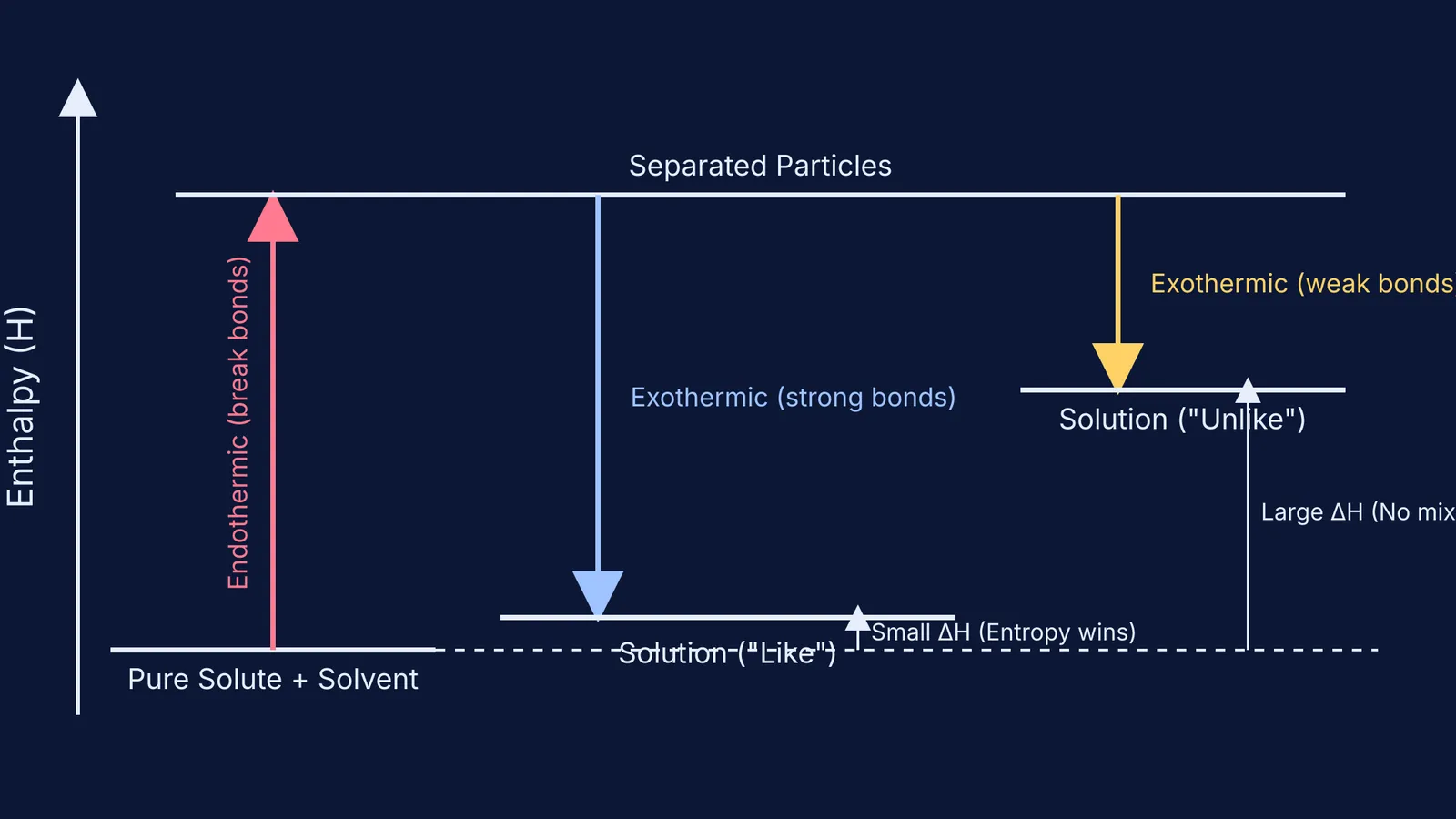
For a solute to dissolve, three things must happen:
Solute particles must separate from each other, which costs energy (an endothermic step).
Solvent molecules must move apart to make room, which also costs energy.
The solute and solvent must form new intermolecular bonds, which releases energy (an exothermic step).
According to Wikipedia, "like dissolves like" means that a solute dissolves in a solvent with a similar chemical structure. When they are "like", the strong new bonds formed release enough energy to overcome the cost of breaking the old ones. Even if the overall process absorbs a little heat, the natural drive towards disorder — the entropy of mixing — is enough to make the substance dissolve. The balance between these forces determines the Gibbs free energy of the system; if the free energy drops, dissolution happens spontaneously.
Why does salt dissolve in water?
Water is highly polar, meaning it has partial positive and negative ends. Table salt (sodium chloride) is ionic, made of positive sodium ions and negative chloride ions held together in a rigid lattice.
When you put salt in water, the strong ion-dipole forces between the water molecules and the ions release a massive amount of energy — enough to pull the solid lattice apart. As a result, NaCl is highly soluble in water, dissolving at roughly 360 grams per litre at room temperature, a value that changes surprisingly little as the temperature rises (Wikipedia).
Why does iodine dissolve in carbon tetrachloride?
Iodine (I₂) is a non-polar molecule. If you drop it into water, the water molecules refuse to break their strong hydrogen bonding just to accommodate the iodine. According to Wikipedia, iodine is only slightly soluble in water (about 0.29 g/L at 20 °C), forming a brown solution.
However, carbon tetrachloride (CCl₄) is non-polar. The forces holding CCl₄ molecules together are weak London dispersion forces. When iodine mixes with CCl₄, it forms weak dispersion forces with the solvent. Because the cost of breaking the solvent apart is so low, the entropy of mixing takes over. Iodine readily dissolves in CCl₄, forming a bright violet solution that matches the colour of iodine vapour.
Why does ethanol mix with both?
Ethanol (C₂H₅OH) is an exception because of its dual nature. It is completely miscible (infinitely soluble) in water, but it also dissolves in non-polar solvents like hexane (Wikipedia). When ethanol and water mix, they pack together so tightly that their combined volume is actually less than the sum of the two separate volumes.
If you study ethanol and ethanoic acid, you will see that ethanol has a highly polar hydroxyl group (-OH) and a short, non-polar ethyl group (-CH₂CH₃). The -OH group forms hydrogen bonds with water, making it miscible. At the same time, its non-polar tail interacts with organic solvents through dispersion forces. Because the chain is short, neither side completely dominates, giving ethanol the ability to bridge the gap between polar and non-polar substances.
If you are visualising these molecular interactions, the Fermi Concept Library maps out every concept in chemistry, each with its own lesson.
How can you predict solubility?
When faced with a question asking whether a compound will dissolve, follow this framework:
Look for ions: Ionic compounds usually dissolve in highly polar solvents like water.
Look for O-H or N-H bonds: Molecules that can hydrogen bond will likely dissolve in water.
Look for long hydrocarbon chains: If the molecule is mostly carbons and hydrogens, it is non-polar and will prefer solvents like hexane or carbon tetrachloride.
Match them up: If the dominant forces match, the substances will mix.


