

On this page
When you stir table salt into water, the white crystals vanish within seconds. Yet drop a pinch of barium sulphate or silver chloride into the beaker, and the solid settles untouched. In Class 11 and Class 12 chemistry, why some ionic compounds dissolve while others remain insoluble is a classic puzzle for CBSE board exams, JEE Main, and NEET-UG. The answer lies in a thermodynamic contest between two opposing forces: lattice enthalpy and hydration enthalpy.
What energetic steps occur when an ionic solid dissolves?
Dissolving an ionic solid involves two distinct thermodynamic stages, as outlined in OpenStax Chemistry 2e using Hess's law enthalpy cycles:
Breaking the crystal lattice: Cations and anions locked tightly in the solid crystal must be pulled completely apart into gaseous ions. This step requires the lattice dissociation enthalpy (Δ_lattice H°), which is always endothermic (positive).
Hydrating the gaseous ions: Surrounding the separated gaseous ions with polar water molecules releases energy through ion-dipole attractions. This is the hydration enthalpy (Δ_hyd H°), which is always exothermic (negative).
As documented on Chemguide, the net standard enthalpy of solution (Δ_sol H°) is the algebraic sum of these two terms:
Δ_sol H° = Δ_lattice H° + Δ_hyd H°
If hydration releases more energy than the lattice requires (|Δ_hyd H°| > Δ_lattice H°), dissolution is exothermic (Δ_sol H° < 0). If the lattice demands more energy than hydration returns, Δ_sol H° is positive.
Why does table salt dissolve if the process absorbs heat?
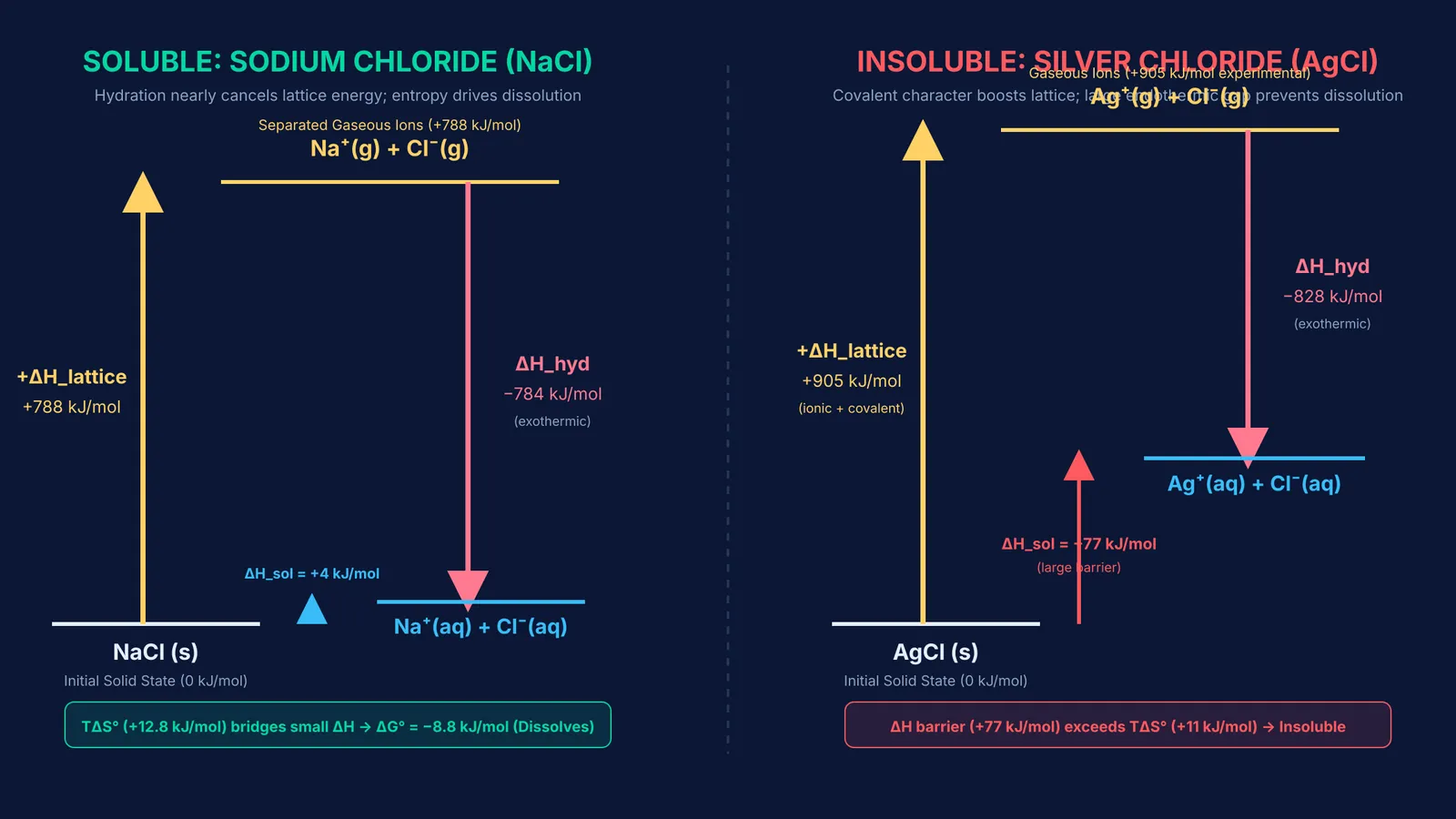
Many students assume a compound only dissolves if it releases heat. Sodium chloride (NaCl) disproves this rule. In standard thermochemical cycles, separating one mole of solid NaCl into gaseous Na⁺ and Cl⁻ ions requires a lattice dissociation enthalpy of +788 kJ/mol. When those ions enter water, hydration releases −784 kJ/mol.
As reported on Chemguide, this leaves a slightly endothermic enthalpy of solution of Δ_sol H° = +4 kJ/mol (+3.9 kJ/mol measured experimentally). Table salt dissolves readily because entropy (Δ_sol S°) increases when ions leave fixed lattice positions to move freely in liquid water. At 298 K, this positive entropy change contributes enough energy (TΔ_sol S° ≈ +12.8 kJ/mol) to make the overall Gibbs free energy change negative (Δ_sol G° ≈ −8.8 kJ/mol).
When evaluating how thermodynamic variables dictate reaction feasibility, the Fermi Concept Library maps every concept in physics and chemistry so you can see how lattice energy links to thermochemical cycles and equilibrium.
Why are barium sulphate and silver chloride insoluble?
If entropy can overcome an endothermic enthalpy gap, why do salts like barium sulphate (BaSO₄) and silver chloride (AgCl) remain insoluble in water?
Barium sulphate: As explained in OpenStax Chemistry 2e, electrostatic attraction in a crystal lattice scales directly with the product of ionic charges (|z₊ × z₋|). Both Ba²⁺ and SO₄²⁻ are divalent (|z₊ × z₋| = 4), which creates an immense lattice enthalpy. Although hydration releases considerable energy, it cannot overcome this steep endothermic barrier.
Silver chloride: According to Born-Haber cycle comparisons on Chemguide, simple ionic models predict an AgCl lattice enthalpy of +770 kJ/mol, but experimental values reach +905 kJ/mol. As explained in our review of Fajans' rules and covalent character, the polarising Ag⁺ ion distorts the chloride electron cloud, introducing significant covalent character that strengthens the lattice and keeps AgCl insoluble.
How does ion size explain the opposite solubility trends in Group 2?
A standard JEE and NEET problem asks why Group 2 sulphates become less soluble down the group (BeSO₄ to BaSO₄), while hydroxides become more soluble (Be(OH)₂ to Ba(OH)₂). As detailed on Chemguide, lattice enthalpy depends on 1/(r₊ + r₋), while hydration enthalpy depends on (1/r₊ + 1/r₋):
Sulphates: The SO₄²⁻ ion is large (radius ~230 pm), so increasing cation radius from Be²⁺ to Ba²⁺ changes the denominator (r₊ + r₋) only slightly, leaving lattice enthalpy nearly flat. However, cation hydration enthalpy drops steeply (from −2494 kJ/mol for Be²⁺ down to −1305 kJ/mol for Ba²⁺). Because hydration energy plunges faster than lattice energy, solubility decreases down the group.
Hydroxides: The OH⁻ ion is small (radius ~137 pm). Increasing cation radius causes a large relative increase in (r₊ + r₋), so lattice enthalpy drops rapidly, outpacing the drop in hydration enthalpy. Thus, solubility increases down the group. You can see how these enthalpies are measured in our review of the Born-Haber cycle and lattice enthalpy.
How do you predict whether an ionic salt will dissolve?
When tackling solubility questions in competitive exams, work through this four-step checklist:
Check ionic charges: Highly charged ions (like Al³⁺ or O²⁻) multiply lattice energy (|z₊ × z₋|), making dissolution rare unless hydration is exceptionally high.
Inspect size matching: Salts with matched ion sizes (small-small like LiF, or large-large like BaSO₄) pack tightly and remain insoluble. Mismatched salts (small-large like LiI or MgSO₄) dissolve readily because the small ion's hydration dominates.
Check for covalent character: Transition metal cations with d¹⁰ electron configurations polarise anions, inflating lattice stability above ionic predictions.
Balance enthalpy with entropy: If Δ_sol H° is only slightly endothermic (as seen with sodium chloride), the accompanying increase in entropy can drive dissolution. If the endothermic barrier is large, the salt remains insoluble.
If you want to practice applying these thermodynamic rules to exam-level problems, the Fermi Problem Library features worked problems with a step-by-step solver that explains the reasoning rather than printing an answer.


