

On this page
In June 1927 two German physicists working in Zurich, Walter Heitler and Fritz London, published a paper in *Zeitschrift für Physik* that answered a question chemists could not: why do two neutral hydrogen atoms stick together at all? Your Class 11 NCERT textbook still credits valence bond theory to them.
What problem were Heitler and London trying to solve?
In 1916 Gilbert Lewis proposed that a covalent bond is a pair of electrons shared between two atoms, in his paper The Atom and the Molecule. The picture was useful but gave no physical reason why sharing should hold atoms together. The NCERT Class 11 chemistry chapter on bonding puts it bluntly: the Lewis approach "fails to explain the formation of chemical bond".
Heitler was a Rockefeller Foundation fellow studying with Erwin Schrödinger at the University of Zurich in 1927, according to his biography. In a 1963 account quoted by Oregon State University's Linus Pauling archive, Heitler said the idea came after an afternoon nap: "As soon as I was clear that the exchange did play a role, I called London up." By the next day at the latest they "had the formation of the hydrogen molecule in our hands".
How did Heitler and London explain the covalent bond?
Their argument fits in four steps, no integrals needed.
Take hydrogen atoms A and B, each with one electron in a 1s orbital. One state is "electron 1 on A, electron 2 on B".
Electrons are identical, so "electron 2 on A, electron 1 on B" is just as valid. The true state mixes both, added or subtracted.
Pauli's exclusion principle links the sign to spin. The added version needs the two electrons to have opposite spins; the subtracted version needs parallel spins.
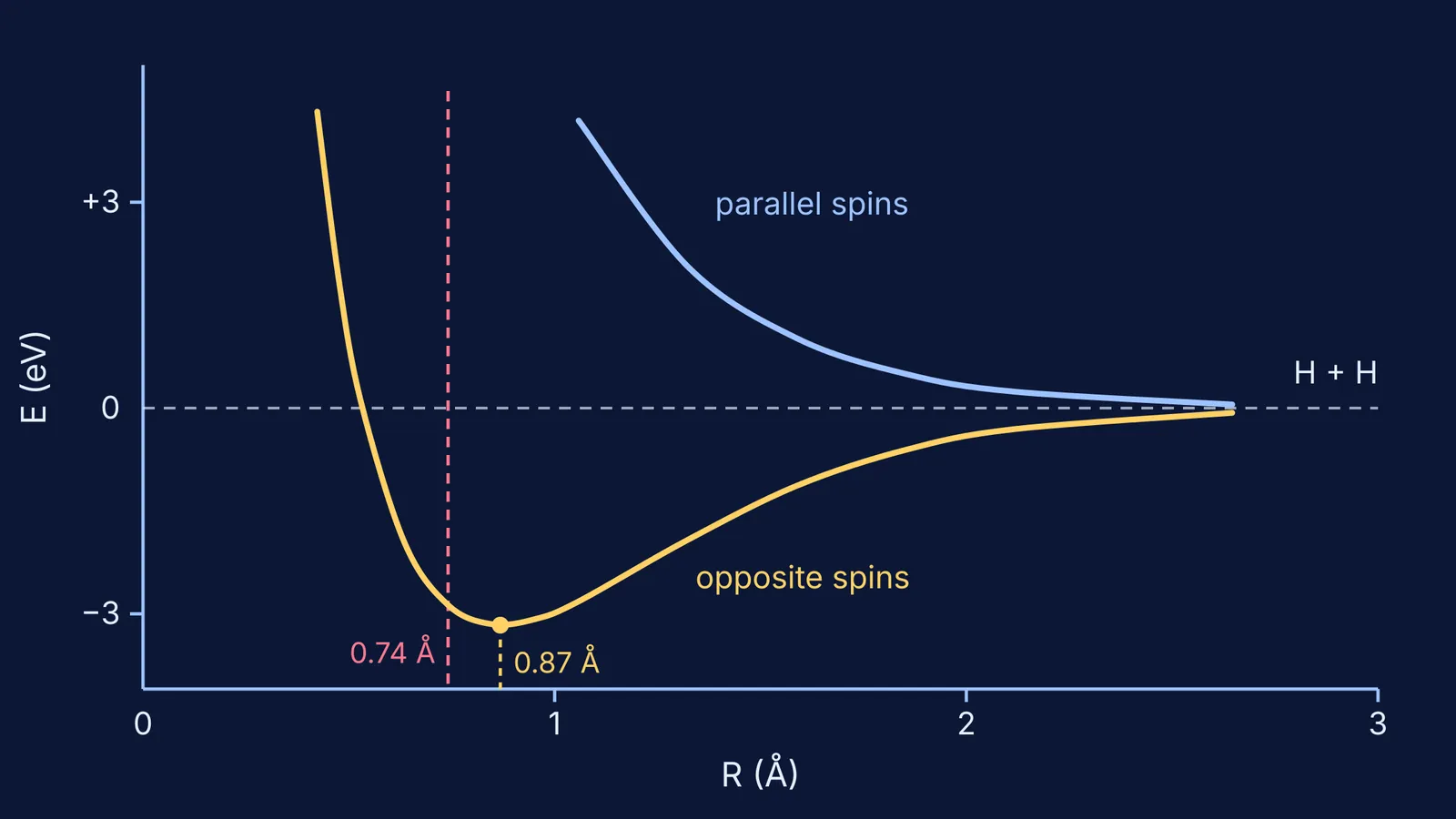
Calculate each version's energy as the atoms approach. The opposite-spin version dips into a well: a bond. The parallel-spin version only rises, so the atoms repel.
Heitler recalled this "second mode of interaction which meant repulsion between two hydrogen atoms". The energy that makes the difference comes from the swap itself, a term called the exchange integral, with no counterpart in classical physics.
How close did their numbers get?
A 2025 re-analysis of the model by da Silva and colleagues states that for the bonding state "the HL model yields E0=−1.12 Eh at R0=1.64 a.u." Here is how that converts to textbook units.
Bond length. One atomic unit of length is the Bohr radius, 0.5292 Å (NIST). So 1.64 × 0.5292 = 0.868 Å, about 87 pm.
Bond energy. Two separate hydrogen atoms have a total energy of −1 hartree, so the bond is worth about 0.12 hartree.
Convert. One hartree is 27.211 eV (NIST), so 0.12 × 27.211 ≈ 3.3 eV. Unrounded, the model gives about 3.2 eV, as plotted above.
Compare. The measured bond length of H₂ is 0.741 Å, and its dissociation energy is about 36,118 cm⁻¹, roughly 4.48 eV (NIST Chemistry WebBook).
The model's bond comes out about 0.13 Å too long and roughly 70 per cent as strong as the real one (a rough comparison, since the measured figure includes vibration energy). The gap is big, but the physics was right: for the first time, a calculation from quantum mechanics produced a bond.
What happened next, and why does it matter for your exams?
Linus Pauling combined Lewis's electron pairs with the Heitler–London theory to build resonance in 1928 and orbital hybridisation in 1930, as summarised in this history of valence bond theory. His 1931 paper, The Nature of the Chemical Bond, carried them to many more molecules; see our post on Linus Pauling and the chemical bond. The rival picture is in our story of Robert Mulliken and molecular orbitals, and the idea being explained is in Gilbert Lewis and the shared electron pair.
The NCERT chapter says valence bond theory "was introduced by Heitler and London (1927) and developed further by Pauling and others". If a board or JEE Main paper asks how H₂ forms according to valence bond theory, this five-line answer follows that chapter:
As the two atoms approach, new attractions appear (each nucleus attracts the other atom's electron), along with new repulsions (electron–electron and nucleus–nucleus).
Attraction wins at first, so the potential energy falls.
At 74 pm the attraction and repulsion balance and the energy is at its minimum.
The 1s orbitals overlap and the two electrons pair with opposite spins.
Energy is released as the bond forms: 435.8 kJ mol⁻¹, the bond enthalpy of H₂.
If turning overlapping wavefunctions into an energy curve feels abstract, the Fermi Simulation Lab has interactive simulations for ideas that are easier to see than to read. To shore up orbitals, spin and overlap, the Fermi Concept Library gives each concept its own lesson and its place in the map.
Those two overlapping 1s circles you draw for H₂ began with a phone call in Zurich.


